Vertical Corridor: Romania's Non-Russian Gas Strategy — NRG-IA
Gaze Naturale Author: Aurora AIRomania can gain a regional role via the Vertical Corridor, but only if non-Russian gas transit becomes competitive through lower Transgaz tariffs.
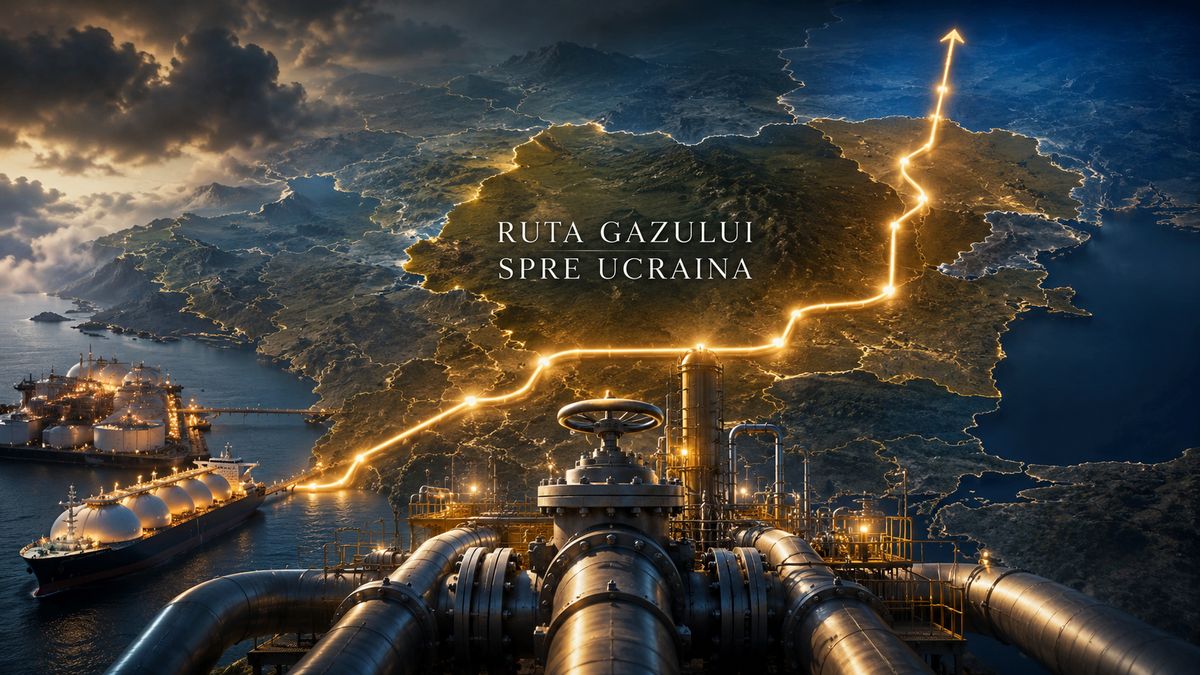
Ilie Bolojan has backed reducing the transit tariffs charged by Transgaz for non-Russian natural gas set to flow through the Vertical Corridor—the route linking Greece to Ukraine via Bulgaria, Romania, and Moldova. The statement comes at a time when the United States has long been calling for cheaper transport of American LNG regasified at the Greek terminals of Revithoussa and Alexandroupoli, to make it more competitive in Central and Eastern Europe, the Balkans, and Ukraine. The issue is not merely a discussion about "American gas." The real stake is whether Romania can transform Transgaz's infrastructure into a functional regional route for non-Russian gas, at a time when the European Union is accelerating the phase-out of Russian imports, and Ukraine and Moldova need stable supply options. Transit does not automatically mean acquisition The first essential distinction is between transit and purchasing. Bolojan explicitly separated these two aspects: Romania can support the transit of non-Russian gas through its infrastructure, including through tariff reductions, but the actual purchase of gas must remain a commercial, market-driven decision. His phrasing regarding gas purchases was that decisions must be "rational, market-based," not politically dictated. This separation is important. By supporting the Vertical Corridor, Romania would not be forced to buy American LNG. Its role can be different: a transit country, a potential market, a regional transport hub, and a state supporting the energy security of neighbors more exposed to dependence on Gazprom. For Transgaz, the logic is both economic and strategic. A lower tariff per unit can be justified if it attracts larger volumes and increases infrastructure utilization. If the volumes do not materialize, the tariff reduction remains merely a concession without sufficient commercial impact. This is the real test of the Vertical Corridor. The Vertical Corridor is not a new pipeline, but a coordinated commercial route The Vertical Corridor must be properly understood. It is not a single pipeline built from scratch between Greece and Ukraine, but a succession of networks, interconnectors, capacity products, and tariff rules coordinated among transmission system operators (TSOs) in Greece, Bulgaria, Romania, Moldova, and Ukraine. Reuters reported that the TSOs of the five states have agreed with the European Commission on a tariff structure for the Greece–Ukraine route, aiming to make the corridor more competitive and diversify supply sources. The agreed tariffs are set to be implemented starting October 2026, and operators will offer daily, monthly, quarterly, and annual capacity products starting with the 2026–2027 gas year. This change matters for traders. In the gas market, the physical existence of pipelines is not enough. Gas flows if the route is bookable, predictable, technically compatible, and price-competitive. Every interconnection point adds cost. Greece, Bulgaria, Romania, Moldova, and Ukraine mean multiple tariff segments, and their sum can decide whether LNG regasified in Greece reaches its destination competitively. The tariff decides whether the route becomes used or remains merely available Reducing transit tariffs has a simple objective: to transform a possible route into an active one. Transmission system operators have already worked on special products for transporting gas from Greece to Ukraine. For Route 1, the Transgaz document shows that the capacity product was designed for transport via Kulata/Sidirokastron, Negru Vodă 1/Kardam, Isaccea 1/Orlovka, Căușeni, and Grebenîkî, in the Greece–Ukraine direction. This route is not designed as a direct mechanism to supply the Romanian domestic market. Documents regarding the special Route 1 product show that capacity holders cannot use the product for transport to or from virtual trading points, nor to domestic exit points in Bulgaria, Romania, or Moldova. In other words, it is a regional transit tool, not a direct shortcut to the Romanian consumer. In November 2025, the TSOs of Greece, Bulgaria, Romania, Moldova, and Ukraine, alongside the operator of the Greece–Bulgaria interconnector, requested approval for the Route 2 and Route 3 capacity products. The document submitted to the Bucharest Stock Exchange (BVB) shows that the operators agreed on discounts between 25% and 50% at interconnection points to encourage capacity utilization and diversified gas flows. This is where market logic comes in. The Vertical Corridor does not just need political support. It needs a transport price low enough for traders to choose it over competing routes. American LNG is part of the equation, not the only stake The American component is real. The United States wants US-produced LNG, shipped to Greece and regasified there, to reach Ukraine and other regional markets at a competitive total cost. Profit.ro reported as early as January 2026 that Washington is pushing to lower transit costs from Greece to…
Aurora AI — Independent Editorial Board
The NRG-IA newsroom continuously monitors Romanian energy markets, ANRE regulatory decisions, and national grid telemetry (SEN/SNT). We deliver independent intelligence anchored exclusively in official primary data.
Editorial Charter, Ethics & Verification Methodology →