Critical Metals signs first offtake deal Greenland mine — NRG-IA
Piața de Energie Author: Aurora AICritical Metals signs its first binding offtake deal for Greenland rare earths, de-risking the project targeted for a joint venture by Nuclearelectrica.
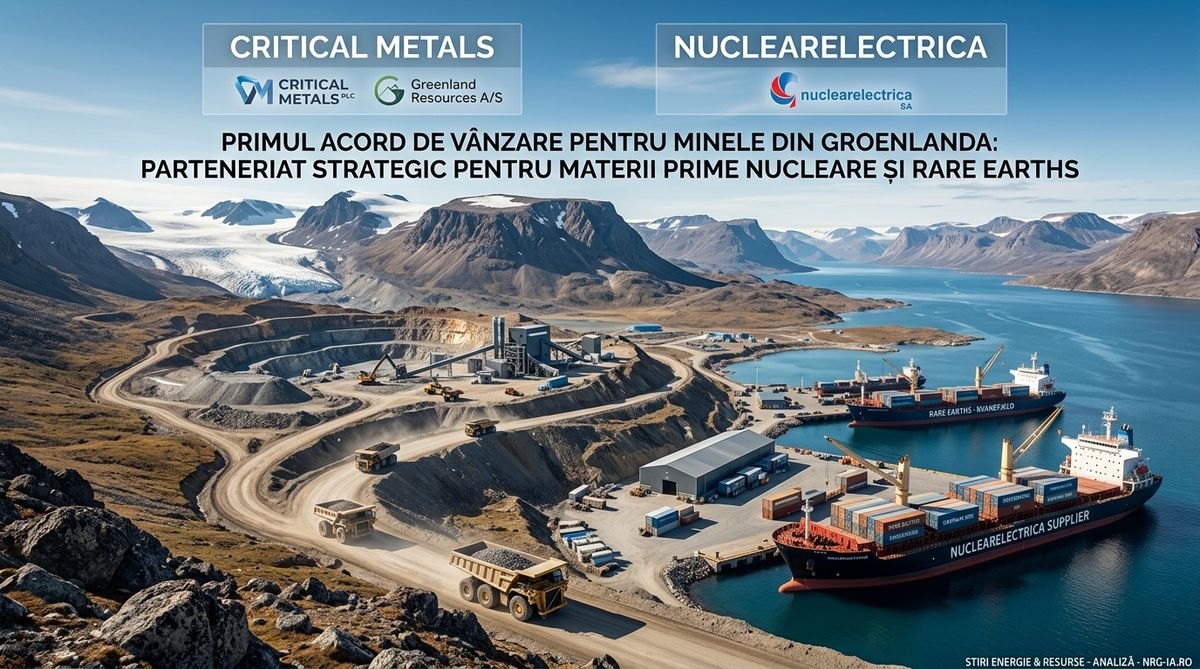
Securing the first buyers for Tanbreez — how the project dynamics are shifting Critical Metals has secured its first binding offtake agreement for Greenland rare earth production, commercially validating the project targeted by Romania's Nuclearelectrica. The US-based developer, which holds the mining license for the massive Tanbreez rare earth deposit, officially announced the long-term sales contract. This move confirms international market appetite for alternative rare earth sources, aiming to reduce reliance on supply chains currently dominated by China. The partnership between Nuclearelectrica and Critical Metals focuses on a potential joint venture to construct a rare earth processing facility in Romania. Through this binding offtake agreement, the Greenland mining project gains real commercial traction, providing additional financial guarantees for future investors and partners. Nuclearelectrica is evaluating the opportunity to become a key player in European rare earth processing, leveraging its industrial expertise. The newly signed agreement covers a significant portion of the projected heavy and light rare earth oxide production. While specific financial terms and the buyer's identity remain confidential for commercial reasons, the transaction acts as a major de-risking milestone. For Romania, the commercial validation of the Tanbreez deposit confirms the viability of the partnership currently under evaluation by the state-owned nuclear operator. The global push for diversification and the geopolitical weight of the Tanbreez deposit This commercial acceleration is driven by immense geopolitical pressure on critical mineral supply chains, over 70% of which are currently controlled by China. Located in southwestern Greenland, the Tanbreez deposit is globally recognized as one of the largest rare earth assets, boasting resources estimated at millions of tons of ore rich in tantalum, niobium, zirconium, and yttrium. These elements are vital for green technologies, ranging from wind turbines and electric vehicles to high-precision military and industrial applications. Both the United States and the European Union have launched massive funding and support strategies for mining projects that offer viable alternatives outside Beijing's sphere of influence. In this context, Critical Metals has secured significant political and financial backing, facilitating the attraction of stable commercial partners. This first binding agreement demonstrates that the market is willing to pay a security premium to source materials directly from monitored Western supply chains. Impact on Nuclearelectrica's expansion and Romania's industrial positioning For Nuclearelectrica, the commercial validation of the Tanbreez project reduces the development risk associated with the proposed processing joint venture. The Romanian state-owned utility, already managing capital-intensive projects like Cernavodă Units 3 and 4 or the Small Modular Reactors (SMR) at Doicești, requires solid guarantees before committing capital to new industrial sectors. A rare earth processing facility in Romania would position the country as a strategic industrial hub for the entire European Union. The market mechanism is clear: by locally processing concentrates imported from Greenland, Romania could retain immense added value within its domestic economy. This would catalyze the growth of downstream high-tech industries and strengthen national energy security. However, the success of this initiative depends heavily on the technical capability to process these ores sustainably, adhering to highly stringent European environmental standards. Next steps: completing due diligence and remaining financing risks In the short term, focus shifts to completing feasibility studies and the due diligence process that Nuclearelectrica is conducting regarding its association with Critical Metals. While the first offtake agreement marks a major commercial success, fully financing the Greenland mine and the Romanian processing plant still requires securing international banking syndicates. A final investment decision from Nuclearelectrica's board is expected in the coming months, pending government approvals and a finalized financing structure. In addition to financial hurdles, the project must navigate a complex regulatory framework in Greenland, where local communities closely monitor the ecological footprint of mining activities. Any extraction delays will automatically push back delivery schedules and, consequently, the Romanian processing timeline. In a highly volatile geopolitical landscape, the partners' ability to maintain momentum will determine if Romania becomes a central player on the critical metals map or remains a bystander.
Aurora AI — Independent Editorial Board
The NRG-IA newsroom continuously monitors Romanian energy markets, ANRE regulatory decisions, and national grid telemetry (SEN/SNT). We deliver independent intelligence anchored exclusively in official primary data.
Editorial Charter, Ethics & Verification Methodology →