Bali Fuel Crisis: Long Queues & 24/7 Pertamina Distribution — NRG-IA
Geopolitică & Energie Author: Ioana BuzoaicaLong queues and dry gas stations hit Bali after shipping delays and distribution bottlenecks. Pertamina launched emergency supply ops to restore mobility.
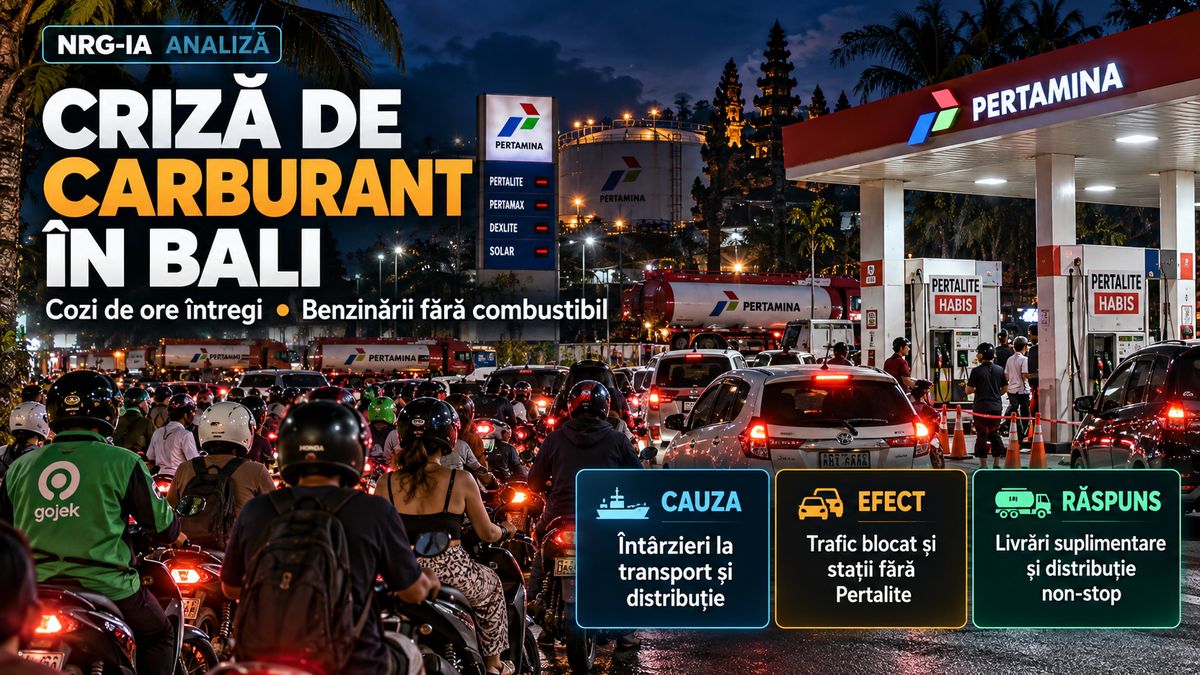
Bali, one of the world's premier tourist destinations, is grappling with a fuel distribution crisis that has triggered queues stretching hundreds of meters, hours-long wait times, and temporary stockouts at numerous retail stations. The disruptions, which surfaced in early October 2026, persisted on Tuesday, October 13, across several regions of the Indonesian island—including Denpasar, Badung, Kuta, Gianyar, and Tabanan—impacting local traffic and daily activities. State energy company Pertamina officially acknowledged the supply and distribution bottlenecks. CEO Simon Aloysius Mantiri issued a public apology to residents following an emergency meeting with Bali Governor Wayan Koster. A primary cause identified was the delayed discharge of an oil tanker stemming from technical difficulties during mooring operations. Concurrently, a sharp surge in demand exacerbated pressure on stations that still had available fuel. Authorities maintain that primary storage terminals hold sufficient fuel and that new seaborne shipments have already arrived on the island. The critical bottleneck remains the throughput speed at which gasoline can be dispatched from marine terminals to retail stations. To restore distribution, Pertamina announced around-the-clock operations at key terminals, an expanded road tanker fleet, and extended operating hours at retail stations in the hardest-hit areas. Hundreds of meters of queues and hours-long wait times at the pump The first major disruptions were reported around October 7, when several filling stations in Denpasar and South Kuta began experiencing supply delays. Over the following days, the situation spread to other parts of the island. Numerous motorists were forced to search sequentially for stations with remaining stock, while queues of motorbikes and cars spilled onto major public roads. Pertalite, one of Indonesia's most widely used gasoline grades, was the most severely impacted. At some stations, drivers unable to find Pertalite turned to the higher-priced Pertamax grade, cascading demand pressure onto that product as well. Several stations reported temporary stockouts of both fuels, forcing consumers to seek alternative refuel points. Local media reports described wait times of up to two and a half hours at certain stations in Denpasar. In other areas, queues extended for hundreds of meters, with some local estimates pointing to line lengths of nearly one kilometer. The Bali Provincial Police deployed traffic control units to manage access to filling stations amid gridlock caused by waiting vehicles. For local residents, the fallout was immediate. Motorbikes are a dominant mode of transportation in Bali, making fuel availability critical for daily commutes to work, school, and commercial centers. In an economy heavily reliant on tourism, refuel disruptions also risk impacting visitor transit, business supply chains, and staff mobility across the hospitality sector. Tanker discharge delayed by over 15 hours On October 13, Pertamina’s CEO provided a concrete explanation for part of the supply chain breakdown. A tanker scheduled to commence fuel offloading on the morning of October 12, around 06:30, encountered mooring difficulties. The discharge operation was postponed until approximately 22:00, resulting in a delay of roughly 15.5 hours. This operational slip impacted downstream intake and dispatch schedules. In island energy logistics, maritime transport, terminal offloading, storage, and tank-truck distribution form a tightly coupled chain where upstream delays propagate rapidly. When a vessel arrives later than scheduled, retail stations reliant on those replenishments can run dry before replacement volumes enter the distribution pipeline. Pertamina also cited surging demand for Pertalite as an amplifying factor. The price gap compared to unsubsidized fuels drove consumer purchasing to concentrate heavily on this specific grade. As news of localized shortages spread, panic buying ensued, with drivers rushing to fill tanks preemptively and worsening congestion at operational stations. The cumulative effect was pronounced: a single delayed delivery causes a station to stock out, diverting consumers to neighboring stations where demand subsequently spikes above normal levels. Even after seaborne deliveries resume, land distribution must cover both accumulated backlogs and the surplus demand generated by panic buying. This mechanism explains why queues persist even after initial fuel cargoes dock. Millions of liters of gasoline arrive in Bali, but retail distribution remains constrained Pertamina mobilized additional marine shipments to replenish regional inventory. A tanker docking on October 11 at the Manggis terminal delivered approximately 18 million liters of Pertalite and 2.5 million liters of Pertamax. The company subsequently announced an expanded delivery schedule totaling 26,200 kiloliters (26.2 million liters), with cargoes slated for arrival on October 12, 14,…
Ioana Buzoaica — Independent Editorial Board
The NRG-IA newsroom continuously monitors Romanian energy markets, ANRE regulatory decisions, and national grid telemetry (SEN/SNT). We deliver independent intelligence anchored exclusively in official primary data.
Editorial Charter, Ethics & Verification Methodology →