US Debates Diesel Export Limits Amid Record Prices — NRG-IA
Geopolitică & Energie Author: Ioana BuzoaicaUS Congress debates diesel export limits amid record prices, threatening a global market already short on Russian and Middle Eastern supply.
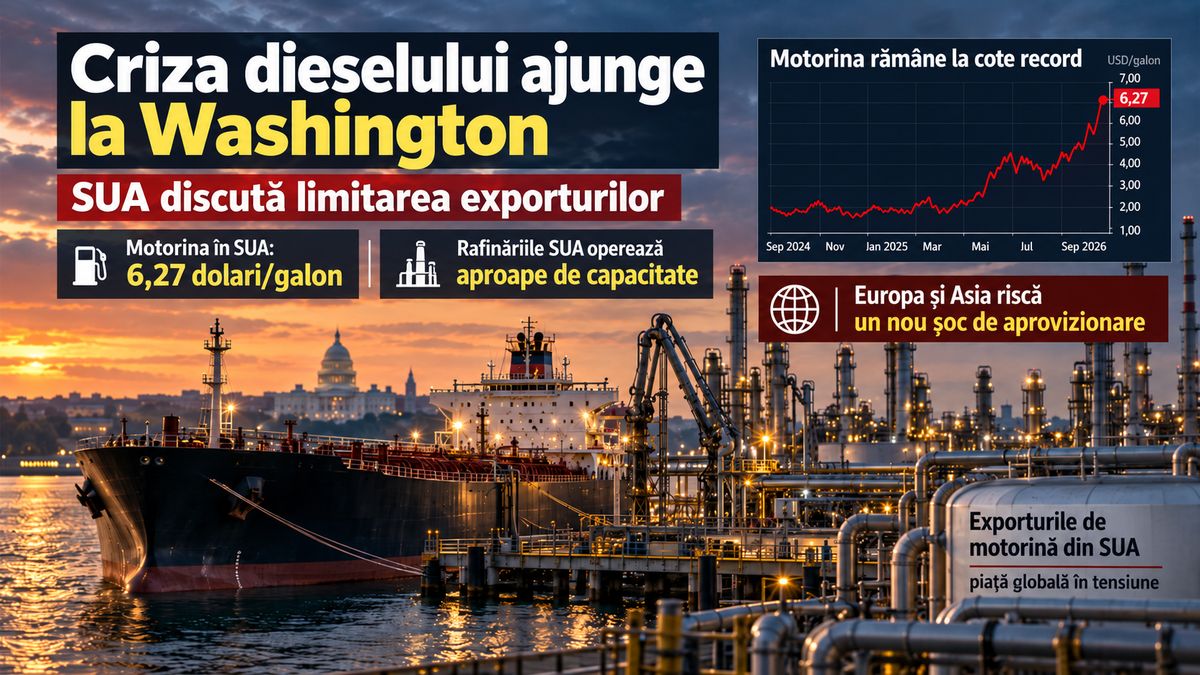
Diesel has reached a record $6.2694 per gallon in the United States , roughly 70% higher than a year ago. This price pressure has pushed an idea in Washington that until recently seemed highly improbable: limiting US fuel exports. Senate Republican Majority Leader John Thune stated on September 15 that he is open to considering such a measure if it could lower domestic prices. This debate emerges just as the global market is becoming increasingly dependent on American refineries. The US is the world's largest exporter of distillates, with weekly exports climbing to nearly 1.9 million barrels per day in August. Russia, the second-largest diesel supplier, has drastically reduced its market presence following repeated attacks on its refineries and the introduction of export restrictions. Meanwhile, conflict in the Middle East has curtailed the availability of refined products from the Gulf. Reuters estimates that diesel exports from Russia and the Gulf states have collectively dropped by approximately 1.6 million barrels per day compared to February . Washington thus faces a difficult contradiction: the very fuel that is becoming increasingly expensive for the US economy is the exact product the rest of the world is purchasing from the US in growing volumes. US Diesel Hits Highest Price Ever Recorded by AAA The national average calculated by AAA for September 15 stands at $6.2694/gallon , up from $3.6858 a year earlier. This is the highest level ever recorded by the organization, surpassing the previous record set in 2022. The surge carries far broader economic implications than just the cost of fueling a passenger car. Diesel powers a major portion of road freight, agricultural and construction machinery, and freight rail. Consequently, its rising cost feeds directly into the transportation costs of food, industrial goods, and construction materials, potentially fueling inflation far beyond the energy sector. This pressure is amplified by low US distillate inventories, which are approximately 13% below the five-year average , according to market data cited in the current analysis. Furthermore, the ability to offset this deficit through a rapid increase in refining is limited. Energy Information Administration data shows that US refinery utilization reached 98% in the week ending August 28 and remained at 97.8% in early September. In the US Gulf Coast, the hub of the American refining and export industry, the utilization rate stood at 98.3%. This means that any potential export restriction would not create new volumes of diesel; it would merely redirect a portion of existing production. The US Becomes the Safety Valve for a Market Deprived of Russia and Part of the Gulf Prior to the current disruptions, Russia was the world's second-largest diesel exporter after the United States, with volumes exceeding 800,000 barrels per day in 2025 , according to market data cited in current reports. The situation changed dramatically in 2026. Ukrainian attacks have repeatedly targeted Russian refining infrastructure, and by mid-September, half of Russia's six major diesel-producing refineries were operating at severely reduced levels or had units shut down. The International Energy Agency estimates that during the first eight months of the year, a Russian refinery was successfully struck, on average, roughly once every three days. Moscow has also intervened administratively by restricting diesel exports. For producers, the current ban remains in effect until September 30. The issue cannot be resolved immediately, even if attacks subside. Damaged facilities require repairs, and Western sanctions complicate access to specialized equipment and components. Restoring capacity can take a long time after the incidents that knocked them offline have ceased. The Middle East adds a second deficit. Disruptions in the Strait of Hormuz, infrastructure attacks, and logistical hurdles have reduced the volume of diesel and other distillates available for export from the Gulf. Consequently, the United States has emerged as the supplier capable of offsetting a portion of the volumes that have simultaneously vanished from two of the world's major exporting regions. Restricting Exports Would Shift the Competition for Diesel Outside the US The political argument for export controls is simple: if more US-produced diesel remains within the country, domestic supply increases, and price pressures should ease. The actual mechanism is more complex. The refined products market is global, and the Gulf Coast—home to a vast share of US refining capacity—is structurally built for export. At the same time, fuel-deficit regions in the US cannot automatically and cost-effectively receive the barrels retained in Texas or Louisiana. Infrastructure geography and domestic shipping regulations limit this redistribution. The East Coast can sometimes import fuel from abroad more efficiently than transporting products from the US Gulf on Jones Act-compliant…