Supply Crisis Expands Beyond Oil to Metals & Fertilizers — NRG-IA
Geopolitică & Energie Author: Ioana BuzoaicaOil, fertilizer inputs, and metal processing are hit by simultaneous disruptions as Saudi Arabia, China, and Russia restrict flows and exports.
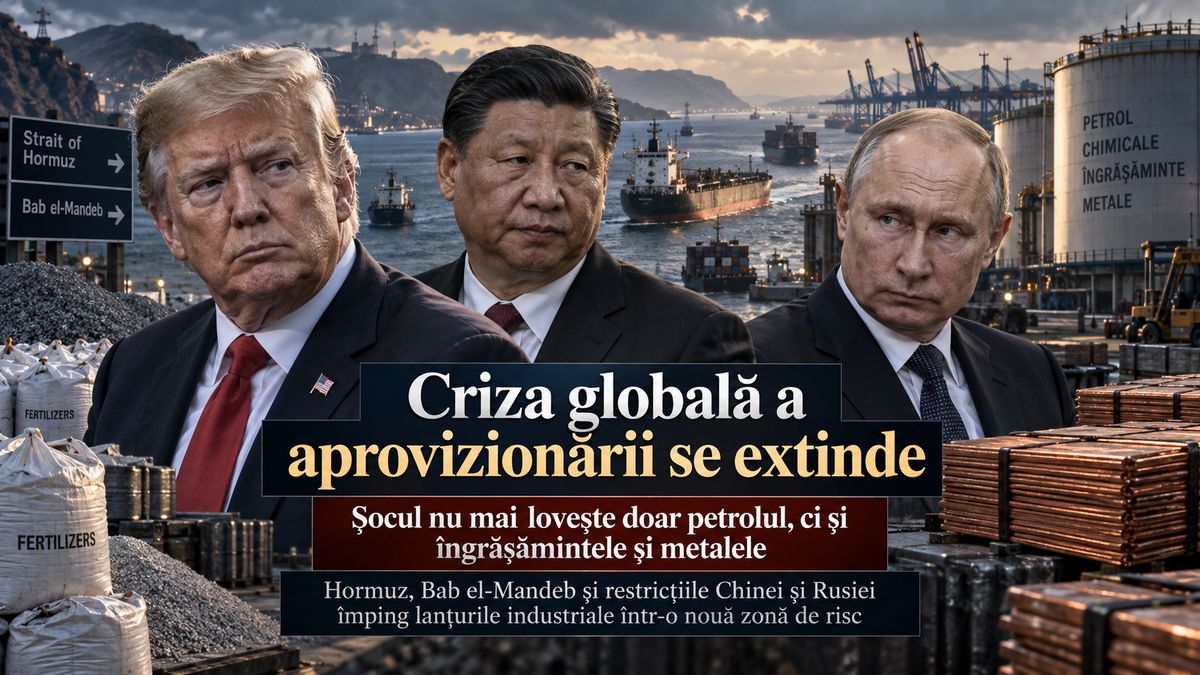
A new vulnerability is emerging in the global economy: energy disruptions are beginning to overlap with restrictions on chemical raw materials critical to agriculture and the metals industry. In just a few days, Saudi Arabia shut down its East–West pipeline following a drone attack, the Houthis seized new positions at the southern entrance to the Red Sea, and Russia restricted sulfuric acid exports until the end of the year, hitting a market already strained by the near-total halt of Chinese industrial exports. The link between these events is not one of direct causality, but of simultaneous vulnerability. Oil and gas are concentrated around a few chokepoints. Sulfur and sulfuric acid, in turn, originate from a limited number of major producers and trade flows. Downstream products—phosphate fertilizers, copper, nickel, uranium, or lubricants—depend on these raw materials at a time when rapid substitution is highly constrained. The result is a shock that can no longer be tracked solely through oil prices. The duration of these restrictions and disruptions is beginning to matter for sectors far downstream from the wellhead or refinery. The Saudi Route Built to Bypass Hormuz Is Shut Down The East–West pipeline spans approximately 1,200 kilometers across Saudi Arabia, linking the eastern oil fields to the Yanbu terminal on the Red Sea. It was built in the 1980s specifically to allow Saudi exports to bypass the Strait of Hormuz. This function became critical in 2026, following severe traffic disruptions in Hormuz and massive production cuts in the Middle East. On September 10–11, Riyadh shut down the East–West pipeline after a drone attack. Saudi authorities attributed the launches to Iraqi territory, and Baghdad acknowledged the origin, announcing an investigation. Agency sources do not support attributing the pipeline attack to the Houthis, although the group targeted other Saudi objectives during the same period. The pipeline's significance lies in its actual flow, not its theoretical capacity. Reuters and analysts cited by the agency point to approximately 4–5 million barrels per day transported in recent months, a volume equivalent to about 4% of global oil supply at a flow of around 4 million barrels per day. The regional estimate for repairs is three to five weeks , according to officials cited by the Associated Press. Some partial flow could resume before full repairs are completed, but the available volume remains uncertain. The immediate issue is the available inventory at the end of the pipeline. Buyers and traders cited by Reuters estimate that Yanbu has enough oil for about five to seven days of exports if the pipeline remains offline. The terminal has an estimated storage capacity of around 35 million barrels, but tanks were not full at the time of the shutdown. Saudi Arabia also holds volumes in Egyptian facilities, including Ain Sukhna and Sidi Kerir, but these do not fully replace the East–West flow. Bab el-Mandeb Turns the Alternative Route Into a Second Risk Point Pressure on the East–West pipeline comes just as the situation shifts at the southern end of the Red Sea. In their September 10–11 offensive, the Houthis seized the port of Mocha, the Dhubab area, and Perim Island (also known as Mayun), located directly in the Bab el-Mandeb Strait. The group now controls positions on the Yemeni coast and an island that divides the strait's shipping channels. For oil transported to Yanbu and destined for Asian markets, the route to the Indian Ocean passes through Bab el-Mandeb. While the pipeline physically bypasses Hormuz, eastbound shipments remain dependent on a second strait now situated in a high-risk military zone. The Houthis claimed that navigation remains safe for non-Saudi vessels. While this statement does not equate to a total blockade of commercial traffic, the shift in territorial control increases maritime shipping risks at a time when the East–West pipeline had become one of the Saudi system's primary safety valves. The importance of this route is amplified by the situation in Hormuz. International Energy Agency data for 2025 shows that approximately 15 million barrels per day of crude oil passed through the strait, representing about 34% of global crude trade. When petroleum products are included, the flow reached roughly 20 million barrels per day . Hormuz is also critical for gas: seaborne LNG exports from Qatar and the United Arab Emirates depend on transit through the strait. The IEA estimates that each month LNG carriers are unable to use this route removes approximately 10 billion cubic meters from available supplies. The EIA described Hormuz as effectively closed for a significant part of 2026, with Middle Eastern producers cutting output by over 11 million barrels per day . For 2026, the IEA projects a reduction in global oil supply of approximately 5.7 million barrels per day , equivalent to nearly 6%. In this context, the temporary unavailability of the East–West pipeline…