Iran Crisis: China Shifts to Russia, Boosts Fuel Exports — NRG-IA
Geopolitică & Energie Author: Ioana BuzoaicaThe Iran blockade shifts global oil flows as China buys Russian crude to offset losses and the US seeks to rebuild Venezuela as a Western supply source.
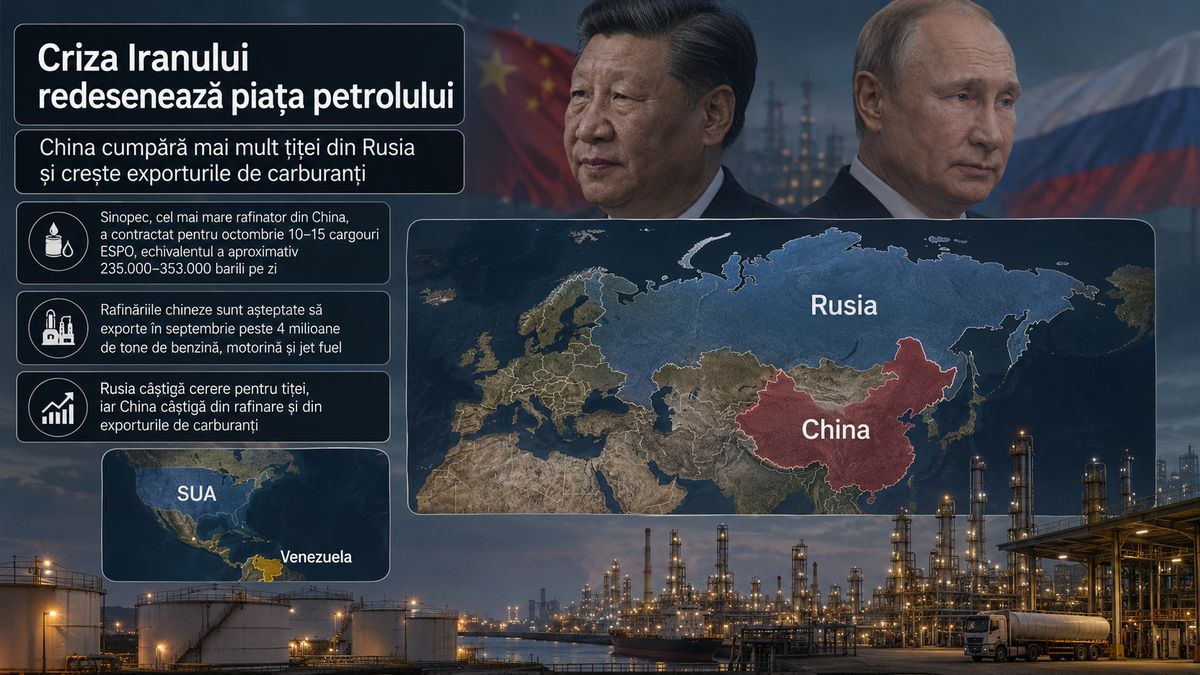
The Iranian crisis is beginning to trigger one of the most significant realignments of the oil market in recent years. China, the primary buyer of Iranian crude, is shifting a portion of its supply to Russia just as Moscow has more crude oil available for export and less capacity to process it into fuel. Beijing is taking the next step: buying the raw material, refining it, and returning millions of tons of diesel, gasoline, and jet fuel to the international market. Meanwhile, Washington is attempting to build a medium-term oil alternative in Venezuela, attracting Western capital and even gaining access to fields previously operated by Chinese and Russian interests. The result is not just a simple redirection of a few cargoes. Roles in the global oil chain are being reconfigured: Russia is becoming more critical for supplying China with crude, China is becoming more critical for supplying Asia with refined products, and the US is attempting to bring Venezuela back into its own energy orbit. The Disappearance of Iranian Barrels Pushes China Toward Russia The pressure begins in the Strait of Hormuz. Iranian exports, estimated at around 2 million barrels per day in March, dropped in August to only about 220,000–255,000 barrels per day, as the US blockade limited Iran's ability to send new cargoes to its primary market. For China, the impact is direct. Iranian oil imports fell, according to Kpler estimates cited by Reuters, to approximately 534,000 barrels per day in August , compared to an average of about 1.4 million barrels per day in 2025 . This gap must be filled. Sinopec, China's largest refiner, has aggressively expanded its purchases of Russian oil. For October, the company contracted 10–15 ESPO cargoes , equivalent to approximately 235,000–353,000 barrels per day . If other Russian grades such as Sokol and Urals are included, total purchases for October could exceed 20 cargoes. This move continues an acceleration that began in the summer. For the July–September period, Sinopec had purchased around 30–40 ESPO cargoes, and in August, its imports from the Russian Far East exceeded 400,000 barrels per day . China is not replacing Iran entirely with Russia. Beijing is also buying additional volumes from Brazil, Iraq, Canada, Africa, and other regions. However, Russia has quickly emerged as one of the most critical solutions for the lost Middle Eastern volumes. Russia Finds Exactly the Buyer It Needs For Moscow, the timing is favorable for an apparently paradoxical reason. Attacks on Russian refineries have reduced domestic processing capacity. Russia has extended restrictions on exports of diesel and other products to protect its own market, leaving a portion of the oil that would have been refined domestically available for export as crude. China has the exact opposite problem: it possesses a massive refining industry but is losing access to some of the cheap barrels coming from Iran. The two imbalances complement each other. Russia has more crude available for export. China needs crude and has the industrial capacity to process it. ESPO is particularly attractive to Chinese refiners due to the relatively short distance from Russian Far East ports and its competitiveness compared to alternatives from the Middle East, West Africa, or Brazil. However, demand has become so strong that this advantage is beginning to narrow. The October ESPO program sold out faster than usual, and offers for some subsequent deliveries reached significantly higher premiums. Russia is thus gaining not only volume but also bargaining power over the price of the barrel available in Asia . China Transforms Russian Oil into an Industrial Advantage However, the most significant part of this repositioning occurs after the oil reaches Chinese refineries. Russia is delivering more raw material at a time when its own refining system is impaired. China is using its industrial capacity to transform crude into finished products just when diesel, gasoline, and jet fuel are highly profitable on the international market. For September, Chinese refiners are expected to export just over 4 million tons of gasoline, diesel, and jet fuel , compared to a monthly average of about 3 million tons in 2025. Of this total, up to approximately 2.4 million tons could be jet fuel, over 1 million tons diesel, and up to 600,000 tons gasoline. Beijing is thus relaxing restrictions previously introduced to protect its domestic market. The reason is economic. The estimated margin for diesel exports exceeds 1,500 yuan per ton, approximately $223 per ton , and Asian refining margins for diesel are at levels well above those existing before the conflict with Iran. For major Chinese companies, the difference is already visible in their results. Sinopec reported a 44.1% increase in its refining margin for the first half of the year, while the operating profit of its refining segment grew by 381.5% . The company linked this performance to the diversification of crude…
Ioana Buzoaica — Independent Editorial Board
The NRG-IA newsroom continuously monitors Romanian energy markets, ANRE regulatory decisions, and national grid telemetry (SEN/SNT). We deliver independent intelligence anchored exclusively in official primary data.
Editorial Charter, Ethics & Verification Methodology →