Romania Q1 2026: Less primary energy, more power exports — NRG-IA
Piața de Energie Author: Ioana BuzoaicaIn Q1 2026, Romania produced less primary energy but had more electricity and higher exports, driven by hydro, renewables, and lower domestic demand.
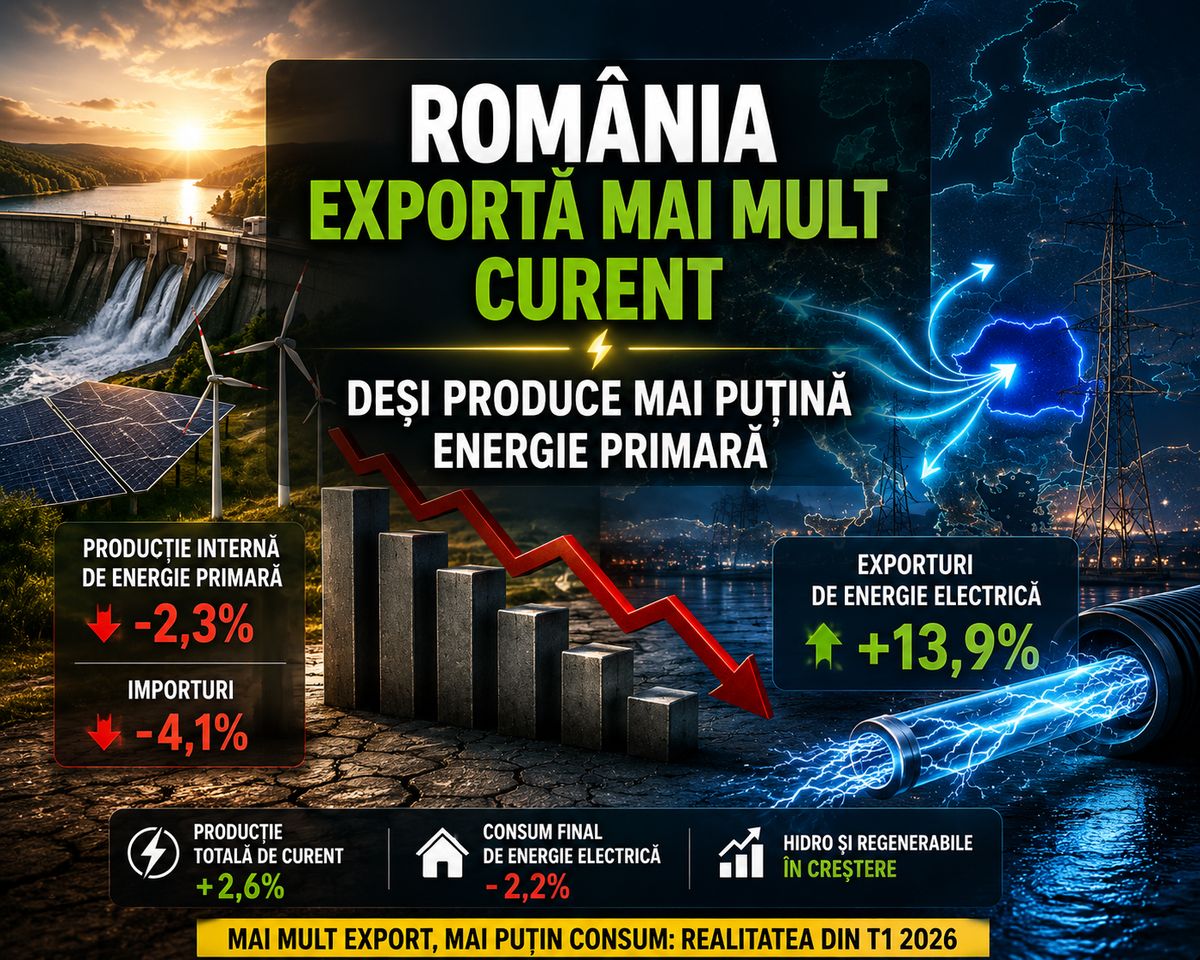
Romania produces less primary energy, but has more electricity in the system The first quarter of 2026 highlights one of the most significant paradoxes of the Romanian energy market: domestic primary energy production decreased, yet electricity resources increased, and power exports rose significantly. According to INS (National Institute of Statistics) data cited by the financial press, Romania's primary energy resources stood at 7.909 million tonnes of oil equivalent (toe) in Q1 2026, down 3.2% compared to the same period last year. Domestic primary energy production was 4.116 million toe, down 2.3%, while primary energy imports decreased by 4.1% to 3.793 million toe. At the same time, electricity resources increased by 2.6% to 18.213 billion kWh. The distinction is crucial: Romania did not produce more energy in a broad sense, but rather benefited from a more favorable electricity generation mix. Hydro power reshaped the quarter The most significant driver was hydropower generation. In Q1 2026, hydroelectric plants generated 3.772 billion kWh, a 38.3% increase compared to the first quarter of 2025. This recovery radically altered the period's electricity balance. Wind power grew by 18% to 1.904 billion kWh, while solar PV generation advanced by 10.7% to 774.1 million kWh. Conversely, thermal power plants produced 3% less, and nuclear generation also fell by 3%. The picture is clear: Romania's electricity outlook improved in Q1 not because all sources grew, but because hydro and renewables compensated for declines in conventional generation. Exports are rising, but the signal must be read carefully Electricity exports reached 3.660 billion kWh, up 13.9% compared to Q1 2025. At first glance, this seems like excellent news: Romania had enough energy to send more power to neighboring markets. However, the correct interpretation is more nuanced. High exports can reflect moments of abundant generation—particularly when hydro, wind, and solar perform well—rather than a constant, structural surplus capacity. In a power system with increasingly variable generation, you can export heavily during certain hours and remain vulnerable during others. Romania has already experienced this reality on days with cheap solar power at noon and high prices in the evening, when the system requires flexible capacity, storage, and dispatchable generation. Domestic consumption is falling, and this is the uncomfortable signal Another critical element is consumption. Final electricity consumption fell by 2.2% in the first quarter of 2026 to 12.822 billion kWh. Industrial and commercial consumption remained nearly flat, with a mere 0.1% decline, but household consumption dropped sharply by 9.2%. This trend must be treated with caution. A drop in household consumption can have several explanations: milder weather, improved efficiency, behavioral changes, self-consumption, economic pressure, or price effects. The raw data does not allow for attributing this to a single cause. Nevertheless, the signal is relevant. Higher exports are not occurring against a backdrop of accelerating domestic consumption, but rather in a quarter where final electricity demand has decreased. This shifts the economic meaning of the figures. A greener market does not automatically mean a more robust system Q1 2026 shows a power market more favorable to low-emission sources, but it does not on its own prove that the Romanian energy system has become structurally more robust. Hydropower had an excellent quarter, but remains dependent on hydrology. Wind and solar are growing, but they are variable and demand flexibility. Nuclear remains a stable pillar but did not grow during this period. Thermal power plants are declining, which reduces the contribution of dispatchable sources, even if they are more polluting and expensive. This combination creates a dual reality: Romania may have an increasing number of hours with clean generation and exportable surpluses, but it still requires investments in storage, flexible capacity, grids, and balancing mechanisms to avoid vulnerability during high-stress hours. The difference between primary energy and electricity matters This topic is also important because it demonstrates why primary energy must be separated from electricity. Primary energy includes resources such as coal, crude oil, natural gas, hydro, nuclear, and renewables, expressed in a common unit. Electricity is merely the final product available in the grid for consumption, export, or covering grid losses. Romania can experience a decline in domestic primary energy production and, at the same time, an increase in electricity generation if the power mix is favored by water, wind, and sun. This is precisely what occurred in Q1 2026. This distinction is essential for a correct market interpretation. Without it, the figures can be misread either as a sign of general weakness or as proof of complete energy strength. The reality lies somewhere in between: Romania…
Ioana Buzoaica — Independent Editorial Board
The NRG-IA newsroom continuously monitors Romanian energy markets, ANRE regulatory decisions, and national grid telemetry (SEN/SNT). We deliver independent intelligence anchored exclusively in official primary data.
Editorial Charter, Ethics & Verification Methodology →