How Gulf Producers Bypass Hormuz: Pipelines & Diesel Crisis — NRG-IA
Geopolitică & Energie Author: Aurora AIGulf producers bypass Hormuz via pipelines, dark transits, and steep discounts, but refined fuels face much higher shipping hurdles than crude.
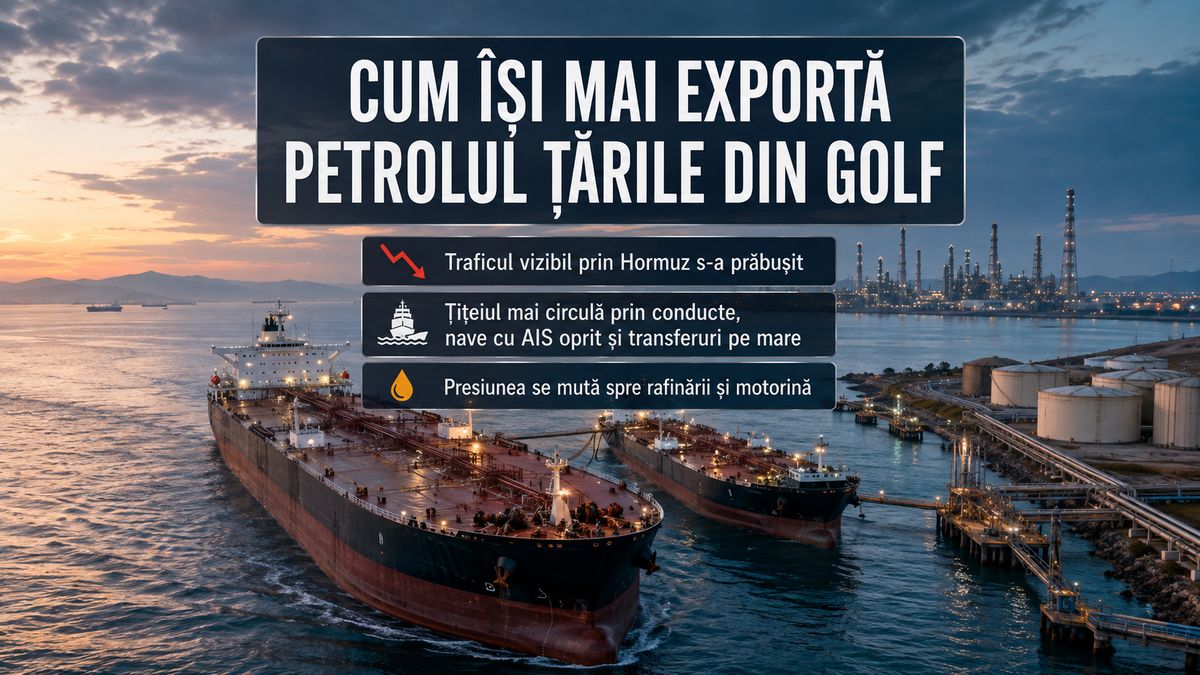
Only two commercial cargo vessels were detected transiting the Strait of Hormuz on Monday, the lowest daily tally since early May and well below the ten-day average of 14 transits. According to Kpler data, one was a very large gas carrier and the other a VLCC, a supertanker capable of carrying approximately two million barrels. Both entered the Persian Gulf. The figure does not capture vessels transiting with their Automatic Identification Systems (AIS) turned off, but it illustrates how severely transparent commercial traffic has deteriorated along a route that, prior to the war, represented one of the world's primary energy arteries. In the week ending August 21, the UK Maritime Trade Operations estimated that AIS-detected transits were approximately 90% below pre-conflict levels. Pressure mounted again on Tuesday. A tanker was struck by an unidentified projectile approximately 16.7 kilometers northeast of Ash Shishah, Oman, and was left disabled, according to the UKMTO. The previous day, Iran had announced the inclusion of 45 tankers on a list of vessels deemed non-compliant with its rules for transiting the strait, warning that they could be fined, detained, or have their cargo confiscated. Thus, the Hormuz issue is no longer just about the price of a potential total blockade. Traffic is already far below normal levels, a portion of the oil is circulating outside the transparent tracking system, the risk borne by shipowners has risen massively, and the greatest pressure is beginning to emerge in a place much closer to the consumer: the fuel market. A 20.9 Million Barrels per Day Artery Operating at a Fraction of Normal Capacity The true scale of Hormuz is most clearly reflected in data from the U.S. Energy Information Administration. In the first half of 2025, prior to the current conflict, an average of 20.9 million barrels per day of crude oil, condensate, and petroleum products flowed through the strait. This volume was equivalent to roughly 20% of global liquid petroleum consumption and a quarter of all global seaborne oil trade. Of the total, about 14.7 million barrels per day consisted of crude oil and condensate, while approximately 6.1 million barrels per day were refined petroleum products. This scale explains why a severe reduction in traffic alone can alter global markets before the strait is even completely closed. The figure of two vessels detected on Monday cannot be directly converted into a percentage reduction in oil volume. The two statistics measure different things: one counts observed vessels on a given day, while the other measures millions of barrels transported. Furthermore, vessels that turn off their AIS disappear from the visible traffic count. However, the trend is clear. Transparent commercial traffic has been drastically reduced, and energy transport continues through a combination of selective transits, hard-to-track vessels, and ship-to-ship cargo transfers. Oil Still Flows Through Hormuz, but Part of the Stream Has Become Virtually Invisible The dispute over the actual volume of oil still transiting the strait highlights how opaque the market has become. U.S. Energy Secretary Chris Wright claimed that oil flows exiting Hormuz averaged about 9 million barrels per day over a seven-day period, pointing to a single day with approximately 15 million barrels. However, commercial tracking services estimate much lower volumes, around 5 million barrels per day. These estimates attempt to include so-called 'dark' transits, where vessels cannot be tracked normally via AIS, as well as ship-to-ship transfers conducted in the Gulf of Oman. The discrepancy between these estimates is massive, but both scenarios convey the same essential point: current flows are far more difficult to track than under normal commercial conditions. This also explains the apparent paradox between the two vessels detected on Monday and the millions of barrels cited by Washington and tracking firms. Two vessels represent the commercial activity observed by Kpler on that day, not the entire physical volume of oil that may have crossed the strait through less transparent mechanisms. Iran Attempts to Turn Military Risk into a Navigation Control System Tehran has meanwhile shifted from general threats over Hormuz to measures applied to individually identified vessels. The newly established Persian Gulf Strait Authority announced that 45 tankers had allegedly violated Iranian rules for transiting the strait. The list includes supertankers, LNG and LPG carriers, and refined product tankers, some associated with major operators from the UAE, Saudi Arabia, Europe, and Asia. Iran states that these vessels can be fined, detained, or have their cargo confiscated. Pressure is also extending to carriers performing ship-to-ship transfers with the listed vessels, who in turn risk Iranian sanctions. Tehran previously claimed that shipowners must obtain its approval for transit and pay for security and other services. In…
Aurora AI — Independent Editorial Board
The NRG-IA newsroom continuously monitors Romanian energy markets, ANRE regulatory decisions, and national grid telemetry (SEN/SNT). We deliver independent intelligence anchored exclusively in official primary data.
Editorial Charter, Ethics & Verification Methodology →