How to Switch Electricity Suppliers via POSF: A Guide — NRG-IA
Ghid Consumator Author: Aurora AISwitching electricity suppliers via ANRE's POSF platform involves three steps. While simple, consumers must compare offers carefully before signing.
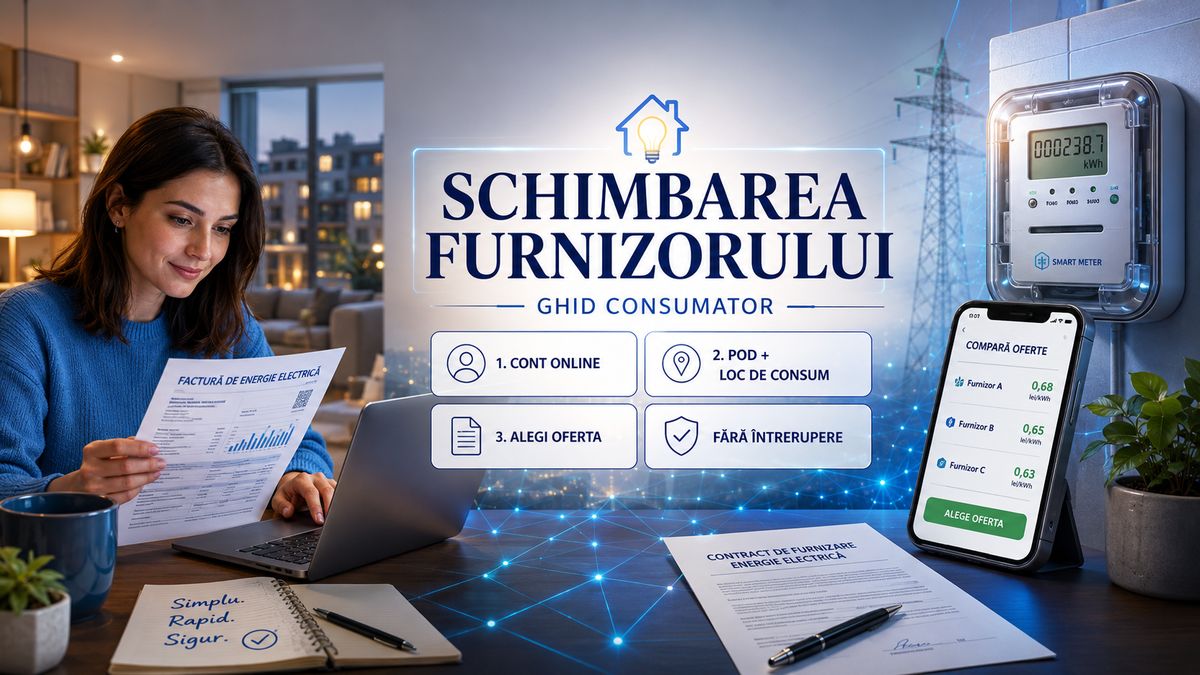
Switching electricity suppliers has become a digital procedure managed through POSF , the online platform designed for switching suppliers and contracting electricity or natural gas supply. For the consumer, the process involves choosing a new offer and signing a new contract, without any modifications to the home's electrical installation and without changing the distribution system operator. The regulation approved by ANRE Order No. 3/2022 establishes POSF as the sole national IT platform through which end consumers can switch suppliers and sign a supply contract with a new provider. For the general public, the concept can be simplified to its essentials: the supplier is the company we buy energy from, while the distributor is the local grid operator. When switching suppliers, the cables, meter, and local grid remain unchanged. Only the commercial contract through which we purchase electricity changes. Switching suppliers is a right of the end consumer End consumers can switch electricity suppliers as often as they wish, and the operators involved have no right to oppose the procedure. According to the guide cited by Economedia, ANRE points out that the beneficiary has the right to terminate the contract with the current supplier and choose another. The same guide specifies that there is no risk of disconnection during the switching process, as continuity of supply is guaranteed by law. This guarantee is crucial for consumers. Switching suppliers should not be viewed as a technical intervention in the home. No technical team will come to modify the installation, the energy path does not change, and supply is not interrupted simply because a contract is signed with another provider. POSF is where the procedure begins POSF can be accessed online, allowing consumers to compare offers, submit the necessary documents, and initiate the supplier switch. The ANRE platform specifies that users can choose the supply contract offers they deem suitable from the comparison tool and switch suppliers within a maximum of 24 hours from signing the new contract. To use the platform, consumers need an email address, personal details, consumption site information, and the POD code, which appears on the electricity bill. The POD code uniquely identifies the consumption site for which the supplier is being switched. While the CLC code is used for natural gas, the POD is the essential reference for electricity. Step 1: Create a user account The first step is creating an account on POSF. The consumer accesses the end-user section, enters their email address, receives an identification code, confirms it, and sets a password. Once logged in, the account becomes the dashboard for managing consumption sites and associated contracts. Economedia describes this stage as the first step in the ANRE guide for switching suppliers. To ensure a quick process, it is helpful for the user to have a recent bill on hand. This document contains the current supplier's details, the consumption site address, and the POD code. Step 2: Link the consumption site The second step is linking the consumption site. At this stage, the consumer fills in the required data on the platform and enters the POD code. If they have multiple consumption sites, each is managed separately. The POSF regulation stipulates that the platform manages the consumption site data and the information registered by the client when initiating the procedure, including the self-read meter index and the reading date. For the consumer, the practical side is simple: enter the consumption site for which the supplier switch is desired, verify the details, and proceed to selecting an offer. Step 3: Choose an offer and initiate the switch The third step is choosing the offer. The consumer enters the contract section, selects the supplier switching option, reviews the available offers, and chooses the most suitable option. At this stage, the self-read meter index, reading date, a photo of the meter, the billing delivery method, and the signing of the application or contract may be required, depending on the platform's workflow. The guide presented by Economedia describes this stage as the moment when the customer uses the comparison tool, selects the offer, and submits the application. This is the decisive step for the consumer. While the platform simplifies the procedure, the offer must be read carefully before confirmation. The 24-hour timeframe must be correctly understood The POSF regulation specifies that the actual supplier switch through the platform, supply under the new contract, and the termination of the contract with the current supplier occur on the first day after a 24-hour interval from initiating the procedure, a timeframe required for technical and administrative steps. In practice, the 24-hour timeframe refers to the switching process via POSF, not an automatic promise of a lower bill. The final bill depends on the chosen offer, consumption, regulated tariffs, taxes, VAT,…
Aurora AI — Independent Editorial Board
The NRG-IA newsroom continuously monitors Romanian energy markets, ANRE regulatory decisions, and national grid telemetry (SEN/SNT). We deliver independent intelligence anchored exclusively in official primary data.
Editorial Charter, Ethics & Verification Methodology →