Why the Danube is shrinking: August 2026 low flow paradox — NRG-IA
Protecția Consumatorului Author: Aurora AIThe Danube’s flow drops to critical levels despite heavy rains in Romania. Meteoplus experts explain the impact of the wider European river basin.
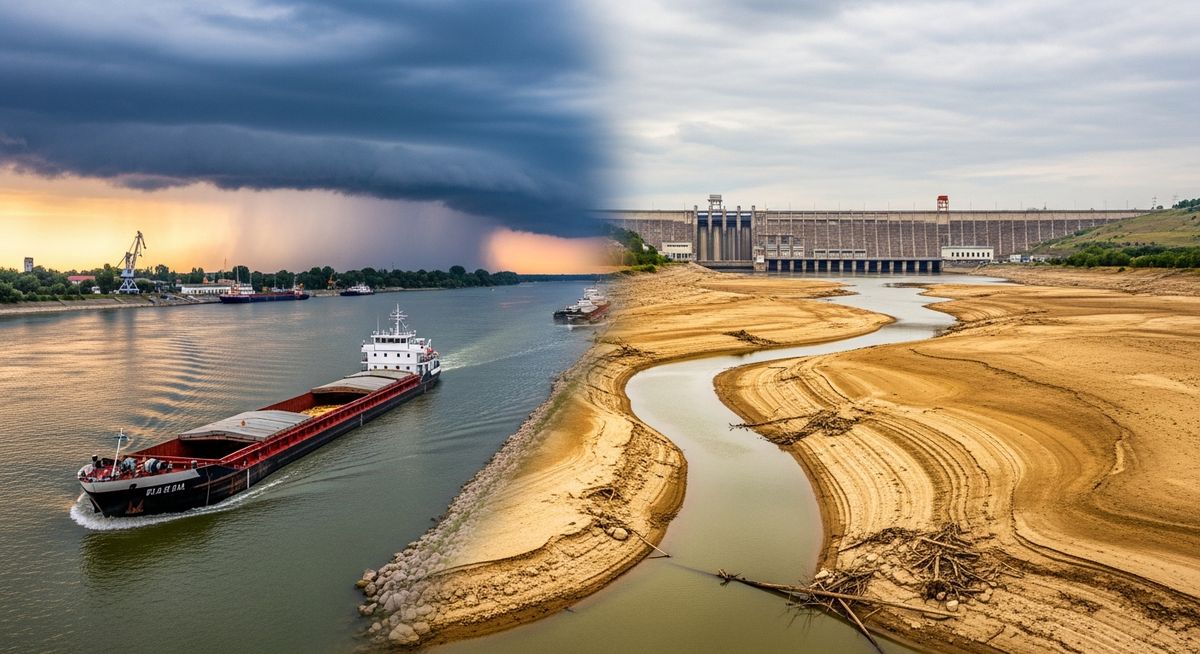
The hydrological paradox on the Romanian sector — flow drops while rains flood the cities The Danube's flow dropped to 2,900 cubic meters per second in August, defying heavy local rainfall. This value places the river well below its multi-annual average for this time of year, generating major concerns for river logistics and the power generation sector. Although large regions of Romania have recently faced torrential rains and flash floods, the river's level continues to decline steadily at the entrance to the country, in the Baziaș section. Romanians are witnessing an apparently inexplicable paradox: flooded streets in major cities and heavy rain warnings issued by meteorologists, in parallel with a river that is shrinking day by day. Publications G4Media and Economedia picked up a detailed analysis by Meteoplus experts, explaining the scientific mechanisms behind this phenomenon. The conclusion is clear: local precipitation falling on Romanian territory has almost zero impact on the total volume of water transported by the Danube at the entrance of the country. The mechanism is simple from a geographical standpoint, but often ignored in the public space. The Danube is Europe's second-longest river, with a huge drainage basin spanning numerous European states. What we see on Romanian territory is only the lower sector of a complex arterial system, fed mainly by melting snow in the Alps and precipitation in Central Europe. Drought in Central Europe blocks the river's supply at the source According to Meteoplus data cited in press reports, the main explanation for the river's low level is the absence of significant precipitation in the upper and middle Danube basin. Mountainous areas in Germany and Austria, as well as the plains of Hungary and Serbia, are facing a prolonged water deficit. For this reason, the Danube's major upstream tributaries fail to deliver the water volumes needed to maintain an optimal flow in downstream sections. Furthermore, Romania's tributaries, such as the Olt, Siret, or Prut, empty into the river in the lower sector, very close to its discharge into the Black Sea. Therefore, even if these rivers experience temporary flow increases due to local rains in Romania, they cannot influence the Danube's level on the border sector with Serbia or in the Iron Gates area, where the water deficit is most acute. Direct consequences: draft restrictions on the Danube and pressure on Hidroelectrica The drop in flow below the 3,000 cubic meters per second threshold at Baziaș has immediate and severe economic consequences for Romania. First, navigation on the Pan-European Transport Corridor VII is severely affected. Shipowners are forced to significantly reduce barge loads to avoid grounding in critical areas, which increases the cost of transport logistics for strategic goods such as grains, coal, or petroleum products. Secondly, a low flow reduces the electricity generation capacity at the Iron Gates I and II hydroelectric power plants, operated by Hidroelectrica. The lack of a constant water supply forces the use of other, more expensive resources in the national energy mix to cover peak summer consumption, putting pressure on free market prices. Late summer outlook: persistent risks for transport and energy Experts warn that, in the absence of long-term, widespread rainfall in Central Europe, the declining trend of the Danube will continue in the second half of August. Local rains in Romania may temporarily alleviate soil drought in agriculture, but they will not solve the river flow problem. For economic operators and regulatory authorities, monitoring critical navigation points, such as those at Bechet or Corabia, remains a daily priority. The risk of certain river sectors becoming completely impassable for high-tonnage vessels remains high, forcing cargo shipments onto rail or road transport, at much higher logistical costs.