Virtual Power Plants: Aggregating Romania's Prosumers — NRG-IA
Energie Regenerabilă Author: Ioana BuzoaicaRomania has over 100,000 prosumers with storage. The next step is aggregating them into virtual power plants to manage solar surplus and peak demand.
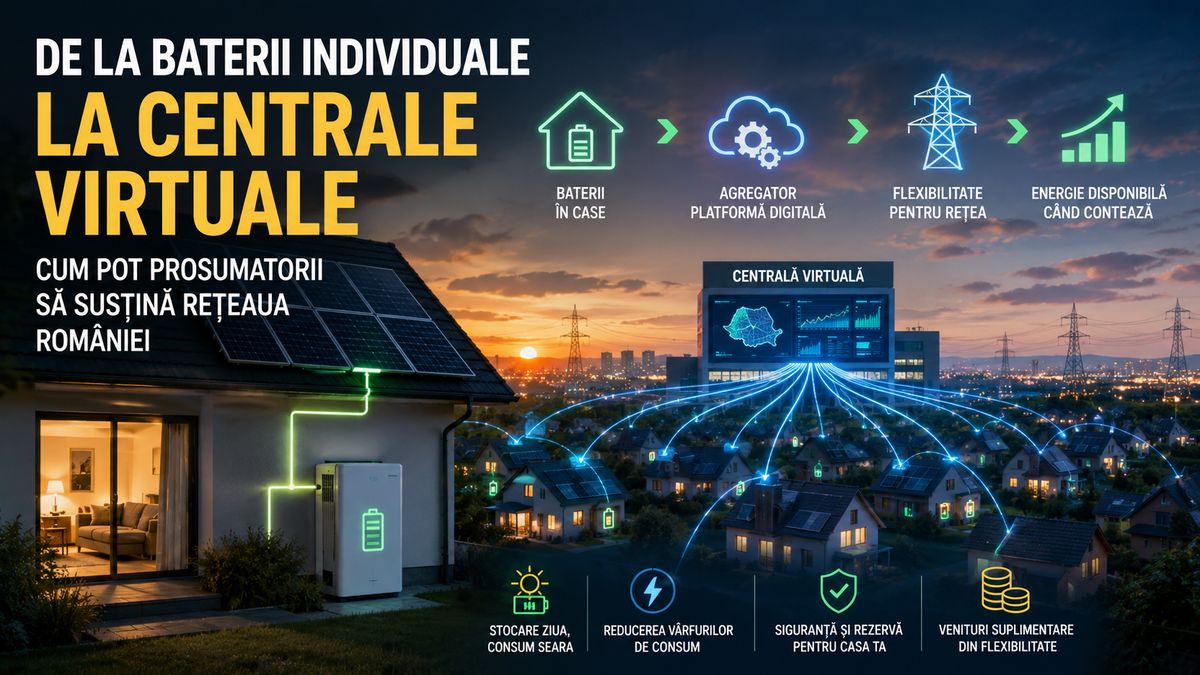
As of April 30, 2026, Romania had 332,684 prosumers connected to the grid, with a total installed capacity of 3,789 MW . Of these, 101,243 had storage installations , over 10,000 more than in the previous month. This figure illustrates how rapidly the market is shifting from simple solar generation to storing energy for later consumption. Today, batteries in homes and businesses are primarily installed for self-consumption: energy generated at midday can be used after sunset when solar panels stop producing. In configurations that allow backup power, they can also keep essential appliances running during an outage. However, the next phase has higher stakes than a single household's bill. A battery does not have to remain just a private piece of equipment that charges during the day and discharges in the evening. Under certain technical and contractual conditions, it can become part of a controllable portfolio capable of responding to grid needs. This is the logic of a virtual power plant: rather than building a new power plant in a single location, it digitally coordinates batteries, small producers, flexible consumers, charging stations, and other dispersed assets. The virtual power plant aggregates small assets into a controllable resource A virtual power plant does not mean that the transmission or distribution system operator can automatically take control of every household battery. Instead, it operates through an aggregator: a company that voluntarily contracts with energy asset owners and manages them within a shared portfolio. The owner sets the terms of participation, including the minimum energy level to be reserved for self-consumption or backup. The aggregator can only utilize the available energy and capacity within these agreed limits. ANRE (the Romanian Energy Regulatory Authority) already allows the voluntary aggregation of producers, consumers, and storage system owners. To operate as a dispatchable aggregated unit, the portfolio must reach at least 1 MW of approved simultaneous capacity for absorption or injection and be capable of responding to dispatch instructions. The 1 MW threshold does not mean a single household must own a battery of this size. It means that many small batteries can be grouped into a single portfolio. A few hundred or thousand installations can collectively provide the required capacity, provided they are technically compatible, have reliable data, and can be activated simultaneously. End consumers can sign a contract with an independent aggregator without their energy supplier's consent. This right already exists under ANRE's regulatory framework; the challenge lies in the emergence of clear, simple, and sufficiently attractive commercial products for battery owners. The value of a battery emerges during the hours when the system needs it most Photovoltaic panels generate the most electricity during periods of high solar radiation. On summer days, available energy surges at midday, precisely when demand is lower than during the evening peak. After sunset, solar generation drops rapidly, and the system must cover demand using hydropower, gas-fired plants, coal, imports, available wind energy, and other flexible resources. During heatwave weeks, this window becomes critical: air conditioning, commerce, services, and industry keep demand high just as solar power fades. Transelectrica explicitly includes distributed storage among the solutions required to integrate large volumes of renewable energy. The transmission grid development plan shows that expanding renewables requires both centralized storage, such as pumped-storage hydropower, as well as distributed batteries and other facilities capable of providing flexibility to absorb surpluses and cover generation deficits. A household battery can contribute at two different times. At midday, it can absorb a portion of locally generated solar energy, reducing simultaneous grid injection in areas with high solar penetration. In the evening, it can cover self-consumption or make a portion of the stored energy available to the aggregator, if contractually agreed. The benefit to the system does not come from a single battery. It arises from coordinating a large number of geographically distributed batteries operated under the same market or flexibility signal. From installed equipment to available energy The number of prosumers with storage does not automatically indicate how much energy can enter the market on any given evening. A battery has two distinct characteristics. Capacity (or power), expressed in kW or MW, shows how quickly it can charge or discharge. Stored energy, expressed in kWh or MWh, indicates how long it can sustain that power output. A 10 kWh battery may have a discharge capacity of 5 kW, but it cannot sustain this output for many hours if it is nearly empty or if the owner maintains a reserve for self-consumption. The same limitation applies to an aggregated portfolio: its actual availability depends on…
Ioana Buzoaica — Independent Editorial Board
The NRG-IA newsroom continuously monitors Romanian energy markets, ANRE regulatory decisions, and national grid telemetry (SEN/SNT). We deliver independent intelligence anchored exclusively in official primary data.
Editorial Charter, Ethics & Verification Methodology →