Delgaz Grid Refinances RON 3B for Grid Modernization — NRG-IA
Piața de Energie Author: Aurora AIDelgaz Grid has signed a RON 3B sustainable refinancing, extending maturity to 5 years to fund grid modernization, smart metering, and renewables.
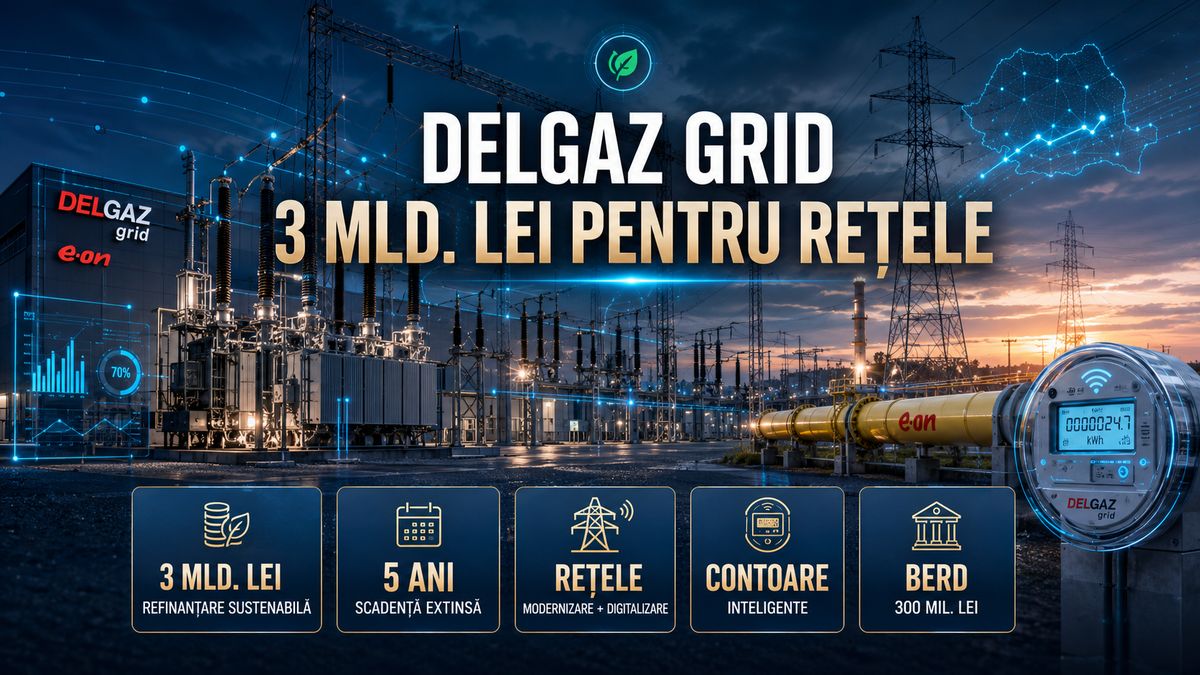
Delgaz Grid, the electricity and natural gas distribution company of the E.ON Romania Group, has signed a sustainable refinancing facility worth RON 3 billion , aimed at covering liquidity needs, increasing financial flexibility, and supporting the company's operational and strategic objectives. The transaction refinances existing facilities originally signed in 2023 and extends the maturity from three to five years , under improved commercial terms. The funds will be primarily used to modernize and digitalize Delgaz's distribution network, including the deployment of smart metering infrastructure. The company states that these investments are expected to improve grid reliability, reduce power outages and grid losses, and facilitate the integration of additional renewable energy capacity. Refinancing provides time and flexibility for investments The transaction does not merely alter the maturity of credit lines. By extending the maturity to five years and improving commercial terms, Delgaz Grid is strengthening its financial foundation at a time when distribution networks require massive, predictable, and longer-term capital. For a distribution system operator, liquidity is inextricably linked to investment. Power and gas grids operate under a regulated model, where investments are gradually incorporated into the Regulated Asset Base (RAB), with recovery achieved through approved tariffs. Delgaz explicitly notes that the syndicated loan also aims to stimulate the growth of its Regulated Asset Base—the assets recognized under the regulated remuneration mechanism. This phrasing is significant for the market. Grid investments cannot be treated as mere operating expenses. They become regulated assets that support service quality, connection capacity, loss reduction, and the integration of new generation capacities. Smart meters take center stage in modernization One of the explicit targets of the financing is smart metering infrastructure. This is a critical link in the energy transition, as a grid with an increasing number of prosumers, flexible consumers, heat pumps, charging stations, and distributed solar generation can no longer be managed efficiently using slow tools and incomplete data. Smart meters transform the relationship between the consumer, the grid, and the market. They enable more precise measurement, remote reading, operational issue detection, fairer billing, and, in the next phase, dynamic tariffs or commercial products tailored to actual consumption profiles. Grid digitalization thus becomes a prerequisite for reducing losses, improving service quality, and integrating renewables. Without better data, operators struggle to detect congestion, overloads, voltage fluctuations, and the bidirectional flows generated by prosumers. EBRD joins the syndicated facility The international component of the transaction is highly relevant. The EBRD previously announced financing of RON 300 million (approximately EUR 57 million ) for Delgaz Grid, as part of the broader RON 3 billion syndicated facility alongside six commercial banks. The EBRD loan funds a portion of the company's capital expenditure program for the 2026–2030 period, focusing on modernizing and digitalizing the electricity distribution network. According to the EBRD, the investments are expected to reduce power outages and grid losses, improve reliability, and enable the integration of additional renewable energy capacity. This direction directly links bank financing to the future operation of the National Energy System. Delgaz Grid serves approximately 1.6 million electricity customers and over 2 million natural gas customers , according to Agerpres, citing EBRD data. The company operates in northern Romania and is part of the E.ON Group, one of Europe's major network operators. Moldavia's grids become a key driver for energy development The regional dimension is significant. Delgaz Grid operates a 25,800 km natural gas distribution network across 20 counties in northern and western Romania, as well as an 81,500 km electricity grid in six counties in the Moldavia region: Bacău, Botoșani, Iași, Neamț, Suceava, and Vaslui. For the Moldavia region, modernizing the power grid has a dual significance. On one hand, it improves service quality for households and businesses. On the other hand, it can build the technical capacity required for local economic development: solar parks, prosumers, industry, logistics centers, EV charging, and new investments dependent on stable energy access. In 2024, the EIB granted Delgaz Grid a EUR 200 million loan to modernize the electricity grid in northeastern Romania, as part of a EUR 630 million investment program. The works targeted high, medium, and low-voltage lines, grid automation, and smart meter deployment, with completion scheduled by 2027. This track record shows that the RON 3 billion refinancing does not occur in isolation. It is part of a broader sequence of financing, institutional loans, European…