Green House Batteries 2026: Submissions Exceed Budget — NRG-IA
Prosumatori & Eficiență Author: Ioana BuzoaicaSubmissions for Green House Batteries reached RON 667.2M, exceeding the RON 400M budget by nearly 67%. Scoring, not speed, will determine final funding.
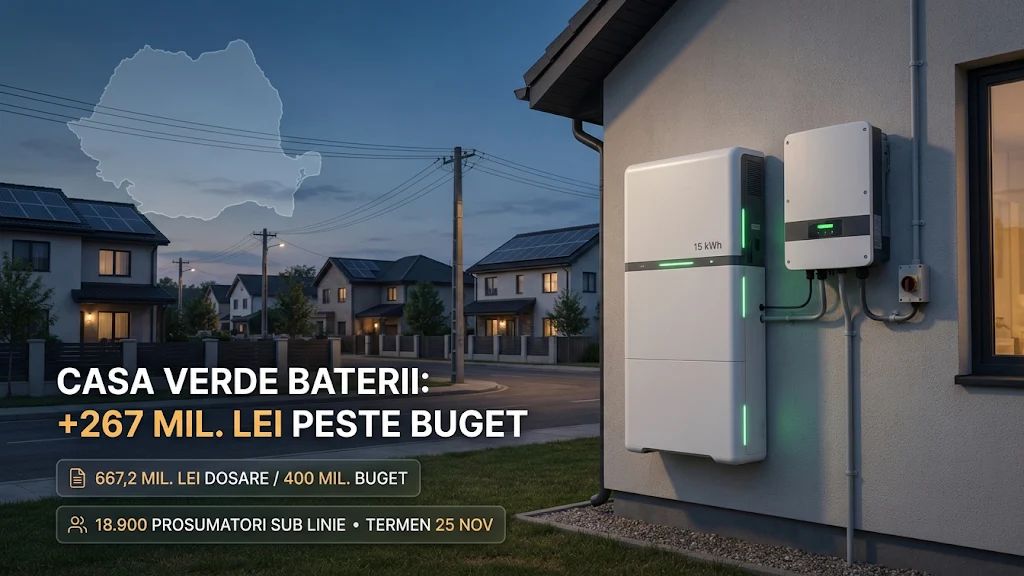
The total value of applications submitted for residential energy storage batteries exceeded the state-allocated budget by 66.8% over a day and a half before the Environment Fund Administration (AFM) session closes. On Tuesday, November 24, 2026, in the early morning, the official portal counter registered 47,152 applications from individuals, representing a combined funding demand of RON 667.2 million against a total budget of RON 400 million—a surplus of RON 267.2 million over the available ceiling. At an average requested value of RON 14,150 per application, the budget arithmetically covers only about 28,270 households, leaving nearly 18,900 registered prosumers outside the funding threshold. The stakes of the final 38 hours of the session—open until Wednesday, November 25, at 23:59—are fundamentally different from all previous editions of the Green House ("Casa Verde") program. Driven by habits from the 2023 and 2024 sessions, when regional budgets vanished in under two minutes, 23,032 Romanians uploaded their documents within the very first hour on Friday, November 20; by 14:49, the RON 400 million cap was surpassed. This time, however, speed offers no protection against disqualification. AFM President Florin Bănică publicly confirmed that winner rankings are determined strictly in descending order of score. This means an application submitted in the final hours of Wednesday with 90 or 100 points will automatically displace an application submitted in the first minute of the session with a lower score. This unprecedented pressure on the budget stems from both a structural deficit in storage equipment and a major shift in grid-feed settlement rules. Centralized data from the National Energy Regulatory Authority (ANRE) for end-September, released last week, shows Romania has reached 394,868 prosumers with a combined installed capacity of 4,389.69 MW, of which 357,148 are residential. Since only 151,404 households currently own energy storage systems, there is a net pool of 205,744 domestic prosumers without storage capacity. Almost a quarter of them entered the AFM race after a 2025 without a new application session and a 2026 budget that allocated zero funds for new solar PV panels. In parallel, Tuesday, November 24, marks the operational deadline under ANRE Order No. 67/2026 for suppliers to implement new monthly settlement and valuation mechanisms, including cross-offsetting for gas bills with the same supplier. The new framework eliminates the legacy 24-month quantitative rollover but preserves the severe price gap between day and night: surplus energy injected into the grid at midday is purchased by suppliers strictly at the active energy market price—excluding transport, distribution, excise, and VAT—whereas in the evening, prosumers buy electricity back at the full retail price, roughly double. Under these market conditions, household energy storage has become the sole method to maintain the return on investment for solar installations. Selection mathematics rewritten four days before launch and the trap of the minimum 25% co-financing The criteria governing the allocation of the RON 400 million budget were fundamentally revised by Ministry of Environment Order No. 2,314/2026, published in the Official Gazette on November 16, just four days prior to opening public applications. Signed by Minister Diana Buzoianu, the regulation replaced the initial September scoring system with a maximum 100-point formula split across three pillars: up to 40 points for battery capacity, between 10 and 35 points for the ratio of self-financing to state grant, and a fixed 25 points for applicants who have not previously benefited from public funds dedicated to energy storage. The first major differentiator is the storage capacity threshold. The minimum acceptable system in the program is 10 kWh, which earns only 20 points, while each additional kilowatt-hour adds 4 points up to the 15 kWh threshold, where the maximum 40-point cap is reached. Because the non-repayable grant covers at most 75% of eligible expenses up to a standard cost limit of RON 1,500 per installed kWh and capped at RON 15,000 per beneficiary, upgrading from a 10 kWh battery to a 15 kWh system yields a dual advantage: it raises the score by 20 points while increasing the maximum reimbursable subsidy from RON 11,250 to RON 15,000. The greatest vulnerability lies in applications submitted with the statutory minimum self-contribution of 25% of the total project value. The official formula calculates the financial score by multiplying the ratio of self-funding to AFM grant by 37.5 and subtracting 2.5. When the subsidy accounts for 75% of the project and self-funding accounts for only 25%, the ratio is one-third, locking the resulting score at the minimum of 10 points. Consequently, a prosumer without prior public funding who hurriedly applied for a 10 kWh battery valued at RON 15,000, requesting an AFM grant of RON 11,250, secures only 55 points—a score…
Ioana Buzoaica — Independent Editorial Board
The NRG-IA newsroom continuously monitors Romanian energy markets, ANRE regulatory decisions, and national grid telemetry (SEN/SNT). We deliver independent intelligence anchored exclusively in official primary data.
Editorial Charter, Ethics & Verification Methodology →