Germany Grid Attacks: 4.2 GW of RWE Capacity Disconnected — NRG-IA
Geopolitică & Energie Author: Ioana BuzoaicaTwo attacks on Germany's grid occurred 12 hours apart. At Bergheim, a localized strike cut 4.2 GW of RWE capacity, highlighting physical vulnerability.
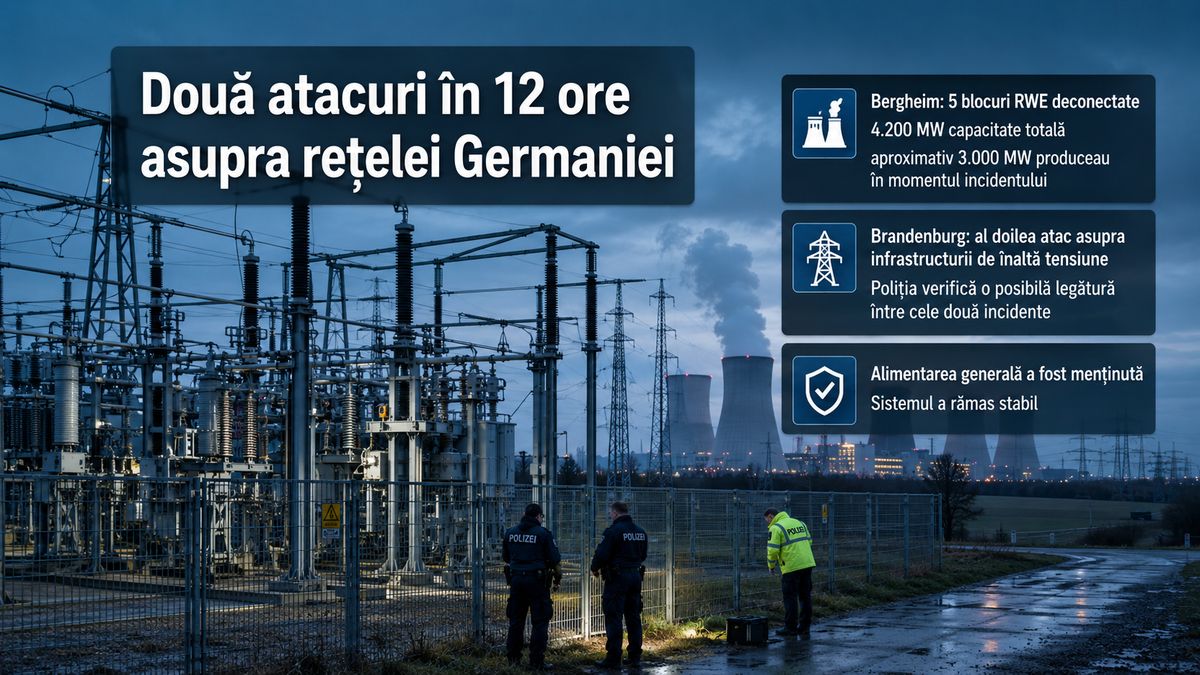
Germany is investigating two attacks on its electricity infrastructure that occurred on the same day, approximately 12 hours apart. The most severe impact on the energy system took place on the evening of September 1, 2026, in the Bergheim area of North Rhine-Westphalia, where a deliberately caused short circuit led to the automatic disconnection of five RWE lignite-fired units at Neurath and Niederaußem. Together, these units had a capacity of 4,200 MW and were supplying approximately 3,000 MW at the time of the incident. About 12 hours earlier, police had been alerted to another attack at a high-voltage facility in Turnow-Preilack, Brandenburg , near the Jänschwalde power station. Several improvised devices, some of them unexploded, were found there, and the State Criminal Police Office (Landeskriminalamt) has taken over the investigation. The perpetrators had not been publicly identified as of the morning of September 3. The succession of the two incidents elevates the issue beyond localized damage to a single facility. The attack in western Germany demonstrated how much generation capacity can be affected by targeting the infrastructure that connects power plants to the grid: there was no need to directly attack boilers, turbines, or the plants themselves to automatically knock gigawatts of capacity offline. A short circuit disconnected five generation units The Bergheim incident was reported to the police around 8:00 PM on September 1. Initial inspections ruled out a simple technical fault and pointed to deliberate action. According to the police, a conductive object was reportedly attached to a fence and projected toward the power line, causing a ground fault and a short circuit. Investigators later discovered several launching devices in a nearby cornfield, suspected of being linked to the attack. Authorities have classified the case as an attack on critical infrastructure, and the Cologne Public Prosecutor's Office is investigating suspected unconstitutional sabotage and disruption of public services. Electrical protection systems reacted automatically. The Neurath and Niederaußem plants were isolated from the grid, and RWE subsequently identified the five affected units: Neurath F and G , and Niederaußem G, H, and K . Their cumulative capacity was 4,200 MW. The 4.2 GW figure describes the total capacity of the disconnected units, not the generation lost at that specific moment. RWE specified that the facilities were actually injecting approximately 3,000 MW when the incident occurred. The distinction is important: the instantaneous shock absorbed by the system was on the order of 3 GW of active power supply, whereas the affected generation infrastructure had the capability to deliver up to 4.2 GW. The attack targeted the plants' connection to the system The Bergheim case highlights a vulnerability specific to large power systems. A power plant can remain physically intact, but if the infrastructure through which its energy is evacuated to the transmission grid is disrupted, protection systems must isolate the facility to prevent the fault from propagating. Substations and extra-high-voltage lines are not simple point-to-point connections. They can represent nodes through which gigawatt-scale capacities are integrated into the system simultaneously. In the Bergheim case, a localized physical intervention on the electrical infrastructure had operational consequences for two separate RWE power plants. Amprion, the local transmission system operator, confirmed that the incident near its Rommerskirchen substation affected the connections of the RWE plants and considers external intervention highly probable. However, the operator specified that the general electricity supply was not affected at any point and that system stability was maintained throughout. This contrast is essential to understanding the energy dimension of the incident. The attack demonstrated that localized infrastructure can concentrate gigawatt-scale vulnerabilities, but also that system protections and redundancy can prevent a major failure from cascading to consumers. Brandenburg infrastructure near Jänschwalde attacked 12 hours earlier The first incident of September 1 occurred in eastern Germany. Around 8:00 AM, Brandenburg Police received a report of damage to an overhead line at a substation in Turnow-Preilack , in the Spree-Neiße district, near the Jänschwalde lignite-fired power plant. Several improvised devices, some of them unexploded, were discovered at the scene. Experts from the State Criminal Police Office (Landeskriminalamt) intervened to neutralize them and collect evidence, and police stated there was no impact on the public. A few hours later, the attack in North Rhine-Westphalia caused a short circuit and a much larger energy impact. German investigators are verifying whether there is a link between the two events. Bergheim police explicitly stated that this possibility is…
Ioana Buzoaica — Independent Editorial Board
The NRG-IA newsroom continuously monitors Romanian energy markets, ANRE regulatory decisions, and national grid telemetry (SEN/SNT). We deliver independent intelligence anchored exclusively in official primary data.
Editorial Charter, Ethics & Verification Methodology →