Cuba's Grid Collapses Twice in Five Days Amid Severe Deficits — NRG-IA
Geopolitică & Energie Author: Ioana BuzoaicaCuba's power grid collapsed for the second time in a week, leaving 10M people in the dark after a single line failure destabilized the fragile system.
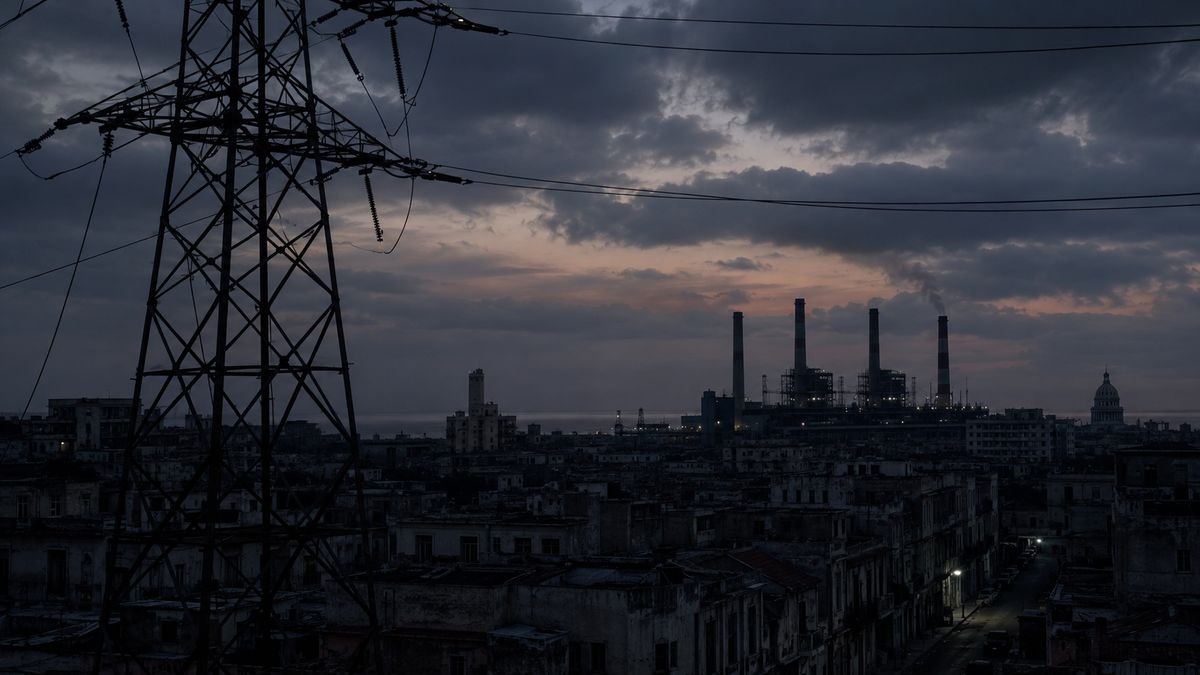
Cuba's national power grid collapsed completely on Friday, July 10, for the second time in just five days and the fourth time since the beginning of 2026. The new blackout affected a country of nearly 10 million people, where many localities had not yet returned to normal power supply following Monday's outage. The incident began at 3:55 p.m. local time when a 220 kV transmission line between Santa Clara and Sancti Spíritus failed. The fault split the national grid into isolated zones, causing several thermal power units to trip, while voltage and frequency began to fluctuate. By 4:30 p.m., the entire national electricity system had disconnected. The line failure was the trigger for the blackout. However, the scale of the collapse demonstrates how little resilience remains in the Cuban grid when faced with a fault that, in a stable system, should be isolated without causing a nationwide power loss. A local fault destabilized the entire island A power grid must constantly balance generation from power plants with consumption from households, industry, and public services. When a major transmission line fails, power must be rerouted through alternative paths, and available plants must quickly compensate for the imbalance. Cuba no longer possessed this safety margin. The splitting of the grid into multiple zones left some regions with insufficient generation and others with unstable parameters. Automatic protection systems tripped several units to prevent severe damage, and successive shutdowns led to the complete collapse of the grid. Key power plants, such as Antonio Guiteras, Nuevitas 6, and Carlos Manuel de Céspedes 4, could only begin startup procedures after receiving external electricity. This situation complicates system restoration: the very plants needed to generate electricity require power themselves to start pumps, control systems, and auxiliary equipment. Cuba had less than a third of the required power available The grid was already operating under extreme stress before the second blackout. On the morning of July 9, Cuba had only 880 MW available against a demand of approximately 2,730 MW. The deficit reached 1,837 MW, and the peak demand deficit was estimated to reach up to 2,260 MW. In other words, the system could supply less than a third of the electricity required at that time. For the evening of July 10, the operator anticipated that approximately 1,952 MW of demand could not be met, even before the transmission line incident occurred. These figures describe a system that was no longer operating normally. Scheduled rolling blackouts, short-interval power supply, and the disconnection of entire areas had become daily tools to maintain a minimal balance. In the absence of generation reserves, any power plant shutdown or major line failure can trigger an imbalance far greater than the initial incident. The Cuban grid no longer has sufficient resources to absorb the shock and continue operating. The second blackout occurred before the first was resolved The week's first national collapse occurred on Monday, July 6. At the time of the crash, nearly two-thirds of the country was already without electricity due to generation deficits and fuel shortages. In Havana, the system could cover only about 1% of the capital's demand during the initial hours of the restoration process. Available electricity was prioritized for hospitals, water supply facilities, and food production units. The operator managed to reconnect most of the grid by Tuesday evening, though supply did not return to normal levels. Santiago de Cuba and other regions remained without power, and some communities received electricity only for brief daily intervals. Friday's collapse thus occurred in a newly reconnected system that was still unstable and unable to meet demand. The succession of the two blackouts indicates that restoring regional interconnections did not equate to restoring secure operations. Fuel shortages leave power plants unable to intervene Cuba produces approximately 40% of its required fuel domestically. The rest must be imported, and a reduction in external deliveries has left thermal power plants and distributed generation units without sufficient resources to operate. A Russian tanker delivered approximately 730,000 barrels at the end of March, providing temporary relief. However, those reserves were depleted by the end of April, and external supplies have not returned to the required levels. The fuel shortage impacts the system in two ways. It directly reduces the amount of power generated and sidelines the units that should quickly start up when a fault occurs. When these reserve capacities are unavailable, the operator can no longer replace the power lost after a plant or line shutdown. The imbalance propagates, and automatic protections begin to sequentially disconnect other facilities. Aging power plants keep the grid in a permanent state of risk A large portion of Cuba's electricity is generated by…
Ioana Buzoaica — Independent Editorial Board
The NRG-IA newsroom continuously monitors Romanian energy markets, ANRE regulatory decisions, and national grid telemetry (SEN/SNT). We deliver independent intelligence anchored exclusively in official primary data.
Editorial Charter, Ethics & Verification Methodology →