Two Tankers Ablaze in Hormuz; EU Gas Surges to €86.59/MWh — NRG-IA
Geopolitică & Energie Author: Ioana BuzoaicaTwo tankers caught fire in the Strait of Hormuz and Aramco offices were hit in Riyadh, driving European TTF gas prices to €86.59/MWh.
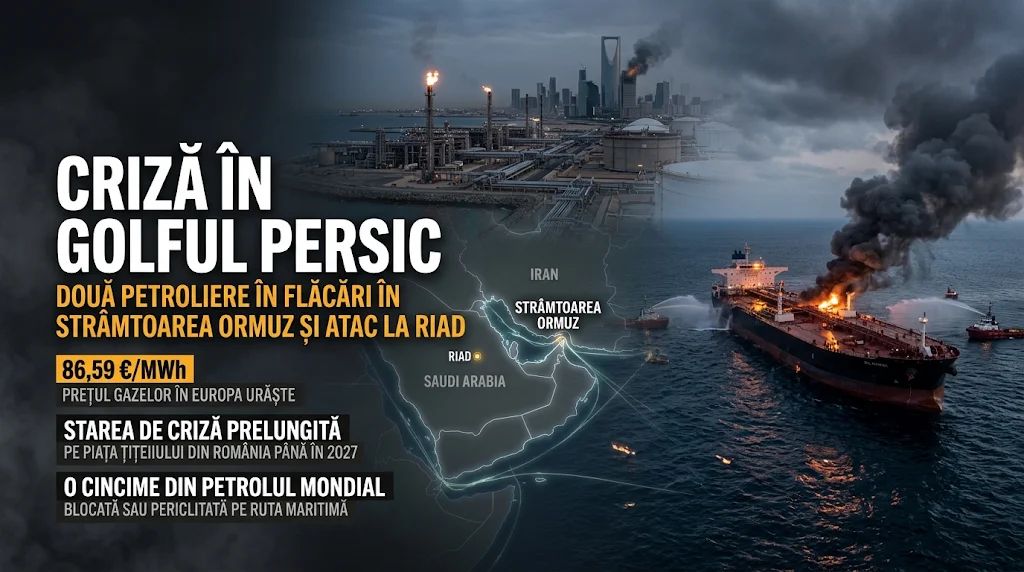
Two oil tankers caught fire on Sunday, November 8, 2026, in the Strait of Hormuz after striking naval mines while underway, according to reports from Iran's official news agency IRNA and international sources. On the same day, Riyadh's financial district was struck, damaging a building belonging to state oil company Saudi Aramco, eyewitnesses cited by news agencies reported. European energy markets reacted immediately at the open of trading on Monday, November 9, 2026, as natural gas prices on the benchmark Dutch TTF hub rose 1.16% to reach €86.59/MWh. These incidents mark a shift in Persian Gulf energy security, moving from general geopolitical risk to active physical impediments along the world's primary maritime artery for hydrocarbon trade. Alongside reported fires at sea and damage in the Saudi capital, the United States military announced its intention to block overland routes into Iran, framing a scenario in which both maritime shipping and regional continental corridors are coming under direct military pressure. The economic stakes of these developments extend far beyond the Middle East, hitting the European Union's energy balance at its most sensitive time of year. As temperatures drop and European energy systems begin drawing down summer-accumulated reserves, any disruption to crude oil and liquefied natural gas (LNG) flows from the Gulf instantly translates into higher cargo replacement costs, elevated war-risk insurance premiums for vessels, and heightened volatility across wholesale power and fuel markets. Mining of Hormuz shipping lane threatens a fifth of global oil consumption and Qatari LNG exports The Strait of Hormuz is the world's most critical maritime choke point for global energy security—a narrow corridor between Iran and Oman through which roughly one-fifth of global crude oil consumption passes, alongside critical volumes of refined petroleum products and LNG. The striking of naval mines by two tankers underway, followed by fires breaking out onboard, introduces the most severe form of operational risk for shipping companies, as sea mines can halt or delay commercial traffic even in the absence of open naval warfare. Unlike isolated incidents targeting a single specific vessel, the presence of mines within the navigable fairway forces shipowners, marine insurers, and terminal operators to reassess the safety of the entire corridor. When two tankers are engulfed in flames on the same day due to naval ordnance, war-risk insurance premiums for every barrel shipped spike sharply. Some carriers may opt to temporarily suspend transit or await minesweeping operations, triggering cascading logistical bottlenecks at the exit of the Persian Gulf. In addition to massive crude flows originating from Saudi Arabia, Iraq, Kuwait, and the United Arab Emirates, this maritime route serves as the sole oceanic gateway for Qatar's liquefied natural gas exports. For European and Asian markets competing directly for every available LNG cargo, any slowdown or threat to LNG carrier traffic through Hormuz squeezes the supply safety margin just as winter heating and power generation demand begins its upward trajectory. Riyadh strikes and damage to Aramco building extend vulnerability to oil sector's command center Sunday's events were not confined to the maritime perimeter of the strait, reaching deep into Saudi Arabia—the world's largest crude exporter and the central pillar of OPEC+'s spare production capacity. According to witness accounts cited by international agencies, Riyadh's financial district was struck, damaging a building belonging to state-owned Saudi Aramco and signaling that corporate infrastructure and major urban hubs are not immune to regional escalation. Although reported damage affected a corporate facility in the Saudi capital rather than shut in oilfields or Gulf coast loading terminals, the psychological and commercial impact on commodity markets is substantial. Saudi Aramco holds the world's only significant spare production capacity capable of being deployed rapidly to offset lost barrels from other conflict- or sanction-affected regions; any strike impacting company assets prompts traders to price in a higher geopolitical risk premium across international benchmarks. This tension is amplified by the U.S. military's announced intention to block overland routes into Iran, pointing toward a tightening regime of economic and logistical isolation in the region. In an interconnected energy system, the convergence of overland blockades, mined shipping lanes, and strikes on Gulf financial centers narrows bypass options around the conflict zone, maintaining upward pressure on benchmark Brent crude prices. European gas exceeds €86/MWh as EU storage begins accelerated winter drawdowns The transmission of this geopolitical shock into the European economy was immediately evident on Monday morning, November 9, 2026, as natural gas futures on the Amsterdam TTF exchange climbed 1.16% to…
Ioana Buzoaica — Independent Editorial Board
The NRG-IA newsroom continuously monitors Romanian energy markets, ANRE regulatory decisions, and national grid telemetry (SEN/SNT). We deliver independent intelligence anchored exclusively in official primary data.
Editorial Charter, Ethics & Verification Methodology →