Nordic Zenith Attack: Risks to Petromidia & Diesel Imports — NRG-IA
Geopolitică & Energie Author: Ioana BuzoaicaRomania refines much of its fuel from Kazakh crude via the Black Sea, but imports over a third of its diesel, exposing it to growing maritime risks.
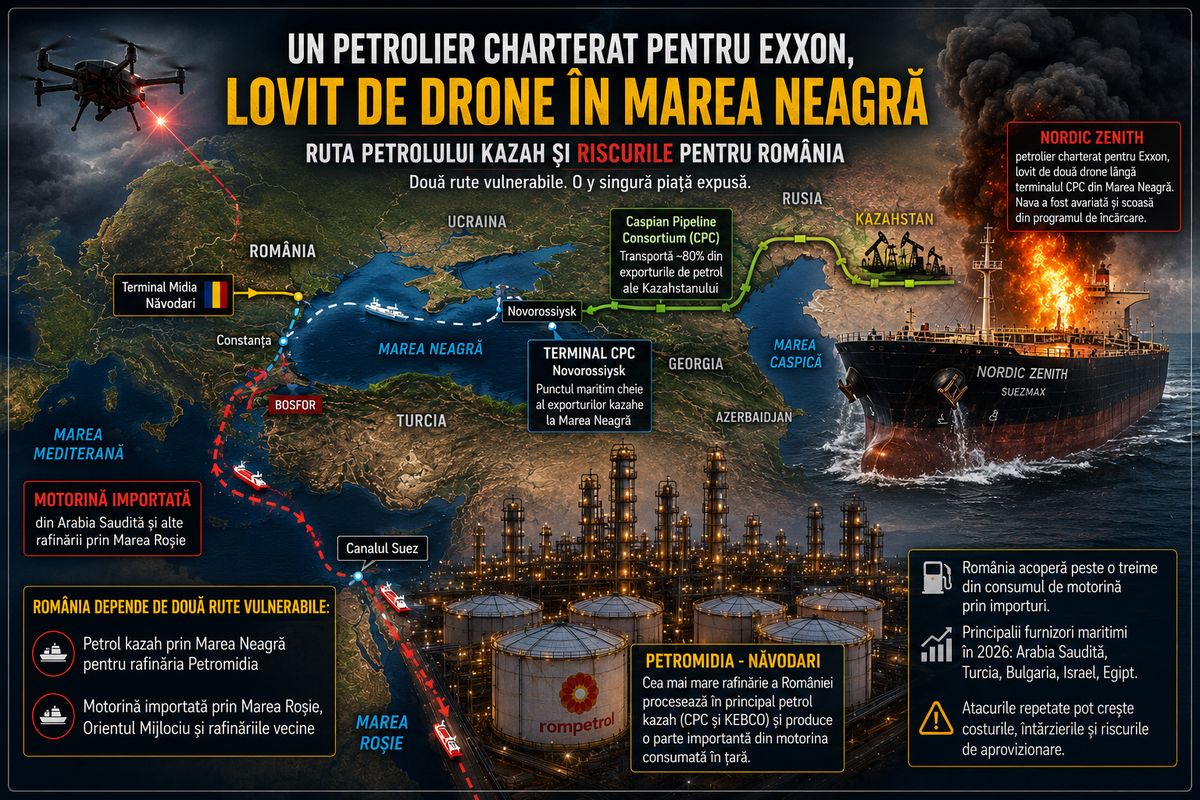
The Suezmax tanker Nordic Zenith, scheduled to load crude oil at the Caspian Pipeline Consortium terminal near Novorossiysk, was struck by two drones and damaged in the Black Sea. A fire broke out on board, part of the crew was evacuated, and the vessel was removed from the loading schedule. According to Reuters sources, the tanker had been chartered by ExxonMobil. The perpetrator of the attack has not been officially identified. The Nordic Zenith was not transporting diesel to Romania, and the incident did not halt operations at the CPC terminal. A single vessel can be replaced, and a cargo can be rescheduled. However, the attack is significant due to where it occurred and the recurring nature of incidents targeting tankers and energy infrastructure in the area. The CPC pipeline carries approximately 80% of Kazakhstan's oil exports and more than 1% of global supply. The pipeline crosses Russian territory and discharges crude at the Black Sea marine terminal, where it is loaded onto tankers. In recent months, drones have struck both loading facilities and vessels heading to the terminal, prompting Kazakhstan to seek international support to protect its oil transit. For Romania, this route is not remote. It feeds the refining system that produces a major share of the diesel sold on the domestic market. Petromidia relies on Kazakh crude shipped via the Black Sea Petromidia, Romania's largest refinery, primarily processes Kazakh CPC Blend and KEBCO crude. Flows are secured with the support of KazMunayGas, Kazakhstan's national oil and gas company and the indirect majority shareholder of the refinery. In 2025, Petromidia processed approximately 5.9 million tonnes of feedstock and produced nearly 4.8 million tonnes of fuel. Of this volume, around 3.1 million tonnes consisted of diesel and jet fuel, with approximately 61% of total fuel production delivered to the Romanian market. The link to the CPC is direct: oil extracted in Kazakhstan is transported via pipeline to the Russian coast, loaded onto vessels, and shipped to the Midia marine terminal. At Năvodari, it is refined into diesel, gasoline, kerosene, and other petroleum products. In the first quarter of 2026, Petromidia processed nearly 1.19 million tonnes of feedstock and produced 614,000 tonnes of diesel and jet fuel. Following a scheduled maintenance shutdown in March, the refinery returned to full capacity, and the company increased the share of fuels directed to the domestic market to 66%. Together, Petromidia and Vega account for about half of Romania's refining capacity. As long as the CPC terminal remains operational and tankers continue to load, an attack on a single vessel does not fundamentally alter the refinery's supply. However, a succession of attacks could change the behavior of shipowners and insurers long before the infrastructure is physically shut down. If the risk becomes too high, tankers may refuse to enter the area, insurance premiums could spike, and chartering a vessel could become more expensive or difficult. These costs ultimately filter into the price of crude delivered to the refinery. The CPC precedent shows how quickly exports can drop The terminal's vulnerability became apparent in late 2025, when a drone attack damaged one of the single point mooring (SPM) loading facilities. CPC Blend exports dropped in December to approximately 1.14 million barrels per day, down from an initial plan of around 1.7 million. Kazakhstan was forced to reroute volumes to China, the Baku–Tbilisi–Ceyhan pipeline, and other Russian routes. These alternatives absorbed only a portion of the flows due to lower capacities, higher costs, and their own technical or geopolitical limitations. The disruptions reached all the way to Kazakhstan's oil fields. Bottlenecks at the terminal led to volumes being diverted to local refineries and production cuts as storage capacity neared its limits. For Petromidia, such an episode does not automatically mean a refinery shutdown. KazMunayGas can draw on inventories, adjust the feedstock blend, or purchase alternative crude grades. However, each alternative solution comes at a cost, and replacing Kazakh crude cannot be achieved instantaneously or in unlimited volumes. Romania produces fuel, but not enough diesel for its own consumption The protection offered by domestic refineries is significant but incomplete. Romania remains a net importer of diesel, covering more than a third of its consumption through foreign purchases. The structure of consumption explains this imbalance. Road freight transport, agriculture, construction, industry, and a large share of the passenger car fleet run on diesel. Demand exceeds the volume that Romanian refineries can consistently supply to the domestic market, particularly during maintenance turnarounds or technical shutdowns. Consequently, the Port of Constanța has become one of the most important entry points for diesel in the Black Sea region. Some cargoes supply Romania, while…
Ioana Buzoaica — Independent Editorial Board
The NRG-IA newsroom continuously monitors Romanian energy markets, ANRE regulatory decisions, and national grid telemetry (SEN/SNT). We deliver independent intelligence anchored exclusively in official primary data.
Editorial Charter, Ethics & Verification Methodology →