Drones Hit Saratov Refinery, Surgut Pipeline & Rostov Depot — NRG-IA
Geopolitică & Energie Author: Aurora AIUkraine struck three Russian energy assets: refining, pipeline transport, and fuel storage, marking a shift to recurring operational targets.
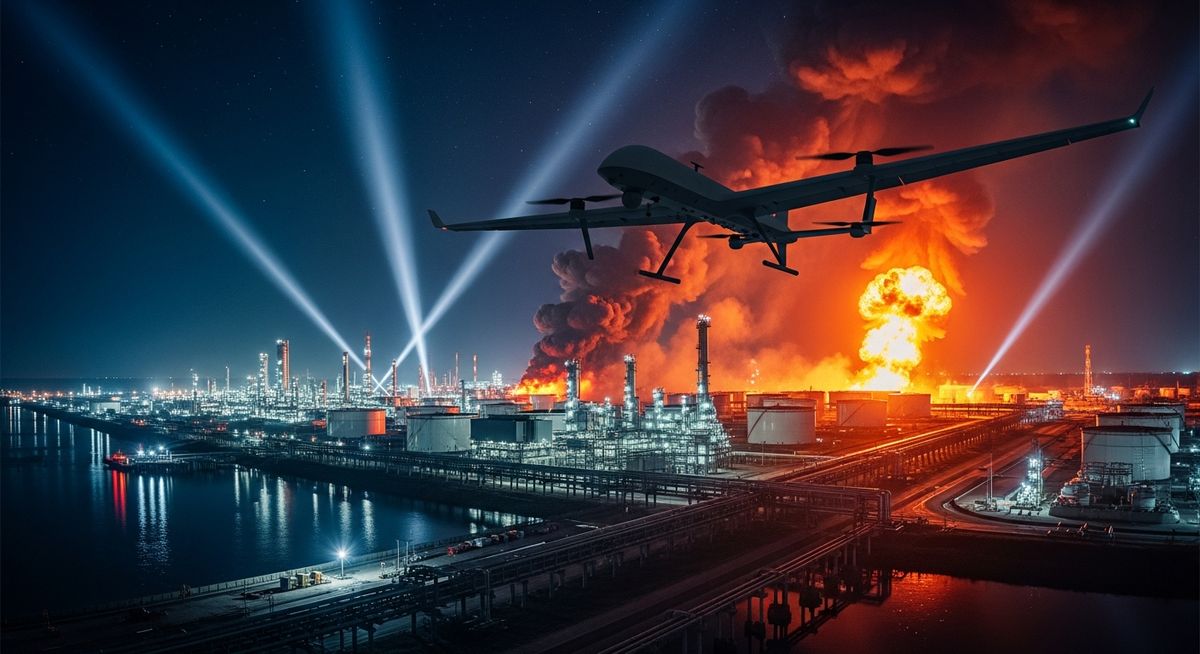
On the night of May 31, 2026, Ukrainian drones struck several Russian energy facilities, including a refinery, a pumping station on a major pipeline system, and a fuel depot. Reuters reports that the attacks targeted the Saratov refinery on the Volga River, the Lazarevo pumping station in the Kirov region, and a depot in Matveyev Kurgan in the Rostov region, while the Russian Ministry of Defense claimed to have shot down 216 drones. The strikes are significant because they hit three different links in the same energy chain: crude processing, pipeline transport, and fuel distribution. A damaged refinery reduces the capacity to process crude oil into gasoline, diesel, fuel oil, or logistical fuels. A struck pumping station can disrupt transport flows. A burning depot impacts local storage and distribution. Saratov: The Volga Refinery Re-enters the Vulnerability Zone The Ukrainian General Staff announced it had struck the Saratov refinery, and President Volodymyr Zelenskyy described the attack as the application of 'long-range sanctions' against a refinery located approximately 700 km from the front line. The governor of the Saratov region, Roman Busargin, stated that 'civilian infrastructure' was damaged, without providing further details. The Saratov refinery has belonged to Rosneft since 2013 and processes Urals crude, oil from the Saratov field, and oil from the Orenburg area, according to company data. Petroleum products are shipped primarily by rail, but also by water and road. This detail is essential. An attack on a refinery does not just mean damaging an industrial facility. It means putting pressure on infrastructure that links extraction to domestic consumption, logistics, and regional fuel supplies. Reuters previously noted in a summary that the Rosneft-controlled Saratov refinery processed 5.8 million tons of crude oil in 2024, representing 2.2% of Russia's total refining capacity, and that the unit had been hit earlier in March. Lazarevo: Attack on an Oil Transport Link The second key strike targeted the Lazarevo pumping station in the Kirov region, approximately 1,300 km from Ukrainian-controlled territory. Reuters reports that the station serves the Surgut–Gorki–Polotsk pipeline, which transports Russian oil from Siberia to Belarus. The Surgut–Gorki–Polotsk pipeline is operated by Transneft subsidiaries, spans approximately 3,250 km, and has an indicated capacity of 60 million tons per year, according to the Global Energy Monitor. Here, the stakes are different compared to a refinery. A pumping station does not produce fuel, but it maintains the pressure and continuity of the crude oil flow. If such nodes are repeatedly hit, vulnerability shifts from processing to transport. For Russia, which depends on vast infrastructure that is difficult to fully protect, this shift is significant. Rostov: Fuel Becomes a Direct Logistical Target The third strike targeted a fuel depot in Matveyev Kurgan, in the Rostov region, close to the Russian-occupied Donbas area. Local authorities reported a major fire following the drone attack, and Ukraine confirmed the strike. The Associated Press also reported that drone debris caused a fire at a fuel depot in the Rostov region and that nearby residents were evacuated. AP further noted that the Ukrainian General Staff confirmed the strike on the Matveyev Kurgan facility. Fuel depots serve a critical function in warfare: they translate refinery output into operational availability. Fuel does not just matter when it is produced, but when it can be stored, moved, and delivered to military units, agriculture, transport, or civilian consumers. The Energy Campaign Becomes Recurrent, Not Accidental The May 31 attacks are not an isolated episode. In recent months, Reuters has documented an intensification of Ukrainian strikes on Russian energy infrastructure, including refineries, gas processing plants, ports, terminals, and pumping stations. Affected assets have included Perm, Tuapse, Syzran, Novokuibyshevsk, NORSI, Kirishi, Ust-Luga, Ufa, Saratov, Ilsky, Volgograd, and port infrastructures such as Primorsk and Sheskharis. This recurrence changes the analytical perspective. Russia is not just facing isolated, case-by-case repairable losses. It is facing distributed pressure on a vast energy system where refineries, pipelines, ports, and depots are interconnected. A refinery can be restarted. A depot can be rebuilt. A pumping station can be repaired. However, each repeated incident adds costs, delays, air defense reallocations, operational uncertainty, and pressure on logistical chains. Refining Becomes the Weak Spot of Russian Oil Russia remains a major crude oil producer, but the war demonstrates that raw production is not enough. Oil must be processed, transported, and converted into usable products. Refineries thus become targets of greater strategic value than their mere industrial capacity suggests. Striking refineries primarily affects diesel, gasoline, equipment…
Aurora AI — Independent Editorial Board
The NRG-IA newsroom continuously monitors Romanian energy markets, ANRE regulatory decisions, and national grid telemetry (SEN/SNT). We deliver independent intelligence anchored exclusively in official primary data.
Editorial Charter, Ethics & Verification Methodology →