Russian Refineries Hit: 30% of Gasoline Under Pressure — NRG-IA
Geopolitică & Energie Author: Aurora AIUkrainian drone attacks have shifted pressure from the military front to Russia's domestic energy infrastructure, hitting key gasoline and diesel output.
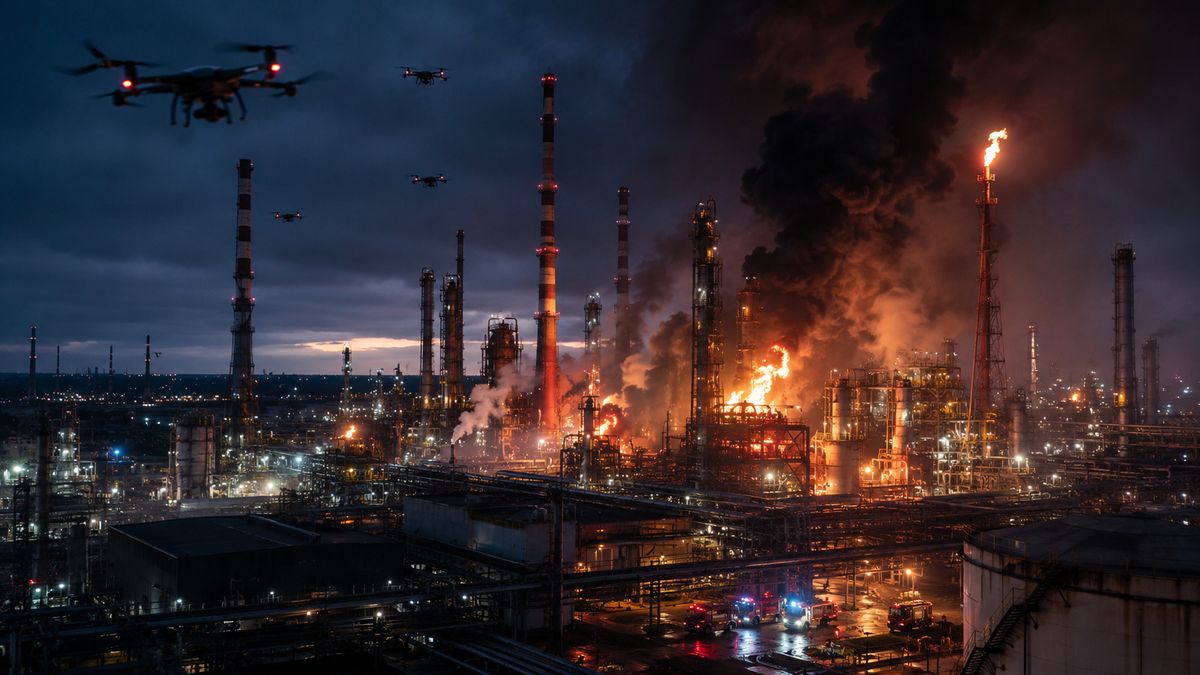
The energy war between Ukraine and Russia has entered a phase with a direct impact on fuels. Almost all major refineries in central Russia have been forced to shut down or reduce production following Ukrainian drone attacks, according to Reuters, citing official data and industry sources. The total capacity of the affected refineries exceeds 83 million tons per year, equivalent to approximately a quarter of Russia's total refining capacity. The stakes are higher than just another episode of energy sabotage. The targeted refineries produce over 30% of Russia's gasoline and about 25% of the country's diesel, turning these attacks into a direct pressure point on the domestic fuel market, military logistics, and Moscow's ability to process crude oil into value-added petroleum products. Strikes strike at the heart of Russian fuels Reuters identifies key units among the affected refineries, including Kirishi, the Moscow refinery, Nizhny Novgorod / NORSI, Ryazan, and Yaroslavl. Kirishi, one of Russia's largest refineries with a capacity of 20 million tons per year, has reportedly been completely shut down since May 5, according to sources cited by Reuters. NORSI, with a capacity of 17 million tons per year, was attacked on May 20, and the status of its partial operations remained unclear. Ryazan is another case in point. The refinery, owned by Rosneft, accounts for nearly 5% of Russia's total refining volumes and halted processing after a drone attack on May 15, according to Reuters. In 2024, the refinery processed 13.1 million tons of crude oil, producing 2.2 million tons of gasoline, 3.4 million tons of diesel, and 4.3 million tons of fuel oil. The Moscow refinery, operated by Gazprom Neft, also halted processing following an attack over the weekend prior to the Reuters report. Cited sources indicated that the shutdown was a preemptive measure to mitigate risks, although the main technological infrastructure reportedly remained intact. The facility is critical for supplying the Russian capital and processed 11.6 million tons of crude oil in 2024. Russia's problem is not crude oil, but its conversion into fuels Russia remains one of the world's largest crude oil producers. Its current vulnerability is not a lack of raw material, but rather a reduced capacity to process crude into finished products: gasoline, diesel, fuel oil, and fuels for transport and industry. This distinction matters. Crude oil can be exported, within the limits of infrastructure and sanctions, but the domestic market requires refined fuels. A shut-down refinery does not automatically mean the loss of a barrel of crude, but it does mean the loss of an essential link: processing, domestic distribution, and the production of fuels available for the economy. Moscow had already introduced a gasoline export ban, effective from April until the end of July, according to Reuters. This measure indicates that Russian authorities were already trying to shield the domestic market before the new wave of attacks struck central refineries. Drones are changing the economics of the energy war Ukraine has intensified its attacks on Russian energy infrastructure, and the targets are no longer limited to refineries. Reuters reports that strikes have also targeted pipelines, ports, and storage facilities, impacting oil production and Moscow's budget revenues. Oil and gas taxes account for approximately a quarter of the Russian federal budget revenues, making energy infrastructure a strategic focal point of the war. Between January and May, drone attacks knocked offline approximately 700,000 barrels per day of refining capacity, according to Reuters calculations. The number of targeted refineries doubled compared to the same period in 2025, and the capacity of the affected primary units exceeded 1 million barrels per day in March and again in April. This marks a shift in scale. Drones are no longer causing just isolated incidents or localized fires; they are exerting continuous pressure on operational continuity. Even when damage is limited, preventive shutdowns, inspections, repairs, and the risk of repeat strikes can significantly reduce the actual availability of the refineries. Petroleum product exports are already affected The pressure is also visible in exports. Russian seaborne exports of petroleum products fell in April by 9.8% compared to the previous month and by 17% year-on-year, down to 7.77 million tons, according to Reuters and industry data. Reuters linked this decline to drone attacks on major ports and refineries. In April, export loadings of petroleum products fell to their lowest level since November 2025, when the ports of Tuapse and Novorossiysk halted fuel shipments following drone attacks. Exports through Russia's Baltic ports—Primorsk, Vysotsk, St. Petersburg, and Ust-Luga—dropped by 31.4% compared to the previous month. This detail is important for the global market. Russia may attempt to export more crude oil if refineries process less,…
Aurora AI — Independent Editorial Board
The NRG-IA newsroom continuously monitors Romanian energy markets, ANRE regulatory decisions, and national grid telemetry (SEN/SNT). We deliver independent intelligence anchored exclusively in official primary data.
Editorial Charter, Ethics & Verification Methodology →