Paks cuts output on warm Danube; Cernavodă monitored — NRG-IA
Piața de Energie Author: Ioana BuzoiacaEurope's heatwave impacts nuclear output. After cuts in France and Hungary, Romania must closely monitor Cernavodă's status as river temperatures rise.
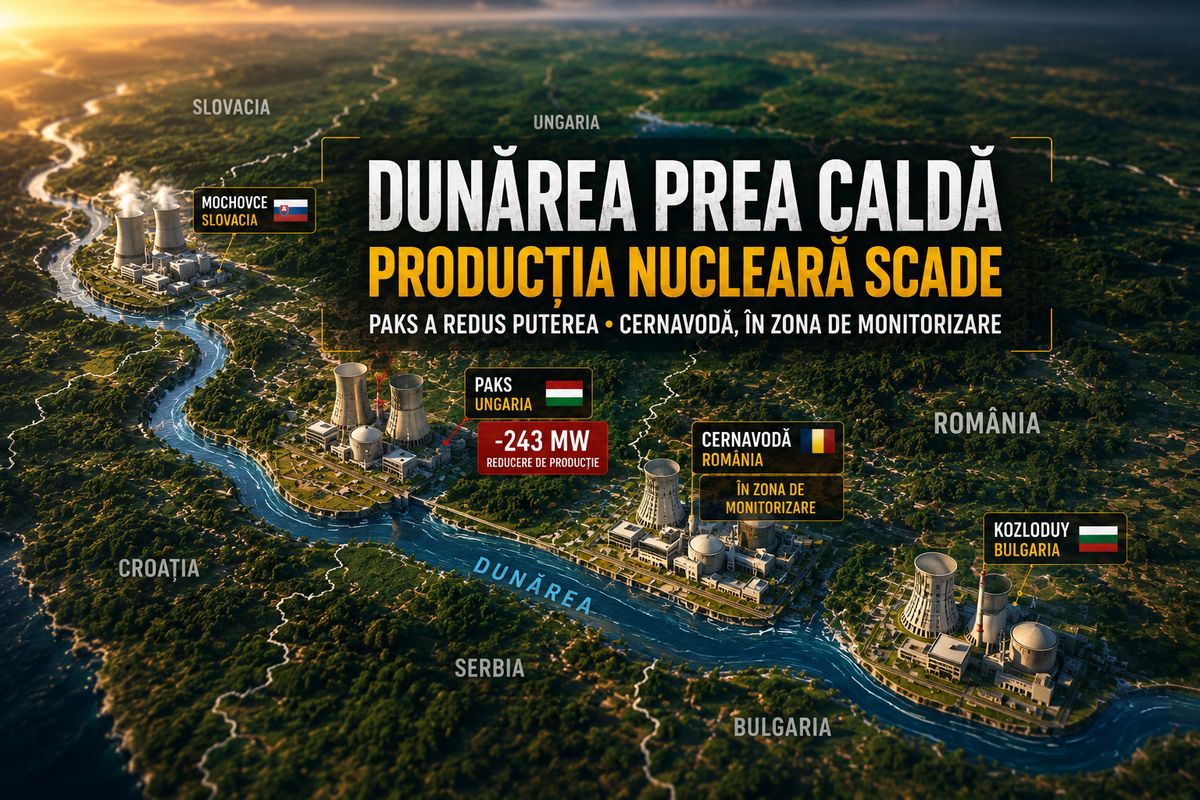
Hungary's Paks nuclear power plant has reduced the output of one of its reactors by 243 MW after the Danube River's water temperature exceeded the technical intervention threshold established for environmental protection. The plant operator decided to curtail capacity after the downstream water temperature reached 29.7°C, surpassing the 29.5°C limit that triggers mitigation measures. The episode highlights an increasingly visible vulnerability of the European power system during heatwaves: nuclear plants may have fuel and be technically available, but can still be forced to curtail output if their cooling water source becomes too warm. The Danube becomes a technical constraint for Paks The Paks nuclear power plant relies on the Danube River for cooling. Under normal conditions, this mechanism ensures stable reactor operations. However, during periods of extreme heat, the river water warms up, and the plant can no longer discharge the same volume of heated water without risking environmental limit violations. The 243 MW curtailment does not mean a plant shutdown or a nuclear fuel issue. Instead, it is a capacity adjustment dictated by water temperature. The reactor continues to operate, but at a lower level, ensuring that the water discharged back into the Danube does not harm the river's ecosystem. This mechanism demonstrates why nuclear energy, despite being a stable and dispatchable source, is not entirely insulated from climate change. When heatwaves drive up river temperatures, a portion of nuclear generation can become constrained by cooling limits. Europe has seen this effect before in France and Switzerland The situation in Hungary is not isolated. In France, EDF temporarily reduced output at several reactors during the heatwave, resulting in a total curtailment of approximately 4.1 GW. The reason was identical: high temperatures in the cooling water sources and the need to comply with environmental discharge limits. In Switzerland, the Beznau plant also faced limitations or temporary shutdowns due to high temperatures in the Aare River. These episodes demonstrate that the issue is not unique to a single country or plant, but is inherent to a type of energy infrastructure dependent on cold river water. For the European electricity market, this effect becomes critical during heatwaves. Precisely when demand surges due to air conditioning, some nuclear and hydro capacities may produce less. The result is a tighter margin between demand and dispatchable generation. Cernavodă must be monitored, without premature conclusions For Romania, the connection is obvious: the Cernavodă Nuclear Power Plant also relies on the Danube. However, this does not automatically mean that Cernavodă's output has been reduced due to the heatwave. To date, there is no solid public confirmation of any production curtailment caused by river water temperatures. The correct approach is to treat Cernavodă as a key point to monitor during the heatwave. Transelectrica's data, Nuclearelectrica's announcements, and Danube temperature trends are the indicators that will reveal whether limitations similar to those at Paks emerge. The distinction is important. Paks has a confirmed output reduction. For Cernavodă, the risk must be monitored, but not treated as a fact without official communication or clear operational data. Heatwaves squeeze both demand and supply Heatwaves strain the power system from two directions. On the demand side, air conditioning drives up electricity consumption, especially in urban areas and during peak thermal hours. On the supply side, warmer rivers can reduce the flexibility of nuclear and hydropower plants. Hydropower is impacted by lower river flows, while nuclear is constrained by cooling water temperatures. At the same time, solar power generates high output during the day but cannot single-handedly cover the evening peak, when demand remains high and photovoltaic generation drops. For system operators, this combination is challenging. Demand rises, dispatchable generation can be curtailed, and the market becomes highly sensitive to imports, spot prices, and the availability of flexible capacity. What is at stake for Romania Romania benefits from growing solar generation on sunny days. However, the system requires dispatchable capacity, storage, available hydro, gas, and imports for the hours when solar output declines. If a heatwave simultaneously impacts demand, hydropower, and potentially regional nuclear generation, wholesale prices can become highly volatile. For Romania, the situation must be monitored across three areas: Danube River trends, Cernavodă's output, and regional power prices. If nuclear curtailments spread to more European countries, the impact will not remain local. Interconnected markets transmit this pressure through commercial flows and high-demand hour pricing. The Paks episode shows that Europe's energy infrastructure is entering a phase where water availability, temperature, and…
Ioana Buzoiaca — Independent Editorial Board
The NRG-IA newsroom continuously monitors Romanian energy markets, ANRE regulatory decisions, and national grid telemetry (SEN/SNT). We deliver independent intelligence anchored exclusively in official primary data.
Editorial Charter, Ethics & Verification Methodology →