Danube to Drop to 1,450 m³/s: Hydropower & Nuclear Impact — NRG-IA
Piața de Energie Author: Ioana BuzoaicaThe Danube could drop to 1,450 m³/s at Romania's border until mid-August. Upstream deficits delay recovery, hitting regional hydro and nuclear generation.
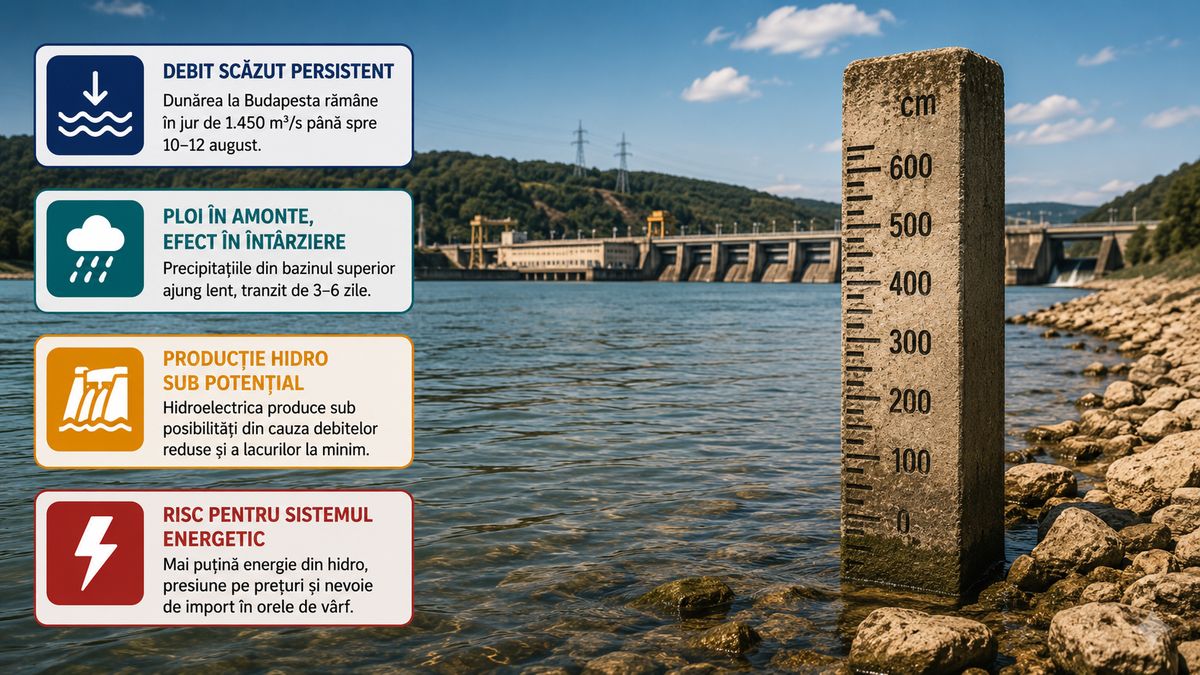
The Danube enters the first decade of August with the prospect of a flow rate of approximately 1,450 m³/s at Baziaș , compared to a multi-annual average for August of 3,900 m³/s . The National Institute of Hydrology and Water Management forecasts a slight decrease to this level followed by relative stabilization, and medium-term estimates indicate that the flow rate could remain around 1,450 m³/s until approximately August 10–12 . A gradual increase is estimated thereafter, with better chances after August 24, but the forecast remains subject to high uncertainty. At 1,450 m³/s, the Danube's flow rate at the entrance to Romania would represent approximately 37% of the multi-annual average for August . This figure illustrates the scale of the hydrological deficit rather than a universal technical threshold for power plant operations: the impact on each facility depends on local water levels, riverbed configuration, water temperature, cooling intakes, operating rules, and hydro-technical interventions. For the regional power system, the challenge is that weather improvement and the recovery of generation conditions do not occur simultaneously. Rain must fall in the relevant areas of the basin, feed the tributaries, overcome the accumulated soil moisture deficit, and then propagate hundreds of kilometers downstream. The first precipitations may halt the Danube's decline without immediately restoring flow rates to near-normal levels. Upstream rains may halt the Danube's decline, but the recovery of the flow rate will be slow The current hydrological forecast includes expected precipitation in the upper Danube basin and Austrian tributaries. However, the estimated effect for early August is not a rapid recovery, but rather a halt to the declining trend: the flow rate is expected to stabilize around 1,450 m³/s before a potential gradual increase in the second half of the month. This development reflects the state of the upstream basin. During the first half of the year, Austria accumulated one of its most severe precipitation deficits in decades. GeoSphere Austria shows that between January 1 and June 30, 2026, national precipitation was 27% below the climate average , and in numerous regions, the deficit reached 30–40% , and up to approximately 50% in the east of the country . The meteorological spring of 2026, spanning March to May, had already been the driest in Austria's 169-year record: precipitation was approximately 50% below the 1991–2020 average , following a deficit of 58% in March, 68% in April, and 33% in May. The deficit is also visible in regions critical for feeding the Danube system. In Kremsmünster, Upper Austria, 332 mm of precipitation accumulated between January 1 and July 13, compared to an average of 533 mm. Ried im Innkreis recorded 298 mm compared to the normal 532 mm, and Salzburg Airport saw 321 mm against a climate average of 625 mm. In mid-July, GeoSphere calculated that to compensate for the national deficit accumulated since the beginning of the year, Austria would need approximately an additional 160 liters of water per square meter on top of normal precipitation in the coming weeks. In such a basin, a series of storms or localized rains does not automatically translate into a comparable increase in the Danube's flow. After dry months, a portion of the water replenishes soil moisture, while high temperatures sustain evapotranspiration losses. For the river's flow rates, the total volume, spatial distribution, and persistence of precipitation across major tributary basins are decisive. The Danube has fallen far below the hydrological scenario with which the summer began The speed of deterioration is also visible when comparing forecasts with different horizons. The long-term hydrological forecast published by the National Institute of Hydrology and Water Management on July 7 estimated a monthly average flow rate of 2,700 m³/s and a monthly minimum flow rate of approximately 2,200 m³/s for August at Baziaș, compared to the multi-annual monthly average of 3,900 m³/s. The operational forecast published on August 1 now indicates a drop toward 1,450 m³/s. The two values stem from forecasts with different horizons and methodologies and should not be treated as a simple comparison between a "correct" and a "wrong" estimate. However, the difference shows how much actual conditions have deteriorated compared to the statistical scenario available in early July, and why operational updates have become critical for running energy facilities. By August 1, the measured flow rate at Baziaș had already dropped to 1,550 m³/s , down from 2,200 m³/s recorded in early July. Within a month, the Danube thus lost approximately 650 m³/s at the entrance to Romania, and the forecast points to a further reduction. Cernavodă shows why the flow rate at Baziaș alone does not dictate how much power can be generated At the Cernavodă Nuclear Power Plant, Unit 1 underwent a controlled shutdown on the morning of July…