August 12 Eclipse to Cut European Solar Output by 9.7 GW — NRG-IA
Piața de Energie Author: Ioana BuzoaicaThe August 12, 2026 solar eclipse will temporarily cut European PV output by 9.7 GW, testing a grid already strained by summer heat and drought.
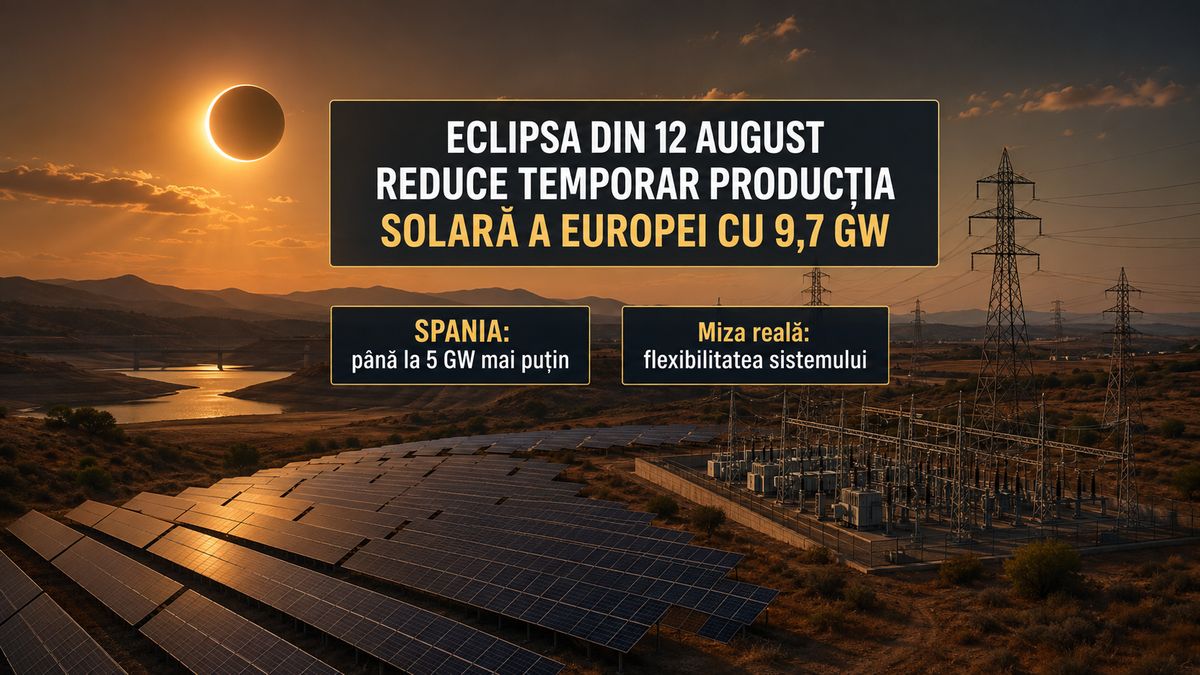
Europe is preparing for a simultaneous drop of approximately 9.7 GW in solar photovoltaic (PV) generation on the evening of Wednesday, August 12, as a total solar eclipse sweeps across northern Spain, Iceland, and the Atlantic, while a partial eclipse covers much of the continent. For the power system, this astronomical phenomenon represents a major flexibility test: thousands of PV installations will ramp down almost simultaneously, forcing grid operators to rapidly replace the missing power and then manage its sudden return. While the 9.7 GW figure is significant, the broader context makes the event particularly sensitive. The eclipse comes on the heels of high temperatures and low river flows that have already impacted hydropower generation and the operation of several nuclear and coal-fired plants across Europe. The very same flexible and conventional resources needed to compensate for the solar drop are operating, in some regions, with less headroom than during a typical summer. Nearly 10 GW to Temporarily Vanish from Solar Generation The total eclipse will cross Greenland, Iceland, the Atlantic, Spain, and a small part of Portugal, while the partial eclipse will be visible across most of Europe. One favorable factor for system operators is the timing of the event: in continental Europe, the eclipse occurs late in the day, when the sun is already low and solar generation is on its natural downward trajectory toward sunset. NASA data shows that in many parts of Western Europe, the sun will set before the partial eclipse concludes. For this reason, the European Commission believes the impact on the system is manageable. Commission spokesperson Anna-Kaisa Itkonen stated on August 6 that the impact is not expected to be severe precisely because the eclipse occurs late in the day. Nevertheless, European transmission system operators (TSOs) are preparing grid operations well in advance to handle the simultaneous generation swing. The technical challenge is not the total volume of solar energy lost over the day, but rather the rapid ramp rate of available capacity. Power grids must be kept in constant balance, with generation matching demand almost instantaneously. When sunlight dims simultaneously across vast areas, the temporary deficit must be covered by other sources, reserves, batteries, or cross-border flows. As the eclipse passes, the process reverses, and the returning solar output must be absorbed without causing grid imbalances. Spain Could Lose Around 5 GW of Solar Capacity Spain carries the bulk of the operational risk. The path of the total eclipse crosses the north of the country, and the Spanish power system has one of the highest solar PV shares in Europe. Pre-event estimates indicate a reduction of up to approximately 5 GW in Spanish solar output. Grid operator Red Eléctrica already has direct experience in managing such events. During the partial eclipse on March 29, 2025, the company estimated that the reduction in PV generation on the Spanish mainland could exceed 3.5 GW around 11:30 AM, depending on weather conditions. For the entire ENTSO-E area, the maximum estimated reduction at that time reached 21 GW. Preparations included specialized renewable generation forecasting, sizing reserves, and close coordination among European TSOs. Red Eléctrica highlighted the crucial role of interconnectors at the time: national systems can mutually offset production swings, turning a continental eclipse from a purely national issue into a coordinated European exercise. The same mechanism will be vital on August 12. While Spain will face the steepest local drop, the response will not be limited to Spanish power plants. The interconnected market allows power to flow from less affected regions, while reserves and flexible sources temporarily cover the shortfall. Drought Limits Europe's Room for Maneuver However, the eclipse coincides with an unusual energy landscape. Heatwaves and low river levels have impacted generation and availability at power plants in France, Romania, Hungary, Slovenia, Italy, and Poland this summer. Nuclear and thermal plants rely on large volumes of water for cooling, while hydropower plants are directly exposed to falling river flows and depleted reservoir levels. In France, three nuclear reactors were affected by restrictions triggered by high temperatures or low water levels. In Poland, coal-fired plants temporarily reduced output or shut down units, removing about 1.3 GW of available capacity. In Hungary, low levels on the Danube posed a challenge for the 2 GW Paks nuclear power plant before hydrological conditions partially improved. Romania entered this period facing hydrological pressure on the Danube, prompting measures to protect the cooling water supply for the Cernavodă nuclear power plant. The eclipse will have a much smaller direct PV impact in Romania than in the Iberian Peninsula or Western Europe, as the phenomenon reaches the country very late, close to sunset.…
Ioana Buzoaica — Independent Editorial Board
The NRG-IA newsroom continuously monitors Romanian energy markets, ANRE regulatory decisions, and national grid telemetry (SEN/SNT). We deliver independent intelligence anchored exclusively in official primary data.
Editorial Charter, Ethics & Verification Methodology →