Electrica plans €185M battery storage and €355M EIB loans — NRG-IA
Piața de Energie Author: Ioana BuzoaicaElectrica seeks approval for €185M in 800 MWh battery storage and €355M in EIB loans for grid upgrades as evening spot prices cross 2,500 RON/MWh.
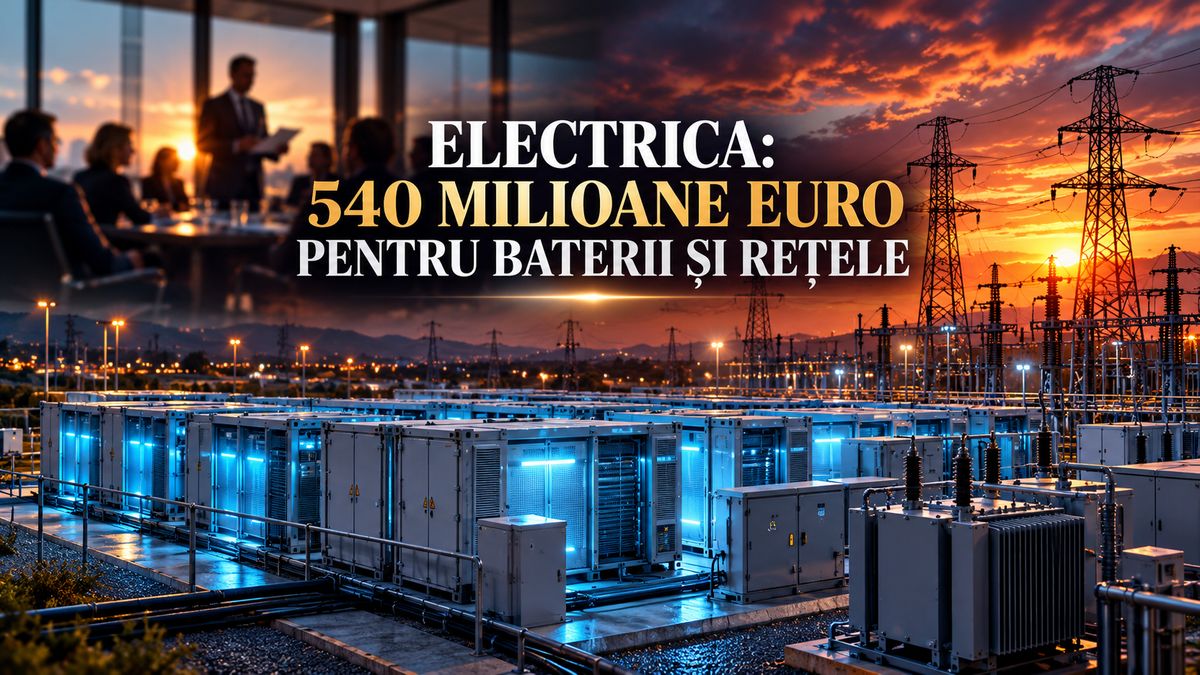
Electrica Group is seeking shareholder approval for a combined investment and financing package worth €540 million, split between developing a massive battery energy storage system (BESS) capacity and securing long-term European financing for distribution grid modernization. According to the convening notice published on October 20, 2026 for the General Shareholders' Meeting scheduled for December, the Bucharest Stock Exchange-listed company is requesting the green light for an investment of up to €185 million (excluding VAT) in a battery portfolio with a cumulative capacity of 800 MWh. In parallel, group management is seeking authorization to secure loans of up to €355 million from the European Investment Bank (EIB), designated for its grid investment plan covering the 2027–2030 period. The move marks one of the largest energy storage initiatives launched to date by a listed Romanian energy company, coming at a moment of extreme tension in the wholesale electricity market. Earlier this week, prices on the Day-Ahead Market operated by OPCOM breached the 2,500 RON/MWh threshold during evening peak hours due to a lack of flexible dispatchable generation after sunset and a high reliance on expensive imports. By simultaneously deploying capital for battery storage and distribution infrastructure, Electrica directly targets the two structural vulnerabilities currently undermining supply security and energy costs in Romania. The stakes of 800 MWh in storage within a market facing peak prices above 2,500 RON/MWh The battery storage project proposed for shareholder approval targets a cumulative capacity of 800 MWh, with an investment cap set at €185 million (excluding VAT). At this ratio between total capital expenditure and targeted energy capacity, the specific capital cost stands at approximately €231,000 per installed MWh. This figure covers electrochemical modules, power inverters, balance-of-plant system integration, transformers, and grid interconnections. The sheer scale of the portfolio positions Electrica as a frontrunner in the flexibility market, providing Romania's power system with urgently needed capacity to absorb surplus midday solar power and dispatch it during peak evening hours. Recent market dynamics in Romania show that the rapid buildout of utility-scale solar farms and prosumer capacity—unaccompanied by equivalent energy storage—creates severe daily market imbalances. During sunny midday hours, the influx of renewable power drives OPCOM spot prices down to near-zero or negative levels. Conversely, as solar output drops at dusk while residential demand ramps up, the system relies on high-cost thermal power plants and heavy power imports. This dynamic pushed hourly evening spot prices past 2,500 RON/MWh in October, driving up balancing market costs while creating a clear economic opportunity for battery storage operators. A cumulative storage capacity of 800 MWh enables—depending on the system's technical power configuration—the dispatch of 200 MW to 400 MW of power for two to four hours into the grid, covering the critical 18:00 to 22:00 window. From a commercial perspective, such a portfolio enables Electrica to perform price arbitrage by storing cheap midday power and selling high during peak evening hours. Crucially, it also hedges its supply portfolio against extreme balancing market volatility. For an integrated utility operating large retail supply operations across millions of customers alongside a growing renewable generation portfolio, storage serves as the key structural mechanism to convert price volatility into operational margin. Aligning with national storage targets and system balancing impact On a macroeconomic and grid scale, Electrica's initiative makes a major contribution toward the target set by Romanian authorities to strengthen National Power System resilience. The Romanian Government and the Ministry of Energy established a strategic target of at least 1,500 MW of installed grid storage capacity to offset renewable intermittency and preserve frequency stability without relying on emergency power imports. Under a standard utility-scale lithium-ion battery architecture with a two-hour duration, 800 MWh equates to approximately 400 MW of power output, covering over a quarter of the country's national storage target. The technical impact of these installations extends beyond simple energy time-shifting. Modern battery energy storage systems offer millisecond response times, enabling them to provide ancillary services to transmission system operator Transelectrica, ranging from primary and secondary frequency control to voltage support at key grid nodes. As additional wind and solar capacity comes online and legacy thermal units with high mechanical inertia undergo maintenance or decommissioning, large-scale battery storage becomes vital infrastructure to prevent cascading outages and lower total balancing costs across the market. €355 million in EIB loans for DEER grid…
Ioana Buzoaica — Independent Editorial Board
The NRG-IA newsroom continuously monitors Romanian energy markets, ANRE regulatory decisions, and national grid telemetry (SEN/SNT). We deliver independent intelligence anchored exclusively in official primary data.
Editorial Charter, Ethics & Verification Methodology →