Salinity gradient power: Nanotube membranes run electronics — NRG-IA
Tehnologie & Inovație Author: Ioana BuzoaicaA nanoscale membrane converts salinity gradients into electricity without turbines. Rapid ion transport could unlock blue energy and lithium recovery.
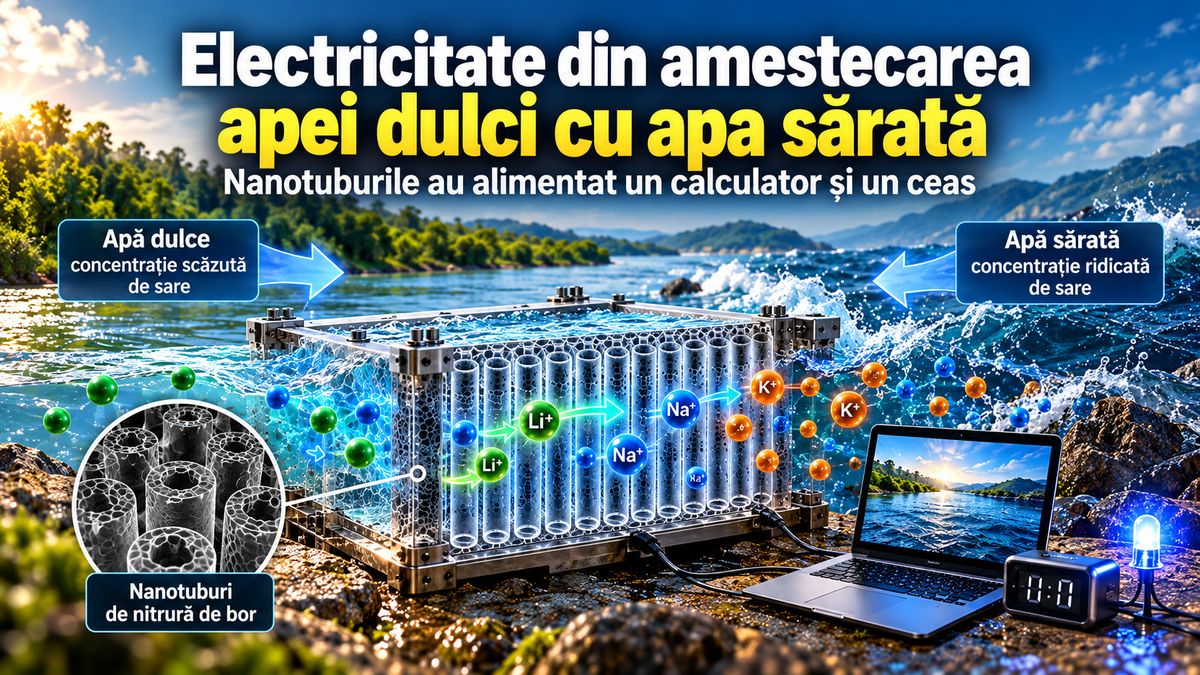
Every time a river flows into the sea, waters with drastically different salt concentrations mix spontaneously, dissipating their chemical potential difference into the surrounding environment. For decades, researchers have sought to harness this mixing energy to generate electricity. A new generation of membranes built from boron nitride nanotubes shows that the process can be pushed down to the scale of just a few nanometers, where ions behave radically differently than in bulk water. In a study published in Nature Nanotechnology , teams from Rutgers University, the University of Illinois Chicago, and Argonne National Laboratory fabricated macroscopic membranes embedded with millions of vertically aligned nanotubes. Eight membranes measuring just 1 cm² each , connected in series and exposed to a controlled salinity gradient, generated enough electricity to power a calculator, a digital watch, and LEDs . The breakthrough matters not for the absolute amount of electricity generated—which remains modest—but for the underlying mechanism it demonstrates. The nanotubes transported positive ions at speeds up to 31 times faster than predicted by conventional diffusion , with lithium moving preferentially compared to other alkali ions. The very same membrane that converts salinity differences into power could, in principle, also serve as a tool for selective lithium recovery. Together, rivers and seas form an untapped energy resource Salinity gradient energy—often termed "blue energy" or osmotic energy—does not stem from kinetic water flow like hydropower. Instead, its source is the concentration difference between two solutions. Fresh water and salt water exist in distinct chemical potential states, and their mixing reduces the free energy of the system. If the two fluids mix freely, this energy is dissipated as heat. However, if ions are forced to pass selectively through a membrane, part of the chemical potential difference can be converted into an electric potential difference and ultimately into current. To conceptualize this simply, imagine a self-recharging natural battery. The river continuously supplies low-salinity water, the ocean provides salt water, and the membrane attempts to convert the delta between them into electricity before spontaneous mixing neutralizes it. Unlike solar and wind power, this resource does not depend directly on sunlight or weather conditions. However, output from a real-world plant would vary with river flow, temperature, and salinity levels, meaning generation would not be entirely constant. Millions of nanotubes act as ionic channels The experimental membranes employ vertically aligned boron nitride nanotubes with diameters ranging between approximately 3 and 12 nanometers . Researchers fabricated architectures featuring densities of up to roughly 10 million nanopores per square centimeter . At these dimensions, the channel wall ceases to be a passive boundary. Upon contact with the solution, the surface of the nanotube acquires an electrical charge that directly dictates which ions can pass through and how fast they move. When one side of the membrane contacts a concentrated solution and the other a dilute one, ions seek to equalize concentrations. The nanotubes selectively favor cation transport (positively charged ions). This selective flux separates electrical charges, generating a voltage. The physics becomes particularly intriguing because ions do not move solely through standard diffusion. The concentration gradient also induces fluid movement along the nanotube surface—a phenomenon known as diffusa-osmotic transport. This additional mechanism massively accelerates ion motion through the nanoscale channels. Ions moved up to 31 times faster than predicted by classical diffusion In the tested nanotubes, cation transport exceeded conventional Fickian diffusion predictions by up to 31-fold . This constitutes the primary physical discovery of the study and the core reason the membrane holds compelling energy potential. Even more surprising was the behavior of lithium. In bulk water, the mobilities of Li⁺, Na⁺, and K⁺ follow a well-established hierarchy. Inside the boron nitride nanotubes, researchers observed a trend reversal: Li⁺ transport was preferentially enhanced, reaching a rate roughly four times higher than that of K⁺ in the team's aggregated results. Simulations indicate that this disparity stems from specific interactions between lithium ions, water molecules, and the charged surface of the nanotubes. At a scale of just a few nanometers, the chemical properties of the wall govern the behavior of the entire ionic flux. For energy generation, this translates into higher current density across a tiny surface area. For the critical minerals industry, the same property opens another frontier: separating lithium from natural brines or battery recycling streams, where it must be extracted from mixtures containing far greater concentrations of competing ions. Eight…
Ioana Buzoaica — Independent Editorial Board
The NRG-IA newsroom continuously monitors Romanian energy markets, ANRE regulatory decisions, and national grid telemetry (SEN/SNT). We deliver independent intelligence anchored exclusively in official primary data.
Editorial Charter, Ethics & Verification Methodology →