Electricity from Evaporation: 14.3 W/m² at 21.5% Efficiency — NRG-IA
Tehnologie & Inovație Author: Ioana BuzoaicaA new hydrovoltaic microgenerator uses water evaporation to convert ambient heat into electricity, reaching 14.3 W/m² at 21.5% conversion efficiency.
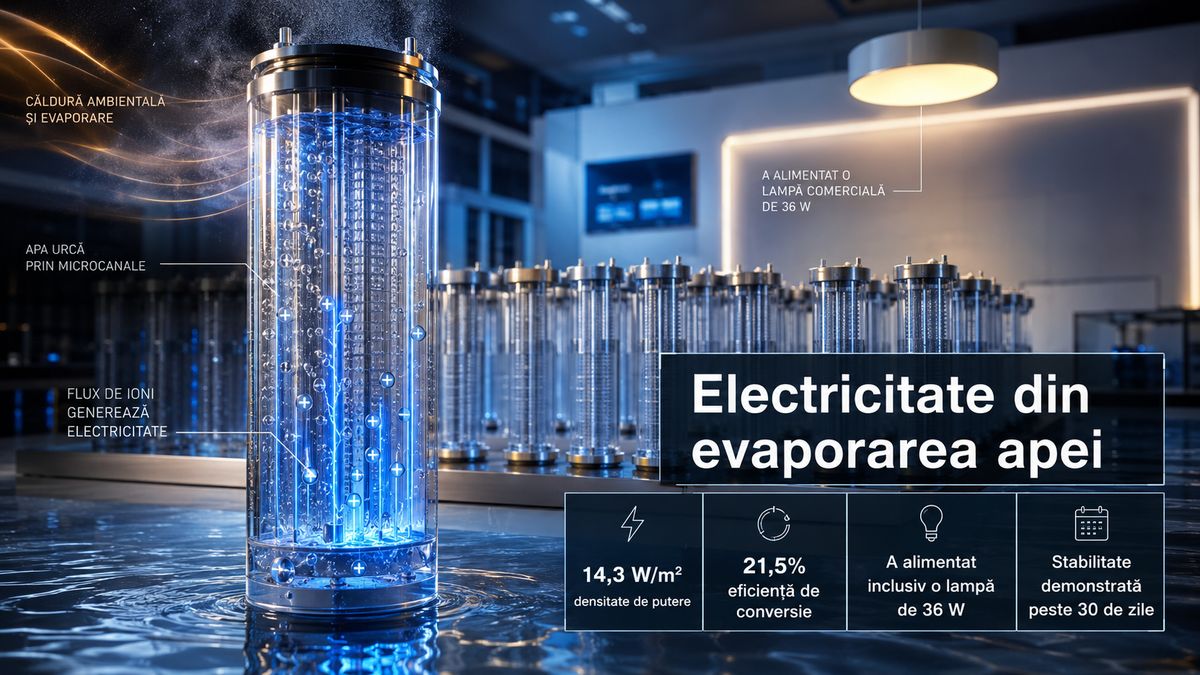
Water evaporates, the surface cools, heat from the air flows toward it, and the ions set in motion generate electricity. Based on this mechanism, a team led by researchers from Soochow University has built a microgenerator that achieved a power density of 14.3 W/m² and a 21.5% conversion efficiency of the atmospheric heat flux absorbed by the device . The results were published on July 27, 2026, in Nature Energy . The generator operated stably for more than 30 days under ambient conditions , and its efficiency remained above 20% over an ambient temperature range of approximately 30 K. Furthermore, the researchers connected thousands of microgenerators into arrays that powered commercial equipment, including emergency lighting systems and a ceiling lamp with a nominal power of 36 W . The technology belongs to a field known as evaporation-induced electricity generation or hydrovoltaic energy. The breakthrough achieved by the new device does not stem from discovering the phenomenon, which has been known for years, but from the ability to much better control the movement of water and ions. The researchers' solution is a microscopic vertical structure in which the flow is directed, rather than moving slowly and randomly through a porous material. The result shifts an energy harvesting method previously associated with very low power outputs toward demonstrations where thousands of devices can be connected to power real-world appliances. Evaporation sets water in motion, and water sets ions in motion The generator does not burn water, nor does it extract chemical energy from the H₂O molecule. The energy source is ambient heat , and evaporation creates the conditions through which it can be converted into electricity. When water evaporates from the device's surface, it consumes energy and cools the material. The surrounding air and environment, which are at a higher temperature, transfer heat to this surface. At the same time, evaporation sustains the movement of water through the microscopic structure. Water transports ions through the material's channels. The interaction between these ions and the electrically charged surfaces produces a streaming potential , meaning a separation of electrical charges that can be extracted as voltage and current. The issue with previous generations was the efficiency with which this process could be organized. In planar or bulk structures, water can follow irregular paths, and ions quickly lose their direction through repeated interactions. Consequently, a significant portion of the absorbed thermal energy ends up being dissipated without contributing to electricity generation. The team at Soochow University changed the geometry of the device. Artificial intelligence helped design the microrod The researchers built a vertical microrod generator , abbreviated as VMG: a vertical microrod through which water moves toward the evaporation zone. To optimize the geometry, the team used a dataset of 585 data points and evaluated eight machine learning algorithms. The model with the best predictive capability identified the width of the structure as one of the decisive parameters, and the optimized configuration in the study reached approximately 550 micrometers . The cylindrical shape and curvature of the microrod create a directional pressure difference associated with surface tension. This Laplace pressure accelerates the movement of the liquid in the desired direction. At an even smaller scale, water passes through pores with reported sizes of approximately 0.67–0.93 nanometers . Confinement at this scale alters ionic transport and reduces the disordered movement of ions. The authors describe the result as quasi-ballistic ionic transport : charges move in a much more directed manner through the device, allowing a larger fraction of the available energy to be extracted. This combination of geometry, capillarity, nanofluidics, and machine learning optimization is at the core of the performance leap. At approximately 20°C, the device delivered 14.3 W/m² In one of the reference conditions close to room temperature, at approximately 20°C , the microgenerator delivered 14.3 W/m² , relative to the projected area of the device. The conversion efficiency was 21.5% , with a very precise reference: the percentage represents the electricity produced relative to the flux of atmospheric thermal energy absorbed by the device , not the water evaporation efficiency, nor an efficiency directly comparable to that of a photovoltaic panel. In the experiment, the absorbed atmospheric heat flux was estimated at approximately 66.45 W/m² , and the delivered electrical power at 14.30 W/m². The ratio between the two yields the value of approximately 21.5%. At higher ambient temperatures, the power density increased. In the warmest experimental condition, around 41.5°C , the device reached approximately 26.3 W/m² , with a conversion efficiency of about 20.5% . The results show an interesting property for…
Ioana Buzoaica — Independent Editorial Board
The NRG-IA newsroom continuously monitors Romanian energy markets, ANRE regulatory decisions, and national grid telemetry (SEN/SNT). We deliver independent intelligence anchored exclusively in official primary data.
Editorial Charter, Ethics & Verification Methodology →