Electricity from Evaporation: 14.3 W/m² Generator — NRG-IA
Tehnologie & Inovație Author: Ioana BuzoiacaResearchers have turned water evaporation into a power source, using ambient heat to drive ions through microstructures and generate electricity.
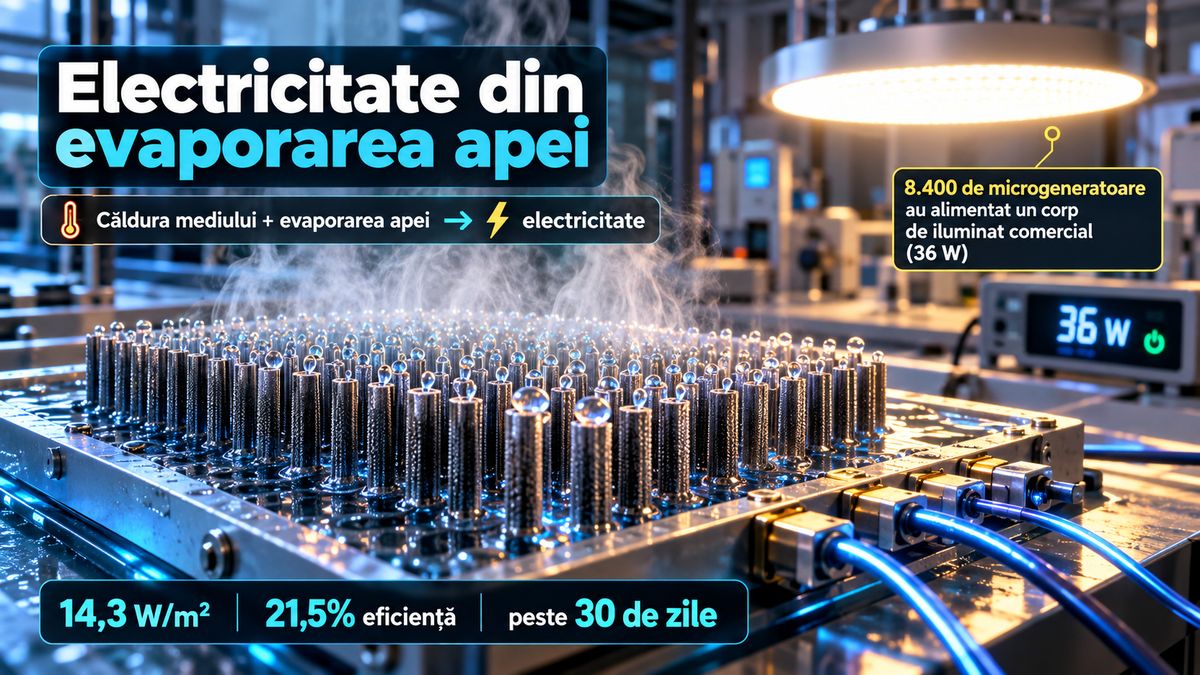
Water constantly evaporates from oceans, lakes, soil, and wet surfaces, utilizing the heat available in the surrounding environment. A research team from Soochow University has demonstrated that a portion of this energy can be directly converted into electricity using vertical microgenerators small enough that thousands of units can be connected into a single network. The device, presented in Nature Energy , achieved a power density of 14.3 W/m² , a maximum conversion efficiency of 21.5% under the defined experimental conditions, and operated stably for more than 30 days under ambient conditions. The most visible demonstration went beyond a voltmeter connected to a laboratory sample. The researchers interconnected 8,400 microgenerators and used the assembly to power a commercial light fixture rated at 36 W . Other configurations were used for emergency lighting, a smoke detector, and electronic devices. The result shifts hydrovoltaic technology from experimental microcurrents to a much more market-relevant proposition: if these elements can be cheaply mass-produced, evaporation could become an autonomous source of electricity for sensors, monitoring equipment, and other devices that currently rely on batteries. Energy Comes from Ambient Heat, Not the Consumed Water The phrase "electricity from water" is incomplete. Water is merely the medium through which energy is transferred. The actual energy source is the low-temperature heat absorbed from the surrounding environment during evaporation . The process can be traced in a simple chain: the environment provides heat, water evaporates, liquid and ions are set in motion through the microscopic structure, and this movement separates electrical charges, producing a potential difference. In other words: ambient heat → evaporation → ionic transport → electricity. This mechanism is fundamentally different from photovoltaics. A solar panel converts photons coming directly from the Sun into electricity. The hydrovoltaic generator exploits the thermal energy absorbed by water during its phase change. Therefore, the technology can function even without direct exposure to the Sun, as long as the environment allows evaporation. The 0.55 mm Microrod Organizes Water and Ions The leap in performance comes primarily from geometry. Evaporation-based generators have existed for several years, but in many porous structures, water and ions move slowly and in multiple directions. A significant portion of the available energy is lost before the movement can be efficiently converted into electricity. The new architecture uses what the researchers call a vertical microrod generator , or VMG: a vertical microscopic rod through which water is transported in a well-defined direction. The team analyzed 585 data points and compared eight machine learning algorithms to determine which parameters most influence performance. The analysis identified the cross-sectional dimension of the device as the dominant factor and guided the design toward approximately 550 micrometers , or just 0.55 mm . Machine learning does not generate energy, nor does it change the laws of physics. Its role was to help researchers identify the geometric configuration in which the hydrovoltaic mechanism operates most efficiently. The Microscopic Shape Functions as a Motorless Pump The cylindrical geometry creates a pressure difference associated with the curvature of the water surface, known as Laplace pressure . This difference helps push the liquid along the microrod. Instead of a slow, disordered movement through a bulk material, water is forced into a faster, better-oriented flow. The second advantage appears at the nanoscale. The structure contains channels with dimensions of approximately 0.67–0.93 nanometers . Their electrically charged walls influence ion movement, making transport much more selective and directional. The authors describe the resulting regime as quasi-ballistic ionic transport : ions do not cross the material without interactions, but they experience less scattering than in conventional diffusive transport. This combination of oriented flow at the microscopic scale and ion confinement at the nanoscale enables a much higher electrical potential than in previous generations of devices. 14.3 W/m² Changes the Scale of the Technology The maximum reported power density, 14.3 W/m² , is one of the study's most significant figures. A previous paper by the same team, published in 2023, reached approximately 0.53 W/m² using a generator based on reduced graphene oxide and carbon nanotubes. The new architecture thus represents a multi-fold leap compared to that generation. However, the figure of 14.3 W/m² does not mean that every square meter of land covered with such generators will constantly produce 14.3 W. Actual performance depends on air temperature, humidity, air circulation, water availability, assembly geometry, and how vapor is removed. In a large system, neighboring devices can even influence…
Ioana Buzoiaca — Independent Editorial Board
The NRG-IA newsroom continuously monitors Romanian energy markets, ANRE regulatory decisions, and national grid telemetry (SEN/SNT). We deliver independent intelligence anchored exclusively in official primary data.
Editorial Charter, Ethics & Verification Methodology →