Laser Power Beaming: 800W Sent 8.6 km, 1kW to Drone — NRG-IA
Tehnologie & Inovație Author: Ioana BuzoaicaLaser power beaming has moved from labs to the field: 800W delivered over 8.6km, and a flying drone powered in 2026. A game-changer where cables fail.
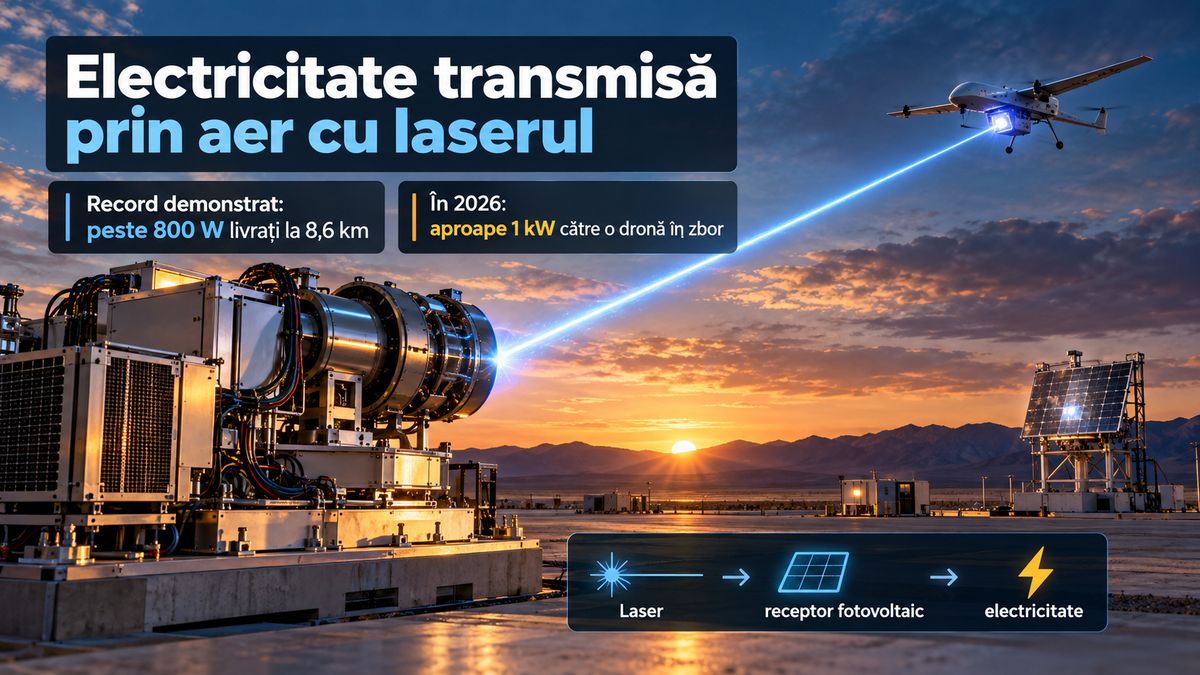
Over 800 W of electrical power was obtained at a receiver located 8.6 kilometers from the source , after the energy traversed the distance as a laser beam. The test, conducted under DARPA's POWER program, lasted 30 seconds and set a benchmark for long-range optical power beaming. Throughout the full experimental campaign, the system transferred over 1 MJ of energy. A year later, the technology took an even more significant step toward practical applications: the receiver was no longer stationary. In April 2026, PowerLight Technologies and Kraus Hamdani Aerospace demonstrated laser-powering of a K1000ULE unmanned aerial vehicle (UAV) in flight, delivering close to 1 kW of power at altitudes of up to approximately 1,500 meters . In less than a year, the question shifted from "can energy traverse kilometers through the air?" to "can the beam track and power a moving consumer?". The demonstrated answer is yes. Electricity is converted into light and then back into electricity Optical power beaming does not send free electrical current through the atmosphere. The energy chain is more complex. Electricity first powers a laser. Electrical energy is converted into light, the beam is focused and directed toward the receiver, and at the destination, a specialized photovoltaic system converts the light back into electricity. The receiver used by DARPA in the PRAD demonstration operated in a manner conceptually close to a solar panel built for a single, highly precise light source. The beam entered the receiver and was redistributed by a parabolic mirror to multiple photovoltaic cells, which generated electricity. The difference from a solar panel is fundamental. The sun illuminates a surface with a broad spectrum from a source roughly 150 million kilometers away. A laser can deliver a concentrated, directed beam with controlled optical properties, and the receiver can be optimized for it. The result is, essentially, a power link without a physical conductor: electricity → laser → atmosphere → photovoltaic receiver → electricity. The 8.6 kilometers change the scale of the problem Wireless power transmission is not new. Inductive charging for phones and electric vehicles already works at very short distances, while microwaves and lasers have been researched for decades for longer ranges. However, the DARPA demonstration showed that power relevant to real-world equipment can be transported optically over kilometers. At 8.6 km , the receiver obtained over 800 W for 30 seconds. This power is sufficient for numerous electronic systems, sensors, communications, and other moderate-sized equipment. DARPA also reported an efficiency of over 20% between the emitted optical power and the electricity obtained at the receiver in tests conducted at shorter distances. This value does not represent the full efficiency of the electricity-to-electricity chain and was not published as the efficiency of the 8.6 km test. The initial conversion of electricity into light, optical losses, atmospheric interference, and reconversion at the destination each consume a portion of the energy. Full efficiency remains one of the factors that will decide the markets in which the technology can compete economically. The drone receiving power in flight changes the application A stationary receiver demonstrates transmission. A mobile receiver opens up an entirely different market. In the 2026 demonstration, the PowerLight system tracked a K1000ULE unmanned aircraft in flight, kept the beam locked on the receiver, and transmitted power to it. The companies involved reported power levels close to 1 kW and operation at altitudes of up to 5,000 ft (approximately 1,500 m). For a drone, the potential advantage is immediate. The range of an electric aircraft is largely limited by its battery. If a larger battery is installed, the aircraft gets more energy but also becomes heavier. The extra weight, in turn, requires more energy to fly. Beaming power from the outside changes this equation. Part of the energy required for the mission can remain on the ground and be transmitted to the vehicle when it is within coverage range. The aircraft could thus use its battery more as a backup and energy buffer rather than as the sole source for the entire mission. Surveillance and communication drones can stay airborne longer The first plausible markets are those where airborne time is highly valuable. A drone used for wildfire surveillance, pipeline and power line inspections, border monitoring, temporary communications, or disaster area observation must currently land periodically to swap or recharge its battery. If power can be beamed from the ground during flight, this downtime can be reduced. For communications, the implication is particularly interesting. An aircraft operating as a radio relay may need hundreds of watts or on the order of a kilowatt for propulsion and equipment. External power could allow it to be kept over an area for longer periods without building…