Elon Musk: Electricity & Economic Power. China vs US — NRG-IA
Piața de Energie Author: Ioana BuzoaicaElon Musk highlights a core economic reality: developed nations need vast electricity to sustain industry, tech, and growth as China outpaces the US.
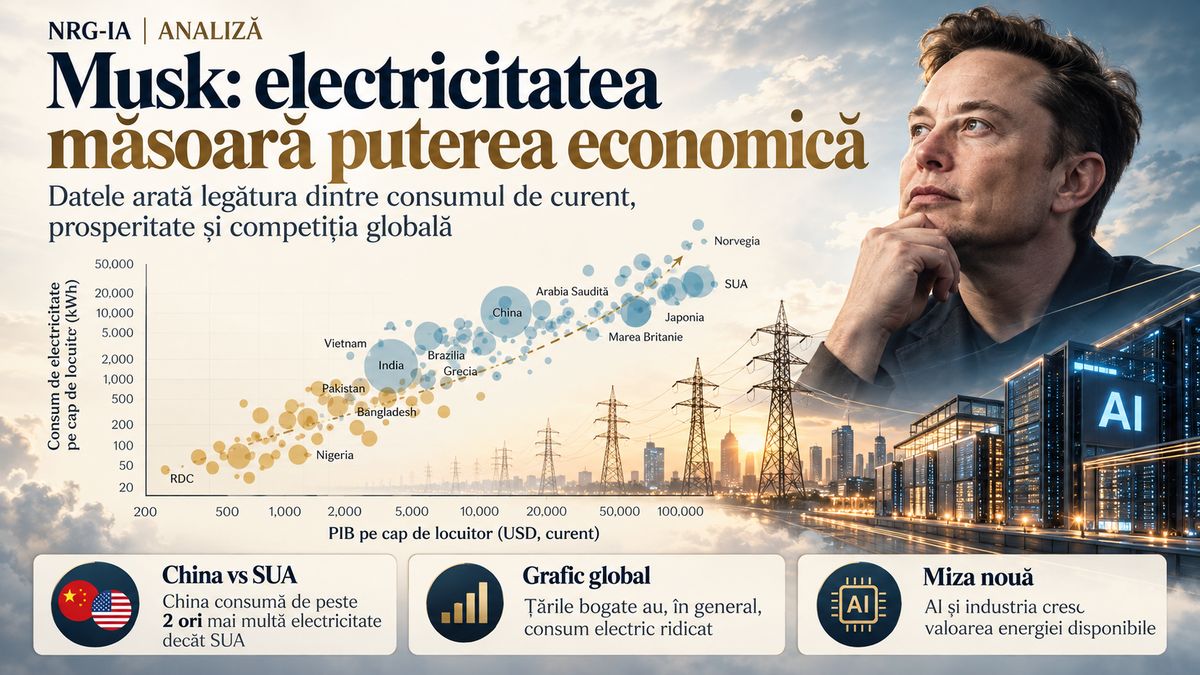
Electricity generation may reveal more about the true strength of a major economy than traditional financial indicators suggest. This is the argument put forward by Elon Musk, who considers a country's power generation capacity a fundamental benchmark of its economic strength. The statement resurfaces a relationship demonstrated by international data: prosperous economies consume substantial amounts of electricity, and the growth of industry, infrastructure, and emerging technologies depends on its availability. In a statement attributed to Musk and shared on October 10, 2026, the formulation is explicit: "Electricity production is, in my opinion, the best single indicator of the real strength of any large economy." The idea is further supported by his previous remarks, including a February 2026 interview where he described electricity generation as a proxy for economic and industrial capacity. The assertion comes at a time when competition between the United States and China is extending beyond technology and trade into the physical infrastructure required for industrial output and artificial intelligence development. In 2025, China consumed 10,573 TWh of electricity—roughly 2.33 times more than the United States, whose consumption stood at 4,536 TWh, according to Ember's Global Electricity Review 2026 report. This gap reflects the scale of Chinese industrial output, the extent of electrification, and the country's capacity to power a massive productive apparatus. At the same time, per capita electricity consumption remains considerably higher in the United States, demonstrating that the total scale of a power system and individual prosperity levels are distinct metrics. Beyond the comparison between the two major economies, data analysis and economic research illustrate why electricity is becoming a central pillar of competitiveness: its availability dictates manufacturing capacity, industrial costs, infrastructure operations, and the feasible development of energy-intensive technologies. The Chart Illustrating the Link Between Electricity and Prosperity One of the key arguments cited in the debate is a chart comparing annual per capita electricity consumption against per capita gross domestic product across numerous countries worldwide. The chart was published in March 2023 by the US-based organization Energy for Growth Hub, in an analysis authored by Todd Moss and Jacob Kincer titled How Does Energy Impact Economic Growth? An Overview of the Evidence. The visualization utilizes 2021 data from the U.S. Energy Information Administration and the World Bank. The visual conclusion is compelling: high-income nations cluster in the high per capita electricity consumption bracket, whereas low-income economies generally exhibit low power consumption. Prosperous countries with extremely low electricity consumption are virtually absent from the distribution. The statistical relationship is defined by a coefficient of determination, R², of approximately 0.8, indicating a very strong correlation between the variables in the model used. The coefficient indicates how effectively the model captures statistical variation in power consumption relative to income levels, based on the transformations and data in the chart. It does not denote the percentage of GDP generated by electricity, nor does it imply a rule that every increase in power consumption automatically drives a proportional economic expansion. The significance of the result lies in the intensity of the relationship between the two phenomena. Modern prosperity is fundamentally linked to the widespread adoption of electricity across manufacturing, services, transport, communications, and households. Electricity powers machinery, automated processes, IT systems, HVAC installations, digital infrastructure, and an expanding share of transportation. As economies grow, reliance on these technologies increases, making electricity demand an integral component of expanding economic activity. However, the relationship operates in both directions. A wealthier economy can afford to consume more energy, while access to reliable and competitively priced electricity enables higher-value, revenue-generating activities. It is precisely this interdependence that makes electricity such a vital economic indicator. Economic Research Confirms Electricity's Impact on Productivity The link between electricity and economic growth is backed by research that goes beyond cross-country statistical comparisons. A 2016 study published in the American Economic Review by economists Hunt Allcott, Allan Collard-Wexler, and Stephen D. O'Connell analyzed the impact of electricity shortages on industrial plants in India. The authors used variations in hydropower availability to isolate the effects of power outages on manufacturing performance. The findings show that at average levels of electricity deficits observed in the study, industrial producers suffered revenue and surplus losses of roughly…
Ioana Buzoaica — Independent Editorial Board
The NRG-IA newsroom continuously monitors Romanian energy markets, ANRE regulatory decisions, and national grid telemetry (SEN/SNT). We deliver independent intelligence anchored exclusively in official primary data.
Editorial Charter, Ethics & Verification Methodology →