Energy Tech: Zero-Cost Offers and AI Grid Impact — NRG-IA
Tehnologie & Inovație Author: Ioana BuzoaicaThe energy market splits between zero-cost midday offers and 24% price hikes. How AI and smart meters change your monthly bill.
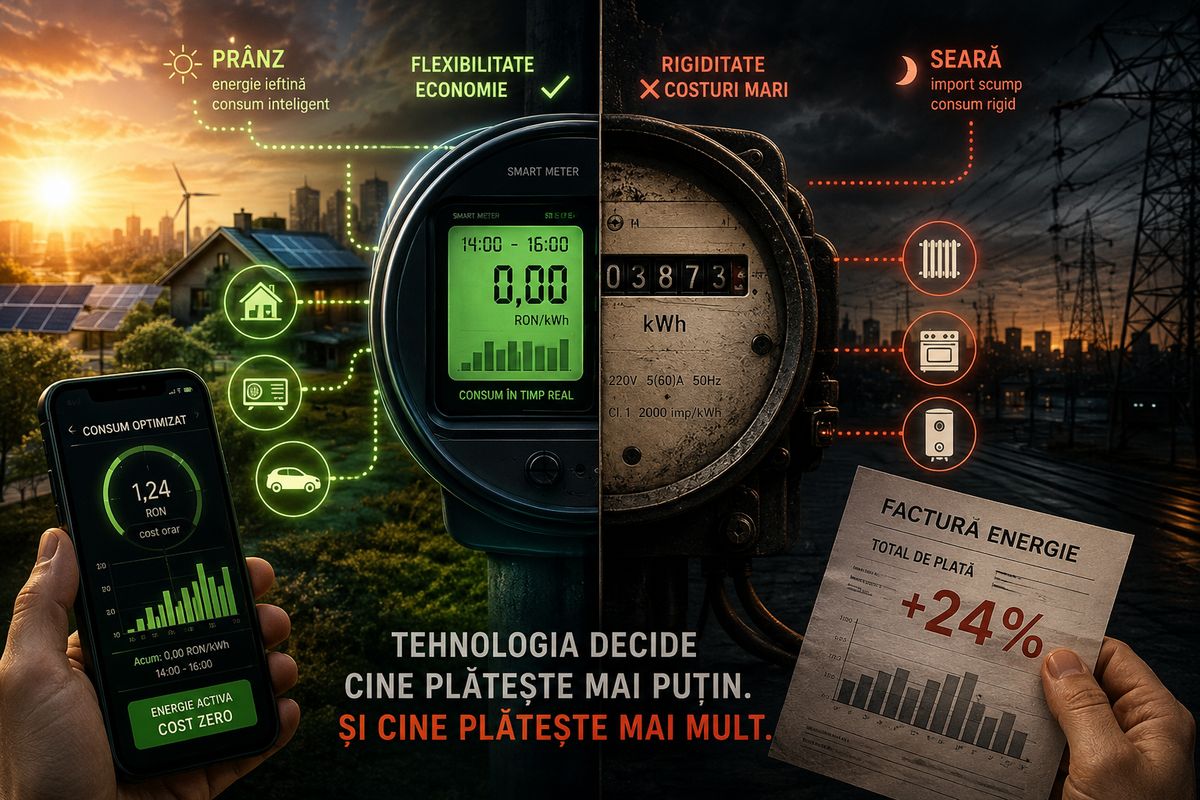
Current Situation The bills of tomorrow will no longer be dictated by the gas exchange, but by the servers training artificial intelligence and supplier algorithms. We are witnessing an unprecedented fragmentation of the Romanian energy market. On one hand, digitalized consumers get access to revolutionary offers. On the other hand, the national grid buckles under the weight of poor technological planning. In the retail sector, innovation has reached a historic threshold. According to Energy-Center, PPC Energie has launched a pilot project where clients receive electricity at zero cost during specific time intervals. This technological move capitalizes on photovoltaic production peaks. However, at a macro level, the infrastructure cannot sustain this pace. Data published by Digi24 shows that Romania massively imports energy at the highest price in Europe. For example, at 8:00 AM, consumption hits 5,200 MWh. Due to a lack of smart storage, our country ends up exporting cheap power and reimporting it 7 times more expensive in the evening. Meanwhile, the industrial sector is radically transforming. "Artificial intelligence no longer evolves at the speed of code, but at the speed of electrons, copper, and steel." According to Economica.net, the race for AI has definitively moved into the energy sector. Data centers require massive computing power, turning power grids into the main global technological bottleneck. Analysis These figures indicate a brutal transition from a centralized energy system to a hyper-technologized, yet asymmetrical one. Technology integration in energy creates a two-speed market. Consumers with smart meters can access dynamic tariffs and shift consumption to midday. Those without technology access remain captive to a rigid system. The paradox is amplified by institutional bottlenecks. Although technology allows huge flexibility, the legislative framework hinders innovation. The draft ordinance targeting "smart guys" in energy, who hoard grid capacities, has been halted. According to Digi24, the fall of the Bolojan Government prevented the act's publication in the Official Gazette. This legislative void keeps the grid blocked with paper projects. Thus, new wind and solar parks, equipped with modern storage technologies, cannot connect. Without these new capacities, the grid cannot support the exponential demand generated by artificial intelligence expansion. Interim Minister Ilie Bolojan is trying to force modernization. According to Economica.net, he is accelerating payments for European energy projects. The salary changes in the ministry aim precisely at attracting specialists capable of managing PNRR funds for grid digitalization. Market and Consumer Implications Technology adoption clearly divides the market into winners and losers. The main winners are active prosumers. The Constitutional Court just validated the prosumer law, confirming that surplus energy is no longer lost. This legal victory turns solar panels from an ecological investment into a predictable financial tool. Also, consumers who adopt offers with free intervals will see substantial reductions. Shifting the consumption of large appliances to peak solar hours becomes a major financial decision. Technology allows them to bypass wholesale market volatility. In the losing camp are passive consumers and traditional industry. The World Bank estimates that energy prices could rise by 24% this year. This price hike, fueled by global geopolitical tensions, will directly hit the bills of those who cannot flex their consumption. Moreover, the 7 times more expensive imports during evening hours are socialized across everyone's bills. Without national-level battery storage and AI management of the transmission grid, the cost of inefficiency is borne by the final client. Scenarios and Perspectives In an optimistic scenario, forced digitalization yields quick results. PNRR funds unlocked by the ministry finance the massive installation of smart meters. Suppliers expand zero-cost midday offers, and the grid naturally balances through consumer behavior. Romania becomes an attractive hub for AI data centers due to cheap daytime green energy. The pessimistic scenario is marked by political and technical paralysis. Blocking the anti-speculation ordinance keeps the grid closed to new technologies. The 8:00 AM consumption hits new records, and expensive imports become the daily rule. In this context, the World Bank's estimate materializes, and household consumers bear the shock of a 24% bill increase this winter. The decision no longer lies solely in politicians' pens, but in the speed of technology adoption. Consumers must actively demand the digitalization of their own consumption points. Without technology integration, the energy bill will only reflect the cost of a system stuck in the past century.
Ioana Buzoaica — Independent Editorial Board
The NRG-IA newsroom continuously monitors Romanian energy markets, ANRE regulatory decisions, and national grid telemetry (SEN/SNT). We deliver independent intelligence anchored exclusively in official primary data.
Editorial Charter, Ethics & Verification Methodology →