What Products Justify Romania's Energy Consumption? — NRG-IA
Piața de Energie Author: Ioana BuzoaicaFirm energy is a strategic resource. Romania must evaluate investments by value created per MWh, from batteries and chips to locally developed AI.
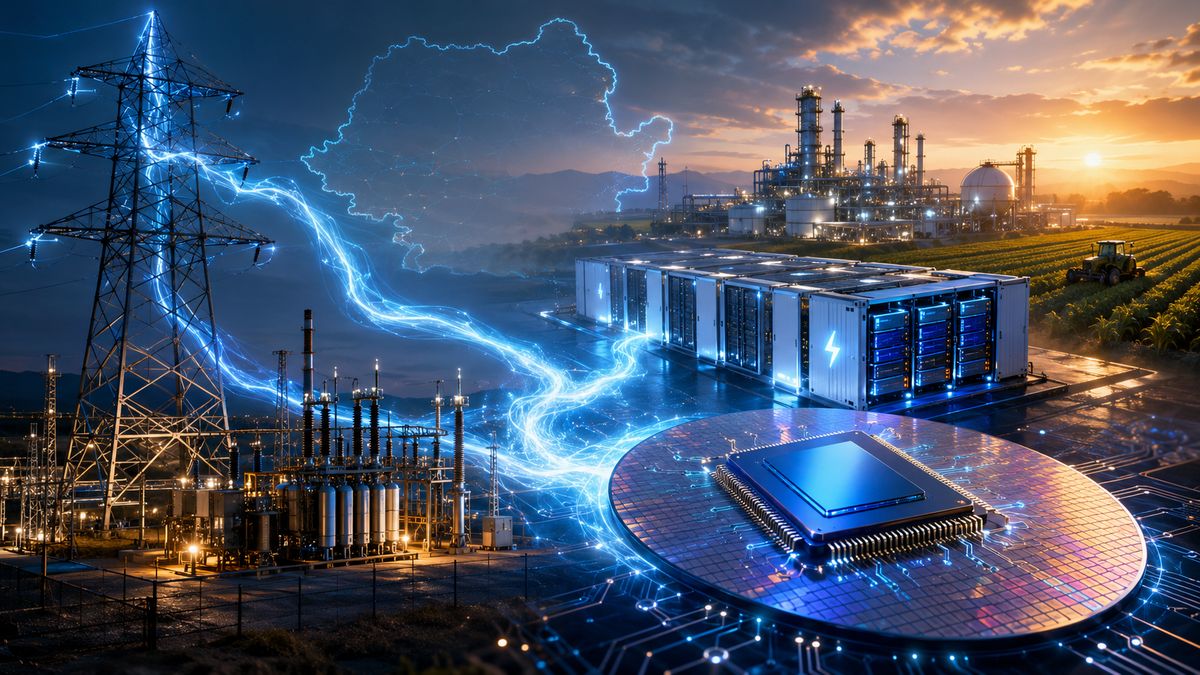
Energy is no longer just a production cost. It is becoming a criterion for industrial selection. In Romania, demand for large grid connections is rising simultaneously from multiple directions: factories, batteries, data centers, hydrogen projects, new electrical consumers, transport electrification, and the expansion of renewable generation. At the same time, grids cannot immediately deliver unlimited power to any area, and extreme price episodes during evening hours show that energy available precisely when the system is strained is worth far more than a MWh produced at noon during a period of solar surplus. The strategic question, therefore, is not who needs the most energy. The question is: what product does the economy obtain from firm energy, grid capacity, and the public or private investment required for connection? A MWh can become primary aluminum, fertilizer, steel, electrical cable, a transformer, a battery, a chip, computing power, or an AI product. All of these consume energy. However, not all retain the same value within the economy. Eurostat measures this relationship through the energy intensity of value added: how much energy is required to create a certain economic value. Across the European Union, service activities generally have a lower energy intensity than the production of goods, but this comparison is insufficient for industrial policy. An economy also needs physical industry, materials, chemicals, and infrastructure, not just digital services. There is no simple ranking of "good" and "bad" products for energy It would be wrong to say that energy should simply be shifted from industry to software or AI. A country cannot build batteries, data centers, power grids, hospitals, or infrastructure without chemicals, steel, aluminum, glass, cables, and processed materials. Energy-intensive industries remain essential for Europe. They account for more than half of European industrial energy consumption and underpin strategic value chains for transport, construction, energy, and industrial equipment. The problem arises when the same grid capacity, the same firm energy, and the same public support are granted without comparing the economic outcome. A factory may consume a lot, create jobs, and play a strategic role, but it may retain little local value if it exports a low-margin commodity. A digital investment can create very high value with a relatively small amount of energy per unit of revenue, but it may leave little in the local economy if the infrastructure, models, data, and customer relationships are controlled from abroad. The correct criterion is not just the value per MWh. It is a broader package: how much value added each MWh produces; how much of this value remains in Romania; what local chain of suppliers, engineers, and services it develops; how much export potential it can generate; which external dependencies it reduces; how flexible the consumption is in relation to the energy system; whether the investment also brings new generation, storage, or grid capacity, rather than just new consumption. Batteries, transformers, and power electronics could be the most realistic energy industry The most promising industrial direction for Romania is not necessarily the giant battery cell factory, where Asian competition is already extremely fierce. It is the broader area of equipment that makes the energy system functional. A storage project is not just cells in a container. It means battery management systems, control software, inverters, converters, transformers, protection systems, energy management systems, communications, maintenance, and market integration. A modern grid is not just poles and cables. It means high-voltage equipment, automation, sensors, digital control, SCADA systems, cybersecurity, generation forecasting, digital twins, and platforms that manage demand flexibility. Here, energy is embedded in a complex physical product with a higher value than the raw material and a technological component that can be exported. Romania already has a high domestic demand for such products, driven by the development of renewables, batteries, interconnections, and distribution grids. This demand can support a regional industry, rather than just equipment imports. The Net-Zero Industry Act explicitly treats batteries, storage, grid technologies, and their components as strategic industries for European competitiveness and resilience. The regulation aims to increase European production of both final products and the components and machinery needed to manufacture clean technologies. For Romania, the realistic goal is not to copy the Chinese industrial model in its entirety. It is to build products and services where competence, market demand, and need already exist: complete BESS systems, battery operating software, power electronics, transformers, digital protections, grid automation, industrial control, and maintenance. Semiconductors concentrate the highest value in a physical…
Ioana Buzoaica — Independent Editorial Board
The NRG-IA newsroom continuously monitors Romanian energy markets, ANRE regulatory decisions, and national grid telemetry (SEN/SNT). We deliver independent intelligence anchored exclusively in official primary data.
Editorial Charter, Ethics & Verification Methodology →