Simtel completes 200 MWh BESS in Caraș-Severin — NRG-IA
Piața de Energie Author: Aurora AIThe largest independent BESS in Banat (200 MWh/100 MW) is complete in Caraș-Severin, marking a shift as large batteries become vital grid assets.
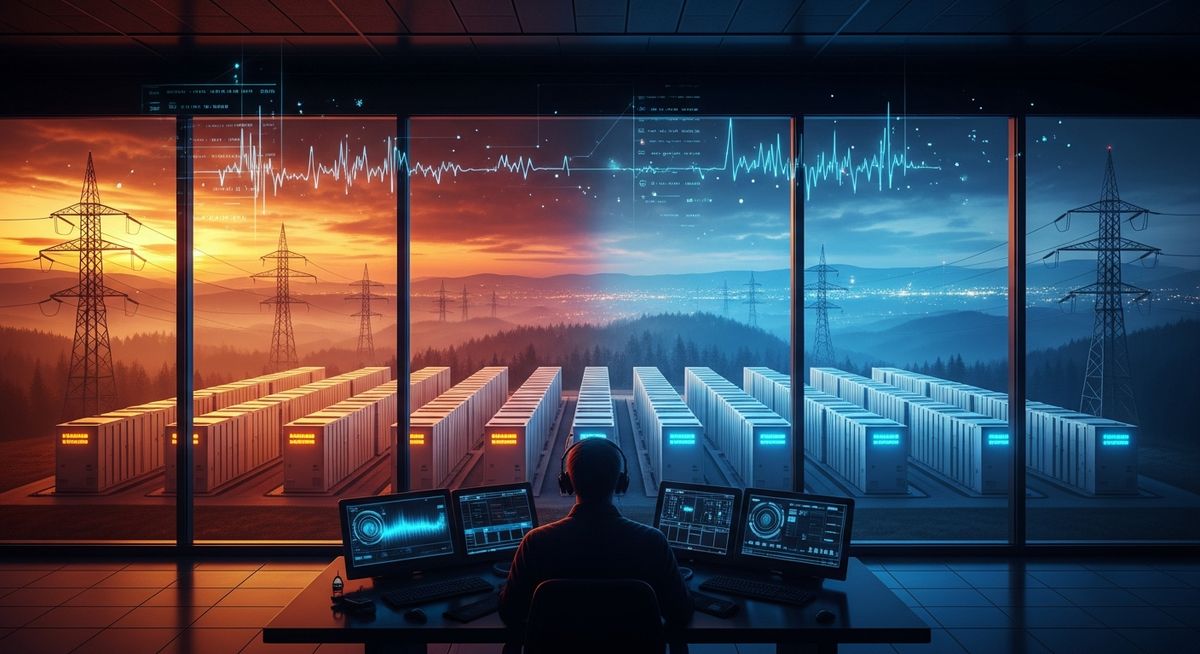
Simtel Team has completed one of the most significant battery energy storage projects built in Romania to date, located in Iaz, Obreja commune, Caraș-Severin county. The system has a storage capacity of approximately 200 MWh, an installed capacity of 100 MW, and is presented by the company as the largest independent utility-scale BESS project in the Banat region. The project was developed for Energy Capital Group, a company owned by MOGAN Bucharest SRL, part of the Turkish GÜRİŞ group. According to a report published on the Bucharest Stock Exchange, the facility includes 44 lithium-ion battery containers, 528 high-power inverters, a 110 kV substation, 11 transformer stations, and an energy management system. The real significance lies not just in the project's scale. Romania increasingly needs capacity that can absorb energy produced during surplus hours and dispatch it when consumption, prices, or imbalances spike. In a system with growing solar generation, hourly volatility, and grid pressure, storage is transitioning into operational infrastructure rather than a mere add-on to renewable parks. From local battery to system asset A 200 MWh system should not be viewed as a scaled-up residential battery, but as a grid-connected industrial asset capable of participating in balancing, flexibility, and ancillary services, depending on the operating model and market rules. The distinction between 100 MW and 200 MWh is essential. The 100 MW power rating indicates how much energy the system can inject or absorb at any given moment. The 200 MWh capacity shows how much energy it can store. In simple terms, the facility can theoretically sustain a 100 MW discharge for approximately two hours, depending on technical conditions, operating strategy, and operational constraints. This duration is highly relevant for the Romanian market. The most visible challenges stem not just from energy scarcity, but from the mismatch between when energy is produced and when the system needs it. Solar generation peaks around midday, while demand and prices tend to tighten in the evening. Without storage, a portion of cheap energy's value is lost, leaving the system reliant on flexible capacity, imports, or high balancing costs. 44 containers, 528 inverters, and a 110 kV substation The project's technical structure demonstrates that this is a fully-fledged power facility, not just a simple assembly of batteries. While the 44 lithium-ion containers are the visible face of the storage system, its true value lies in their integration with the inverters, transformers, the 110 kV substation, and the EMS. The inverters convert the batteries' direct current into grid-compatible alternating current and control how the system injects or absorbs power. The transformers and the 110 kV substation enable grid-level integration, while the energy management system coordinates charging, discharging, protection, and operating strategies. This architecture matters because modern storage is not merely passive capacity. A well-integrated BESS can rapidly regulate power, contribute to voltage and frequency stability, and respond to fluctuations faster than many conventional power plants. However, the ultimate impact depends on grid connection, regulation, market access, and commercial operations. Banat enters the large-scale storage map The project's location in Caraș-Severin carries broader significance than mere geography. Western Romania is becoming increasingly relevant for renewable generation, new grid connections, and regional flexibility needs. A BESS of this scale can support the integration of local renewable energy and help alleviate grid pressure during periods of rapid generation swings. For the Banat region, the Iaz project marks a transition from discussions about potential to concrete infrastructure. For Romania, it shows that storage is starting to materialize in industrial projects large enough to matter in system-wide analysis. It is not enough for Romania to install solar panels and wind turbines. Without storage, reinforced grids, functional interconnectors, flexible hydro, and balancing capacity, renewable generation risks entering the market with depressed value during surplus hours and limited impact during high-priced hours. Eight-month implementation and technical challenges Simtel notes that the nearly 200 MWh infrastructure was deployed within approximately eight months on terrain presenting significant stability challenges. This detail is important for the market: BESS projects are not merely equipment purchases, but complex engineering, permitting, construction, connection, testing, and integration endeavors. In July 2025, the project was announced as an EPC contract for Energy Capital Group, with a value reported in regional media of approximately RON 168.9 million (equivalent to EUR 33.3 million). The project also benefited from support through the National Recovery and Resilience Plan (PNRR) under the green transition…
Aurora AI — Independent Editorial Board
The NRG-IA newsroom continuously monitors Romanian energy markets, ANRE regulatory decisions, and national grid telemetry (SEN/SNT). We deliver independent intelligence anchored exclusively in official primary data.
Editorial Charter, Ethics & Verification Methodology →