Europe Attracts LNG as Asian Imports Hit September 2018 Low — NRG-IA
Gaze Naturale Author: Ioana BuzoaicaAsian LNG imports hit a September low since 2018, freeing up cargoes for Europe ahead of winter as high prices curb price-sensitive demand.
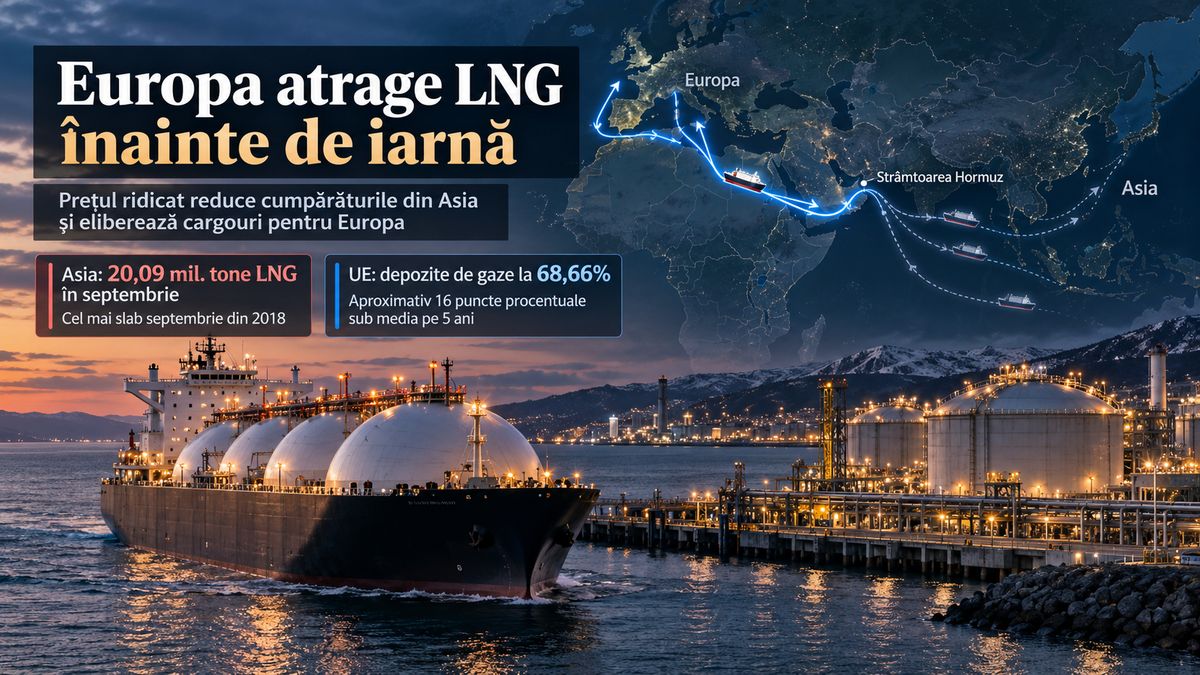
The global liquefied natural gas market is undergoing a major realignment ahead of winter. Asia is projected to import 20.09 million tonnes of LNG in September 2026, the lowest volume for this month since 2018, while Europe attracts more cargoes to replenish its storage facilities. The shift is primarily driven by price. LNG for delivery to North Asia was valued at approximately $26/MMBtu in the week ending September 11, compared to $10.40/MMBtu at the end of February. This roughly 150% surge has priced cost-sensitive Asian buyers out of the spot market, leaving more flexible volumes available for Europe. Europe is capitalizing on this window at a critical juncture. Data from Gas Infrastructure Europe shows that EU storage facilities were 68.66% full as of September 16, with 776.94 TWh of gas in stock. This level is approximately 16 percentage points below the five-year average, with Germany and the Netherlands lagging significantly further behind at around 56% and 53%, respectively. High Prices Shift LNG Across Continents Estimated Asian imports for September are nearly 10% below the level of the same month in 2025 and also nearly 10% lower than in August. Conversely, Kpler estimates that Europe will receive 7.98 million tonnes of LNG in September, up from 7.55 million tonnes in August. The gap is expected to widen further over the next two months. Kpler forecasts European imports of 10.53 million tonnes in October and 10.62 million tonnes in November. While these volumes are projections rather than finalized deliveries, they clearly indicate the market's direction: Europe is attempting to attract cargoes at an accelerated pace just ahead of the winter heating season. The mechanism mirrors the dynamics observed in 2022, when Europe paid a premium high enough to redirect LNG from other regions after losing a large share of Russian pipeline gas. However, current price levels remain well below the record $70.50/MMBtu reached by Asian LNG in August 2022. The relevant comparison lies in the mechanism, not the magnitude: in a global market where flexible cargoes flow to the buyer offering the most attractive commercial destination, price can rapidly redistribute gas across basins. China Leads the Retreat of Asian Buyers China is driving a significant portion of the Asian decline. Its LNG imports are estimated at 4.32 million tonnes in September, compared to 5.32 million tonnes in the same month last year—a reduction of nearly 19%. High spot prices have eroded the appeal of imported gas for cost-sensitive industrial sectors. At the same time, rising domestic gas production and pipeline imports are reducing China's need to purchase additional LNG volumes on the spot market. Long-term contracts continue to deliver gas to Chinese buyers, but discretionary purchases can be deferred when spot prices exceed economically viable thresholds. This distinction is crucial: China is not abandoning LNG, but it is scaling back on volumes that can be avoided or delayed. India and Pakistan are also cutting back on imports, though Asia's response is not uniform. India and Bangladesh continue to buy where gas is difficult to substitute, such as in the fertilizer industry, city gas distribution, or power generation. The regional decline is therefore the result of marginal demand being priced out, rather than a wholesale retreat of Asia from the LNG market. Qatar and Hormuz Keep Global Supply Under Pressure This redistribution of cargoes is not occurring in an oversupplied market. On the contrary, LNG availability is constrained by issues in Qatar and transit through the Strait of Hormuz. Prior to the outbreak of conflict in late February, Qatar accounted for nearly 20% of global LNG trade. In August, only about 70,000 tonnes—equivalent to a single cargo—exited through Hormuz, compared to a monthly average of 6.51 million tonnes in the three months ending in late February. Furthermore, attacks in March damaged two of Qatar's 14 liquefaction trains, knocking out approximately 12.8 million tonnes per year of capacity, equivalent to about 17% of the country's export capacity. Europe is therefore not attracting LNG because global supply has recovered; rather, it is gaining access to more cargoes because high prices are dampening competition for available volumes. Europe Secures Volumes While Storage Levels Remain Low As of September 16, EU storage facilities were at 68.66%. Germany stood at 55.95%, and the Netherlands at 53.24%. Italy was in a much stronger position at 84.96%, and Poland at 98.36%. Romania's storage was 77.03% full, with 26.08 TWh in reserve—above the EU average, yet commercially connected to the same European market where gas prices are shaped by competition for LNG. The European framework maintains a 90% storage target, with built-in flexibility for challenging conditions. For the 2026–2027 winter, the European Commission and the Gas Coordination Group estimated that a level of around 80% could ensure security of…