Europe faces 510,000 bpd jet fuel deficit in Q4 2026 — NRG-IA
Geopolitică & Energie Author: Ioana BuzoaicaEurope enters Q4 with a vulnerable jet fuel market: Energy Aspects projects a 510,000 bpd deficit as long-haul imports offset Middle East disruptions.
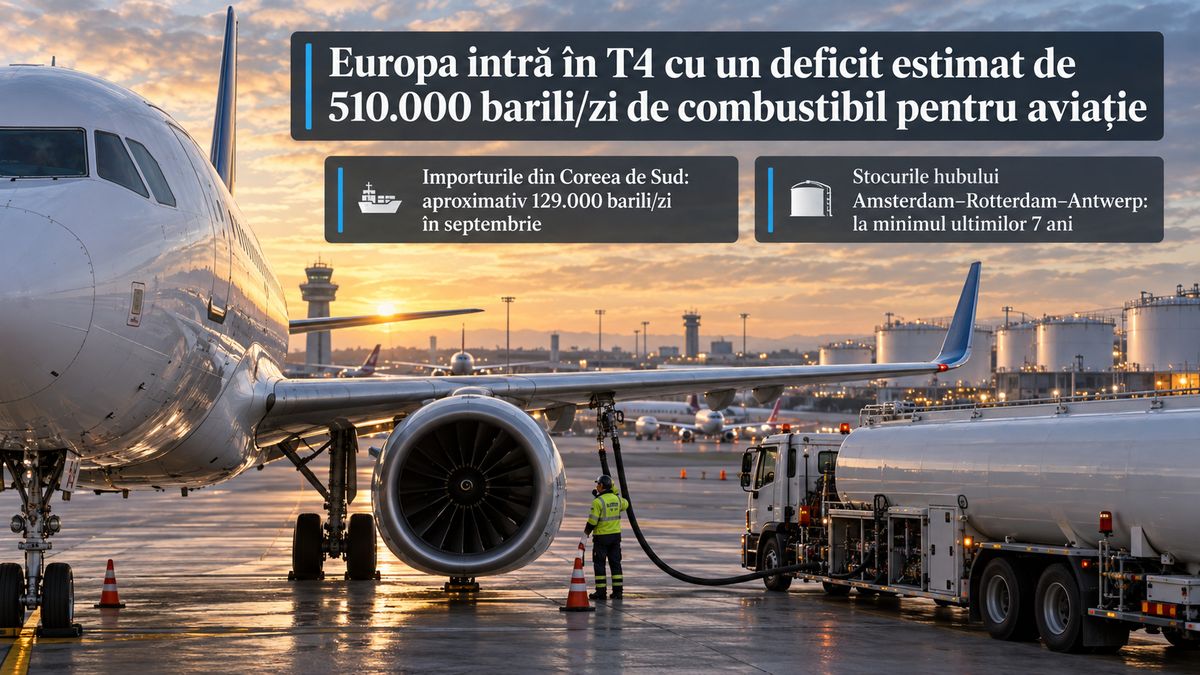
Europe enters the final quarter of the year with an estimated deficit of 510,000 barrels per day of jet fuel , as Middle East disruptions have cut off a significant portion of traditional supply, and inventories in the continent's main oil hub have fallen to a seven-year low. For European aviation, the energy shock from the Gulf is beginning to transmit from the crude market to the fuel required for the daily operation of tens of thousands of flights. The estimate comes from Energy Aspects and is cited by Reuters. For the fourth quarter, the consultancy sees Europe with a 510,000 bpd deficit, while the Asia-Pacific region is expected to have a surplus of 419,000 bpd , and the United States a surplus of 18,000 bpd . This gap highlights how dependent Europe has become on attracting additional volumes from other regions to balance its market. Europe replaces lost Gulf barrels with increasingly long-haul shipments The conflict involving Iran has disrupted Middle East shipments and cut European jet fuel imports from the region by roughly half, according to Reuters. To compensate, Europe has increased purchases from Nigeria, the United States, and Canada, and in September, South Korea emerged as one of the most important swing suppliers. European imports from South Korea reached approximately 129,000 bpd in September, according to Kpler data cited by Reuters, marking the highest level since October 2022. LSEG data indicate similar volumes. The surge in shipments is no coincidence. South Korean jet fuel production reached nearly 13.89 million barrels in July, a seven-year high, while exports climbed to their highest level in three and a half years. South Korean refineries processed approximately 2.7 million barrels of crude oil per day in July, up 16% from June. Asia is thus becoming the balancing supplier for a Europe that must pull fuel from much greater distances. The mechanism is purely economic: when the price spread between the European and Asian markets covers shipping costs and provides a sufficient margin for traders, cargoes are rerouted to Europe. Reuters reports that the spread between European and Asian benchmarks has widened enough to make exports to Europe increasingly attractive. European inventories fall to a seven-year low Supply pressure is amplified by low commercial inventory levels. Independent jet fuel stocks in the Amsterdam–Rotterdam–Antwerp (ARA) hub fell to their lowest level in seven years in the week ending September 10. ARA is one of Europe's primary refining, storage, and trading hubs for petroleum products, and the decline in inventories indicates a thinner safety margin in the event of further supply disruptions. The projected Q4 deficit does not automatically mean European airports will run dry. However, it does mean that the regional balance between available supply and market demand remains negative and must be offset by additional imports. With inventories already low and a portion of traditional Gulf supply disrupted, Europe is becoming more dependent on the smooth operation of long shipping routes and the availability of refining capacity in other regions. European aviation consumes fuel as traffic remains high This tension comes at a time when operational demand in the aviation market remains strong. Between September 7 and 13, EUROCONTROL recorded an average of 35,893 daily flights across the European network, up 2.6% compared to the same period in 2025. At the same time, jet fuel prices have rapidly rebounded toward peak levels. EUROCONTROL data shows that on September 11, the average price reached $4.58/gallon , up 18% from two weeks prior and close to the historic highs recorded in April. This combination is challenging for airlines: high traffic, expensive fuel, and a European supply balance that must be sustained by increasingly long-haul imports. Fuel could account for nearly a third of airline operating costs The pressure is already visible in the global aviation economy. IATA estimates that the average jet fuel price will reach $152/barrel in 2026, nearly 70% above the 2025 average of $90/barrel. Total fuel costs for airlines are projected to rise from $252 billion in 2025 to $350 billion in 2026 , an increase of nearly 40%. Fuel is thus expected to represent 31.4% of total airline operating expenses in 2026 , up from 25.4% in 2025. IATA estimates that the total volume of fuel consumed globally will remain virtually unchanged at 104 billion gallons, meaning the increased share is driven by rising prices rather than higher consumption. For airlines, this shock is difficult to fully absorb. While some consumption is covered by hedging contracts, IATA estimates that only about a third of the industry's 2026 fuel requirements are protected this way. Furthermore, many hedging strategies track crude oil prices, leaving operators exposed to the widening spread between jet fuel and crude. This margin, known as the crack spread, is estimated by IATA at $57/barrel in 2026 ,…