EU Gas Storage at 63%: TTF Could Exceed €100/MWh This Winter — NRG-IA
Gaze Naturale Author: Ioana BuzoaicaEurope approaches winter with low gas inventories and high LNG dependence. A cold winter and tight Middle East supply could push TTF past €100/MWh.
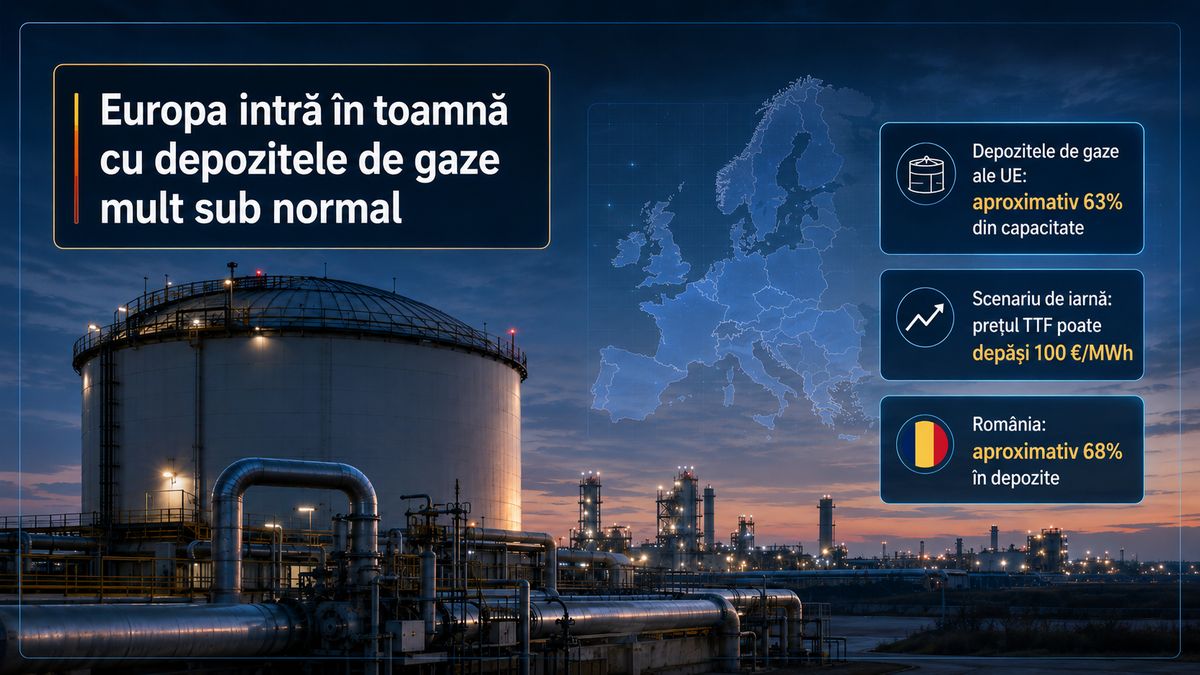
Europe enters the final stretch of the storage season with gas inventories at approximately 63–63,5% of capacity , compared to a five-year average of around 81–82% for this period. This gap of nearly 20 percentage points does not signal an immediate supply crisis, but it severely reduces the buffer available to absorb a cold winter or further disruptions in global liquefied natural gas (LNG) supply. Market tension is already reflected in prices. European TTF contracts, the continental benchmark, climbed above 68 €/MWh this week—their highest level since early 2023—before partially retracing. A scenario of low temperatures and continued tight supply could push prices into a 90–120 €/MWh range, according to a Morningstar estimate cited by CNBC. Goldman Sachs believes that if Middle Eastern LNG exports normalize only gradually through 2027, the European market may require prices above 100 €/MWh to attract sufficient cargoes and curb competition from Asian buyers. The €100/MWh threshold is therefore not an inevitable forecast for the coming winter. Rather, it is the potential price tag of an unfavorable combination: low storage levels, cold weather, and insufficient LNG volumes available to Europe . Europe has gas in storage, but the winter buffer is much smaller The current level must be put into perspective. During the same period in 2025, European storage was approximately 76% full, and in 2024 it approached 92% . Europe continues to inject gas today. The issue is not summer depletion, but rather that the restocking season started from a very low baseline and never closed the gap. At the beginning of April, following the end of the cold season, EU inventories had dropped to just about 28% . A colder winter, increased gas-fired power generation, and unfavorable conditions for other energy sources consumed a larger-than-usual share of the previously accumulated reserves. Summer failed to provide the typical recovery window. High temperatures boosted electricity demand for air conditioning, while weak wind generation and temporary nuclear outages increased the gas needed for power generation. Consequently, gas that would otherwise have been injected into storage had to meet immediate consumption needs. The Gulf LNG crisis hit right during the filling season Compounding the storage issue was a shock in the global LNG market. Qatar's LNG exports plummeted by approximately 96% during the first six months of the conflict , according to Reuters data. The number of cargoes dropped to 18, compared to 509 in the corresponding prior period. Before the disruptions, Qatar supplied about one-fifth of the global LNG market. The impact on Europe is greater than the direct share of Qatari gas in EU imports would suggest. In the winter of 2025–2026, Qatar accounted for about 7% of European LNG imports, according to ACER. However, removing such a massive volume from the global market forces Europe and Asia to compete for the same alternative cargoes. The United States has become the primary shock absorber. US LNG now accounts for about two-thirds of the EU's liquefied natural gas imports and around 30% of all European gas imports, according to ACER. US LNG exports rose by approximately 23% in the first seven months of 2026 compared to the same period last year. While this additional capacity helps Europe, it does not eliminate competition. A flexible US LNG cargo can be routed to either a European terminal or an Asian buyer, depending on price spreads and shipping costs. Prices must keep US cargoes in Europe This is the mechanism that could turn low inventories into a fresh price shock. Currently, Europe benefits from shorter shipping distances for a large portion of US-produced LNG. However, if a cold winter sharply boosts Asian demand, Asian buyers may start bidding high enough to divert cargoes that would otherwise head to Europe. The European market would then have to respond with its own price signal. Morningstar estimates that Europe could require around 64 billion cubic meters of US LNG in a scenario where other sources remain constrained. This volume would represent approximately 77% of the US exports projected in that analysis. Securing such volumes is not guaranteed by simply booking theoretical capacity. Europe must bid high enough to ensure that globally available gas actually lands at its terminals. This is why Goldman Sachs sees the potential for TTF to be pushed above €100/MWh if Middle Eastern LNG recovers too slowly: high prices would serve the economic purpose of destroying some demand and keeping more cargoes headed toward Europe. Lower storage levels become a bigger problem late in the winter Total storage volume is not the only critical metric; the rate at which gas can be withdrawn also matters. As storage facilities empty, their daily deliverability declines. Europe could thus have gas left in stock but lack the capacity to deliver it to the grid on a day of peak demand. This risk is concentrated in…
Ioana Buzoaica — Independent Editorial Board
The NRG-IA newsroom continuously monitors Romanian energy markets, ANRE regulatory decisions, and national grid telemetry (SEN/SNT). We deliver independent intelligence anchored exclusively in official primary data.
Editorial Charter, Ethics & Verification Methodology →