EU Gas Storage Below 58%, Lowest Level Since 2011 — NRG-IA
Gaze Naturale Author: Ioana BuzoaicaEurope enters late storage season with the lowest inventories since 2011, facing weak injection incentives and tight global LNG supply.
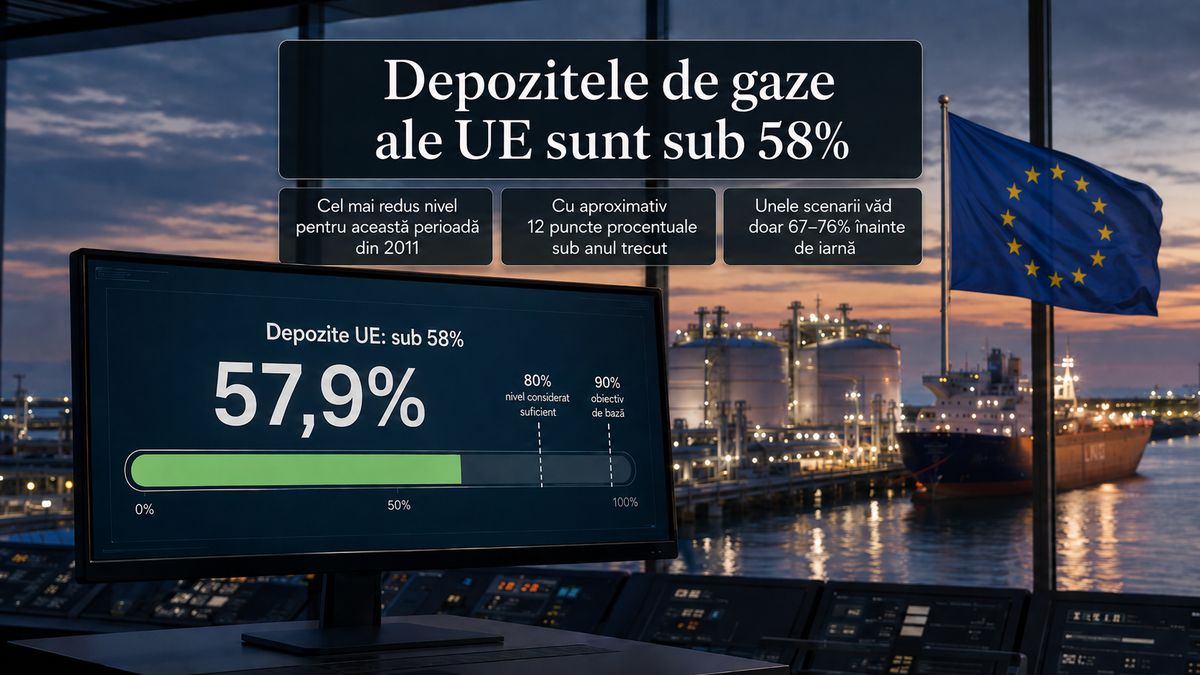
Underground gas storage facilities in the European Union are filled to just under 58% of capacity, the lowest level for this time of year in data series dating back to 2011. The filling level is approximately 12 percentage points below that recorded during the same period last year, according to Gas Infrastructure Europe data cited by Reuters. The gap does not mean Europe faces an immediate gas shortage. Today, the European system has a larger import capacity than during the 2022 energy crisis, consumption has decreased, liquefied natural gas infrastructure has been expanded, and reliance on Russia has dropped sharply. The real issue lies elsewhere: Europe must inject significant volumes into storage ahead of winter at a time when the market offers little commercial incentive for storage, and disruptions to Qatari exports are tightening the global liquefied natural gas supply. Approximately 12 billion cubic meters separate Europe from last year's level The European Union's aggregate underground storage capacity slightly exceeds 102 billion cubic meters. A filling level of approximately 58% corresponds roughly to a volume of around 59 billion cubic meters in storage. The 12 percentage point difference compared to the same period last year represents, relative to current total capacity, an order of magnitude of approximately 12 billion cubic meters. Storage facilities are essential during the cold season as they can cover approximately 30% of the European Union's gas consumption during the winter months. While they are not the sole source of supply, they provide the necessary flexibility when demand spikes rapidly or when imports are disrupted. The current level thus leaves the European system with a smaller buffer ahead of a period when seasonal consumption begins to rise. The European target remains 90%, but Brussels considers 80% sufficient under current conditions European regulations maintain the baseline target of 90% for storage filling levels, but amendments adopted in 2025 have introduced more flexibility in achieving it. Member states can reach the target level between October 1 and December 1, and under difficult market conditions, the regulation allows for a 10 percentage point deviation. The European Commission can authorize additional flexibility if unfavorable conditions persist. Amid energy disruptions in the Middle East, the Commission has recommended that member states utilize these mechanisms and indicated that a filling level of approximately 80% would be sufficient for security of supply in the coming winter. The distinction is important: the baseline legal target has not simply been lowered from 90% to 80%. The 80% level represents the threshold deemed sufficient under current conditions by utilizing the flexibilities provided by the European framework. To go from nearly 58% currently to 80%, Europe would need to add roughly another 22–23 billion cubic meters to storage. To return to 90%, the gap is approximately 33 billion cubic meters. The market does not sufficiently reward gas storage The obstacle is not just the physical availability of gas. Normally, operators have a strong incentive to buy gas during the summer months, store it, and sell it in winter when prices are higher. The spread between the injection season price and the cold season price must cover storage tariffs, financing, operational costs, and commercial risk. However, the current structure of the European market does not offer a sufficient advantage for this operation. The gas forward curve is structured such that near-term deliveries are relatively expensive compared to subsequent periods. Under these conditions, buying gas now to sell it during the winter may yield a commercial margin too narrow to justify storage. Aurora Energy Research estimates that, at current prices, the financial incentive to fill storage is virtually non-existent. ENTSO-G, the European Network of Transmission System Operators for Gas, had already flagged the same issue in its outlook for the summer 2026 season: the spread between summer prices and those for winter 2026–2027 did not create a strong enough economic incentive for rapid injections. Europe thus needs more gas in storage, but the commercial mechanism that should normally drive this accumulation is functioning poorly. Qatar is missing just when Europe needs more LNG The storage issue overlaps with a deterioration in the global liquefied natural gas market. Qatar accounts for about one-fifth of global LNG trade. Disruptions caused by the conflict in the Middle East have forced QatarEnergy to shut down liquefaction facilities, suspend some exports, and declare force majeure on certain deliveries. For some Asian buyers, the measure was extended until mid-September, and the market is factoring in the possibility that some disruptions could continue into October. This situation directly alters the economics of European supply. The European Union has massively increased its LNG import…