Aramco Cancels Europe Cargoes After East-West Attack — NRG-IA
Geopolitică & Energie Author: Ioana BuzoaicaThe attack on Saudi's East-West pipeline hit the infrastructure built to bypass Hormuz. Aramco has canceled or delayed some European cargoes.
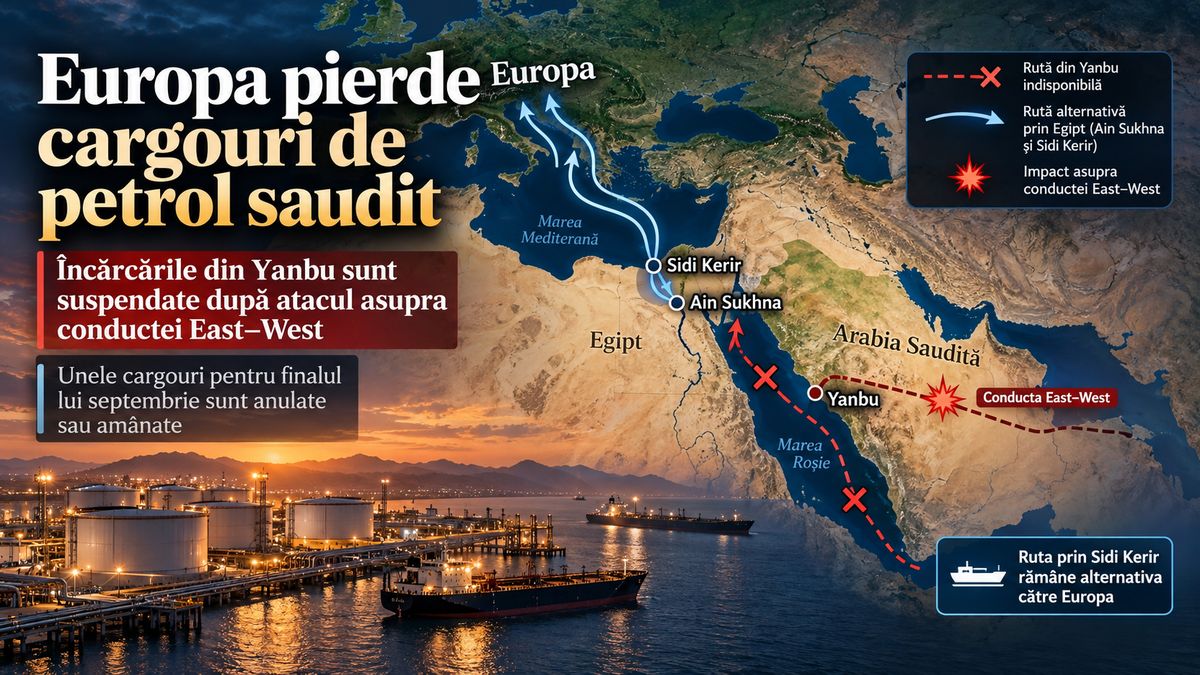
Europe is beginning to lose actual Saudi crude cargoes after the September 10 attack damaged the East-West pipeline, the main overland route through which Saudi Arabia can move crude from the east of the country to the Red Sea without passing through the Strait of Hormuz. Saudi Aramco has canceled or delayed some deliveries scheduled for European refineries at the end of September, and crude loadings from Yanbu have been suspended. This shift is particularly significant given that on August 19, Aramco had informed at least three European refineries that they would receive their full contracted volumes requested for September. Two were scheduled to lift crude from Sidi Kerir on Egypt's Mediterranean coast, while the third could use Sidi Kerir, Yanbu, or ship-to-ship transfers near Malta. Less than a month later, a portion of those flows must be replaced on the spot market. This change does not represent a Saudi embargo on Europe. The route through Egypt continues to operate, and some Saudi deliveries are still reaching the continent. However, the temporary loss of the Yanbu flow removes a major piece of logistical flexibility just as Hormuz is already severely disrupted. The East–West Pipeline Was Saudi Arabia's Insurance Against a Hormuz Crisis The East-West pipeline, also known as Petroline, spans approximately 1,200 kilometers across Saudi Arabia, linking the kingdom's eastern oil infrastructure to the Yanbu terminal on the Red Sea. Its nominal capacity is around 7 million barrels per day , though this does not represent the actual volume transported. The Associated Press estimates that prior to the shutdown, approximately 2.6–4 million barrels per day flowed through the pipeline, representing up to roughly 4% of global oil supply. The pipeline's function is strategic: it allows Saudi Arabia to export oil without it transiting Hormuz. In 2026, this redundancy became essential. Regional conflict has severely reduced traffic through the strait between Iran and the Arabian Peninsula, prompting Aramco to shift volumes to the Red Sea, Yanbu, and the Egyptian SUMED system to maintain access to international markets. The September 10 attack thus struck not a secondary pipeline, but the very infrastructure designed for a scenario where the Gulf's primary maritime outlet no longer functions normally. Pipeline Repairs and Flow Resumption Have Different Timelines Assessments of the outage's duration vary. Regional officials quoted by the Associated Press estimate major repair works lasting three to five weeks . Meanwhile, the US Secretary of Energy stated on September 15 that crude is expected to begin flowing through the system again within days. These two estimates are not necessarily incompatible: resuming a partial flow can precede the full repair of the infrastructure. For the market, however, the difference between days and weeks is massive. Available inventories in the Yanbu area were estimated by traders and buyers at only a few days of exports if pipeline supply does not resume. Reuters reported as early as September 13 that available stocks could cover approximately five to seven days at the current export pace. This highlights the immediate vulnerability: the infrastructure may require weeks for a full recovery, while the commercial buffer is measured in days. Cancellations Have Already Reached European Refineries Reuters confirms that some European customers have been notified that certain September-loading cargoes will be canceled, and loading operations at Yanbu have been suspended. Saudi Aramco has declined to comment publicly on the scale and duration of the disruption. Market intelligence indicates cancellations or delays for deliveries scheduled particularly in the final days of September, with some volumes pushed back to November. Quantum Commodity Intelligence separately reports that Aramco is in the process of notifying some European buyers with long-term contracts of force majeure following the attack on the East-West pipeline. However, there is no public announcement from Aramco declaring such a measure for all European deliveries. Consequently, the deterioration is already commercial, not just technical: the pipeline is unavailable, Yanbu is no longer delivering normally, and the contracts of some European refineries are being modified. Orlen Buys Alternatives Following Saudi Crude Reductions One of the clearest consequences is emerging in Central Europe. Polish group Orlen receives a highly significant portion of its crude requirements through its relationship with Saudi Aramco and operates refineries in Poland, Lithuania, and the Czech Republic. Following the disruption of Saudi deliveries, traders cited by Reuters say the group is seeking additional oil from the North Sea, the United States, Kazakhstan, and other sources. Orlen has already purchased North Sea grades such as Grane, Johan Sverdrup, and Johan Castberg, and has also sought US WTI Midland or Kazakh CPC Blend, according to…