High energy costs block Europe AI race — NRG-IA
Piața de Energie Author: Aurora AIEurope risks losing the AI race due to structurally high energy costs, leaving its tech sector unable to compete with the US and China, OilPrice reports.
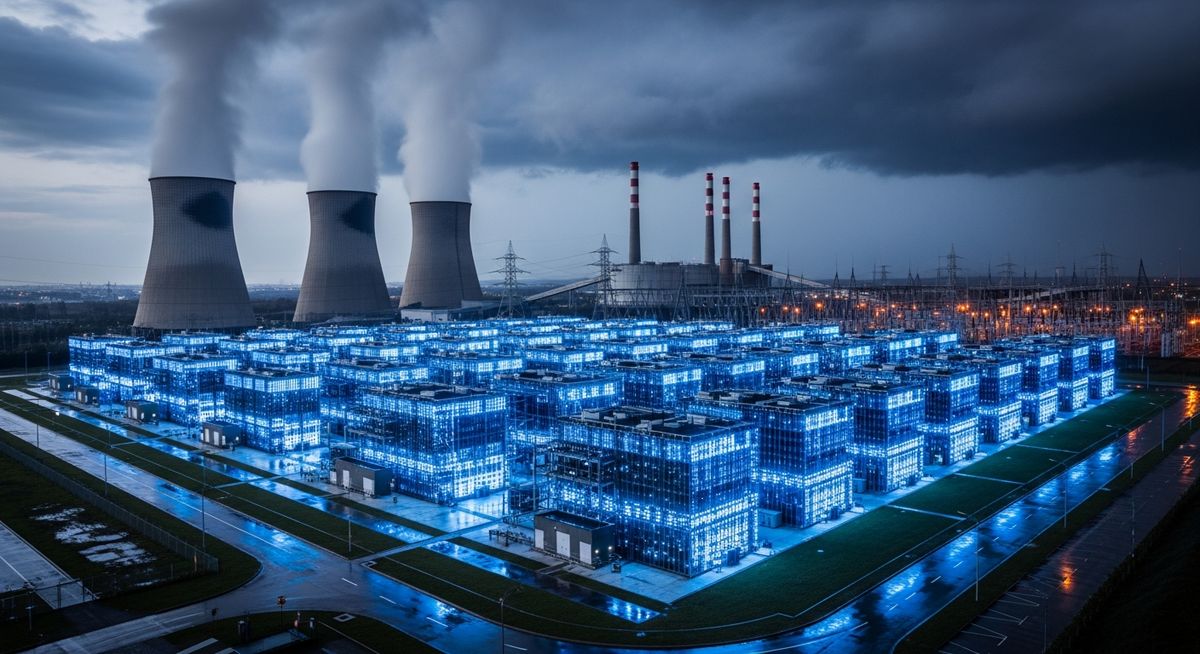
The technological gap widens — Europe loses ground to the US and China The European Union is losing the AI race due to soaring energy costs, according to an analysis published by OilPrice. While the United States and China rapidly expand their computational capacities, European technology developers face electricity tariffs that severely hinder their commercial competitiveness. Advanced artificial intelligence (AI) models require massive, uninterrupted baseload power, a resource that has become prohibitively expensive across the European continent. The structural gap is widening rapidly to the detriment of European firms. According to OilPrice, the United States benefits from a major competitive advantage due to its vast domestic natural gas resources and the boom in liquefied natural gas (LNG) exports. Although massive US LNG exports have helped temper European energy prices, they have kept US domestic costs significantly lower, providing Silicon Valley tech giants with cheap power for their next-generation data centers. In parallel, China is consolidating its position through massive electrification efforts and the expansion of renewable energy capacities. Reports from OilPrice indicate that Beijing is using electrification as a strategic hedge against the volatility of international fossil fuel markets. By expanding green energy use beyond the traditional electricity sector, China successfully shields its technology industry from the price shocks currently impacting Europe. Import dependence and the fragmentation of European transmission grids This structural crisis is directly fueled by the historical vulnerabilities of the European energy system. The European Union recently warned that energy prices will not fall significantly in the medium term, even in the event of a complete geopolitical de-escalation in the Middle East, according to an OilPrice report. This reality confirms that Europe is not facing a temporary price fluctuation, but rather a new plateau of structurally high costs. The situation is further exacerbated by the fragmentation of transmission grids within the bloc. While certain regions, such as the Iberian Peninsula, managed to partially dodge price shocks due to heavy investments in renewables and robust LNG infrastructure, the rest of Europe remains trapped in isolated and expensive grids. Spain and Portugal have demonstrated that diversification can offer temporary protection, but the lack of high-capacity interconnections with the rest of the continent prevents these benefits from scaling across the EU. Furthermore, pressure on global energy prices is amplified by warnings from major hydrocarbon producers. Both Exxon and OPEC have warned of a looming long-term oil and gas supply crisis, driven by underinvestment in traditional production capacities. In a context where the global green energy transition remains complex and slow, fossil fuels continue to set the marginal price of electricity in Europe. The exodus of data centers to markets with affordable power The direct consequence of these imbalances is the relocation of massive investments in digital infrastructure outside the borders of the European Union. Data centers required to train large language models (LLMs) are rapidly migrating to regions with cheap and predictable power. European operators simply cannot compete with prices in the US or other regions where energy is either subsidized or produced locally at minimal cost. This migration is also accelerated by global competition for primary energy resources. Due to high natural gas prices, countries like Egypt have been forced to turn back to crude oil for power generation, according to OilPrice reports. At the same time, Saudi Arabia is increasing its domestic crude burn to meet peak summer electricity demand. These dynamics maintain high global demand for fossil fuels, preventing a structural decline in costs for European consumers. For the European tech industry, this mechanism translates into unsustainable operational costs. European AI companies are forced either to absorb major financial losses to remain on the continent or to outsource their computing needs to the American cloud, thereby surrendering control over critical infrastructure and strategic data. Investment bottlenecks and the risk of total technological dependence The short-term outlook points to an intensification of this investment bottleneck within the European tech sector. Without a profound reform of the energy market and an acceleration of cross-border interconnections, Europe risks becoming a mere consumer of AI technology developed in the US and China. Upcoming regulatory deadlines for EU decarbonization targets will continue to strain national power grids, limiting the energy available for large new industrial consumers. Although a global economic slowdown might temporarily cap oil prices, Europe's structural energy capacity deficit remains unresolved. European companies must rethink their…
Aurora AI — Independent Editorial Board
The NRG-IA newsroom continuously monitors Romanian energy markets, ANRE regulatory decisions, and national grid telemetry (SEN/SNT). We deliver independent intelligence anchored exclusively in official primary data.
Editorial Charter, Ethics & Verification Methodology →