Europe Pays €100B Extra for Energy: EU Summit 2026 — NRG-IA
Piața de Energie Author: Ioana BuzoaicaThe EU faces €100B in extra fossil fuel costs amid Middle East energy turmoil. Leaders meet in Brussels to address consumer and industrial pressures.
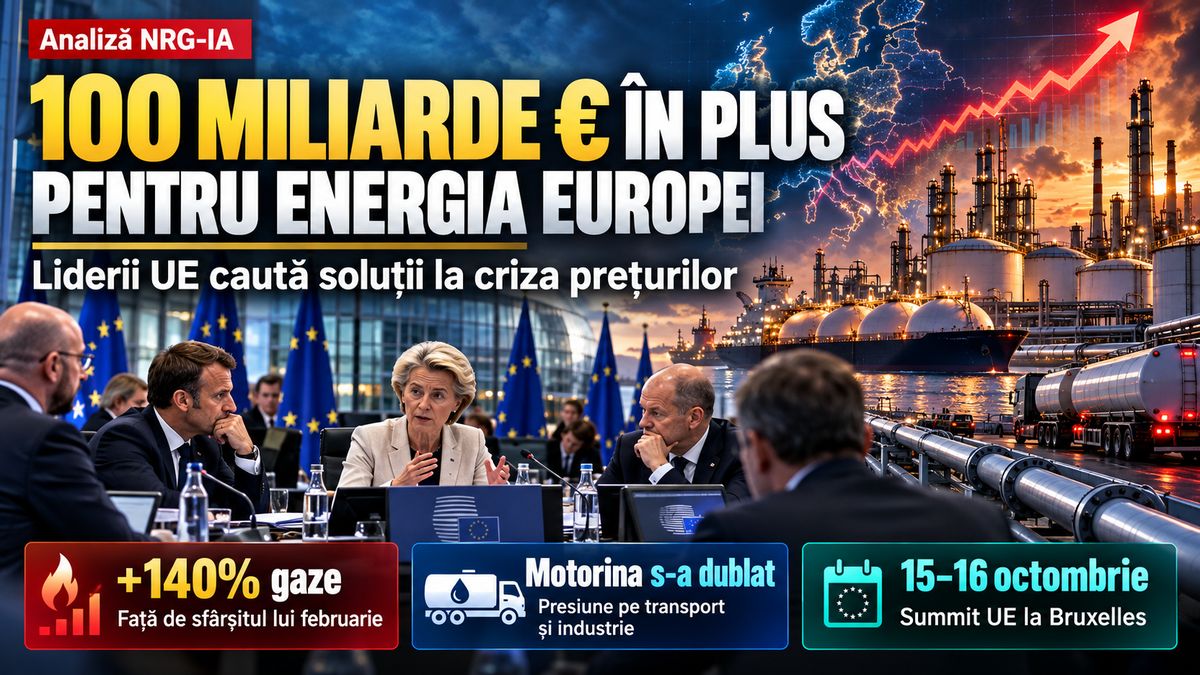
Europe is paying approximately €100 billion more for imported fossil fuels without receiving any additional energy in return. This is the financial scale of the current energy crisis, outlined by European Commission President Ursula von der Leyen ahead of the European Council summit on October 15–16, 2026, in Brussels. In just a few months, natural gas prices have surged by 140%, and diesel prices have doubled, intensifying pressure on European households, transport, and industry. The €100 billion figure represents the Commission's estimate of the extra cost of fossil fuels imported by Europe since the onset of the energy shock in late February. The sum reflects the economic burden of soaring prices for oil, gas, and refined petroleum products, occurring as global supply chains have been disrupted by Middle East conflict and maritime transport bottlenecks. The crisis now tops the agenda for the leaders of the 27 member states. The European Council is examining temporary measures to mitigate costs borne by citizens and businesses, alongside structural solutions to reduce the European economy's structural vulnerability. The debate comes at a critical time when price pressures threaten industrial competitiveness and winter readiness, amidst diverging national energy systems and interests. An extra hundred billion euros for imported fuels The current crisis highlights Europe's persistent dependence on global fuel markets. According to 2024 Eurostat data, the European Union covered approximately 57% of its total energy requirements through net imports. Oil and petroleum products accounted for 37% of final energy consumption, natural gas roughly 20%, and electricity only 23%. These shares explain why the rapid buildout of renewable and nuclear electricity generation does not automatically insulate the European economy from fuel price spikes. A vast share of transport, heating, and industrial processes remains reliant on oil, diesel, and natural gas. When global prices for these commodities surge, the costs pass through directly to businesses and consumers. The impact is exacerbated as Europe competes for the same energy resources against other major importing economies. Export cuts in certain regions, rising freight rates, and refinery disruptions can amplify price hikes even when total available volumes do not fall symmetrically. The scale of the deterioration is illustrated by the trajectory of European Commission estimates over recent months. In April, the additional cost of fossil imports was estimated at €24 billion. By late July, it had reached €62 billion, and by mid-September, it exceeded €90 billion. On October 6, Ursula von der Leyen put the figure at approximately €100 billion. This sharp increase reflects the compounding financial strain over a relatively short period. For the European economy, the consequence is a reduction in capital available for consumption, investment, and industrial development, as governments face pressure to fund additional social safety nets and economic aid packages. Expensive gas and diesel squeeze industry and push up consumer prices Rising fuel prices ripple through the European economy via distinct yet interconnected mechanisms. Natural gas prices directly impact energy-intensive industrial operations and can drive wholesale power prices higher during peak periods when gas-fired plants set the marginal electricity price. At the same time, diesel is a crucial cost driver for road freight, agriculture, construction, and broad industrial sectors. Higher fuel prices inflate logistical overheads, feeding directly into final retail prices for food, building materials, and consumer goods. For European enterprises, the impact hinges on energy intensity and their ability to pass input costs on to end customers. Internationally exposed firms face severe competitive disadvantages when competing against global rivals operating in regions with cheaper energy. In energy-intensive sectors like chemicals, metallurgy, and fertilizer production, energy accounts for a dominant share of total production costs. Divergent national energy mixes complicate a unified European policy response. In her October 6 speech, Ursula von der Leyen highlighted two member states where wholesale power traded at roughly €145 and €70/MWh, respectively. In the former, prices were driven by gas-fired generation, whereas in the latter, nuclear and renewable output dominated the power mix. This stark contrast underlines the difficulty of implementing one-size-fits-all measures across the Union. Lowering a specific energy cost parameter can yield major relief in one state while having minimal impact in another, depending on generation structure, grid cross-border capacity, and existing supply contracts. EU leaders seek emergency measures, but environmental rules spark discord European Council President António Costa asked EU leaders to provide guidance to the Commission on temporary, targeted measures to shield…
Ioana Buzoaica — Independent Editorial Board
The NRG-IA newsroom continuously monitors Romanian energy markets, ANRE regulatory decisions, and national grid telemetry (SEN/SNT). We deliver independent intelligence anchored exclusively in official primary data.
Editorial Charter, Ethics & Verification Methodology →