Mediterranean's 552 GW Renewables Pipeline Surpasses US — NRG-IA
Energie Regenerabilă Author: Ioana BuzoaicaThe Mediterranean's 552 GW wind and solar pipeline surpasses the entire US power pipeline, with grids and permitting as the next key hurdles.
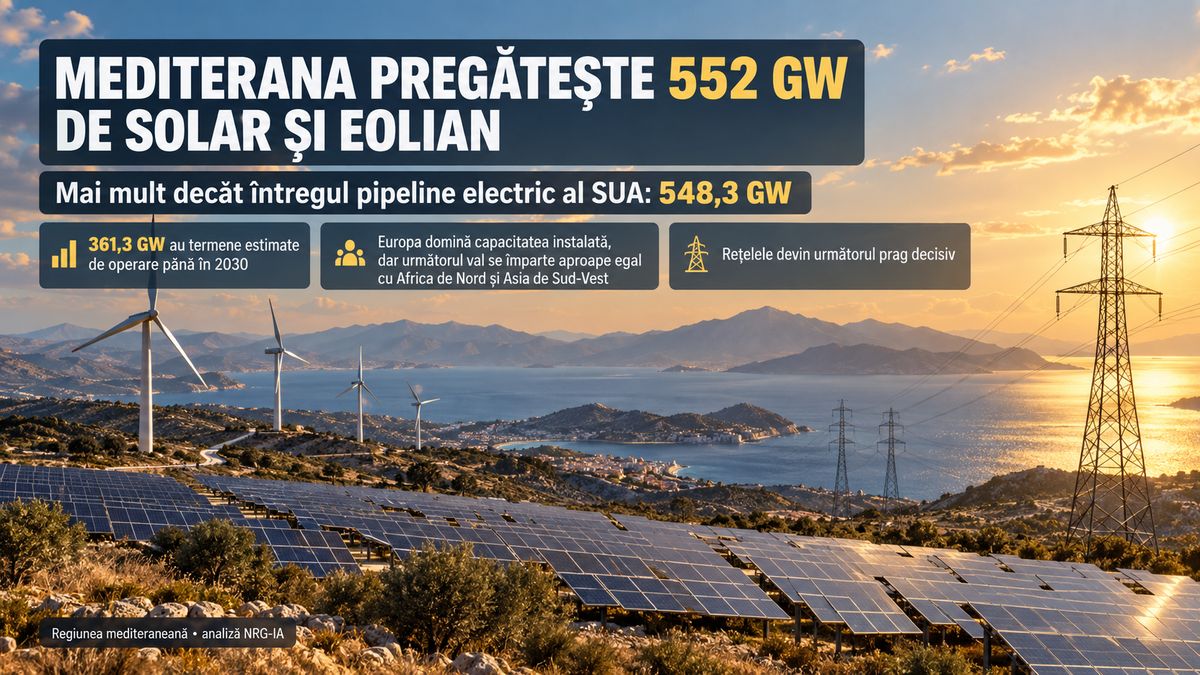
The Mediterranean region has reached a pipeline of 552 GW of utility-scale wind and solar projects , enough to easily surpass the entire US portfolio of new power generation capacity, valued at 548.3 GW . The comparison by Global Energy Monitor highlights the scale of the new renewable wave around the Mediterranean: solar and wind projects in various stages of development alone total more nominal capacity than all planned new power capacity in the United States, regardless of technology. The difference is small—about 3.7 GW —but the significance is considerable. This 552 GW does not belong exclusively to Europe, nor does it represent already built capacity. It covers a much broader energy territory, linking Southern Europe with North Africa and Southwest Asia, from Spain, France, and Italy to Morocco, Algeria, Egypt, Türkiye, Israel, and the Eastern Mediterranean states. Global Energy Monitor classifies announced, pre-construction, or under-construction projects as "prospective capacity." Therefore, the 552 GW figure describes the size of the pipeline , not current electricity generation or capacity that will automatically come online. The Mediterranean already has over 250 GW of wind and solar in operation The starting point is already substantial. The region analyzed by GEM has approximately 251.6 GW of operational wind and solar capacity , of which 100.9 GW is wind and 150.7 GW is solar. Europe currently accounts for about 82.5% of this operational capacity , reflecting the head start built up by Spain, Italy, France, Greece, and other European markets over the last two decades. However, the geography of the next wave looks very different. Of the prospective projects with an estimated commissioning date by the end of 2030, approximately 51% are located in Europe , and 49% in Southwest Asia and North Africa . This near-perfect split signals a structural shift. While Europe remains the current hub of installed capacity, the southern and eastern shores of the Mediterranean are catching up rapidly through very large-scale projects. 361.3 GW targeted for operation by 2030 Out of the entire 552 GW pipeline, 361.3 GW have an estimated commercial operation date by the end of 2030 . Global Energy Monitor estimates that this capacity represents approximately 10% of the entire global pipeline of utility-scale wind and solar projects with a commercial target by 2030 . This figure shows how important the Mediterranean could become in the coming years, but also how wide the gap is growing between announced capacity and actually built capacity. The monitored projects are in various stages, and permitting, grid connection, and financing will determine how much of this pipeline actually enters operation. GEM notes that globally, in 2024, only about half of planned wind and solar projects became operational according to their initial schedules. For the Mediterranean, the scale of the pipeline is already proven; the next test is execution speed. Spain leads Europe with 165.3 GW of projects Spain is by far the largest European hub in the new Mediterranean wave. Global Energy Monitor identifies approximately 165.3 GW of prospective capacity in wind and solar, including 108.8 GW of utility-scale solar and 56.5 GW of wind . However, project maturity is uneven. Only about 8.4 GW are actually under construction, while approximately 132 GW are in pre-construction —a category that includes projects that have begun concrete permitting, financing, or preparation processes. Spain's case illustrates the gap between the pipeline's massive potential and the ability to turn projects into functional power assets. The country boasts excellent solar and wind resources and a mature market, but grid development and the capacity to integrate new generation are becoming increasingly critical as volumes grow. Egypt is building the Mediterranean's second-largest renewable hub On the southern shore, Egypt emerges as one of the most ambitious development hubs. Its pipeline reaches approximately 94.6 GW , split almost equally between 46.7 GW of utility-scale solar and 47.9 GW of wind . This scale is impressive compared to its current base: Egypt had about 6.3 GW of installed wind and solar capacity as of February 2026 . Of the 94.6 GW of prospective capacity, 22.9 GW have an estimated commercial operation date by the end of the decade . However, a significant portion of this development is destined for a different purpose than traditional power grids. Around 37.7 GW of the Egyptian projects are linked to green hydrogen production . This transforms North African renewables from a simple source of electricity into a potential foundation for industry, low-emission fuels, and energy exports. Grids become the critical infrastructure The 552 GW shifts the core challenge from installing panels and turbines to the infrastructure needed to transport and integrate the generated power. Global Energy Monitor identifies grids and interconnectors as one of the…