Europe's AI Gigafactories: Power Is the Real Test — NRG-IA
Tehnologie & Inovație Author: Ioana BuzoaicaEurope wants to be an AI leader, but digital ambition faces energy reality: data centers need massive, continuous power. Grid speed will decide the winners.
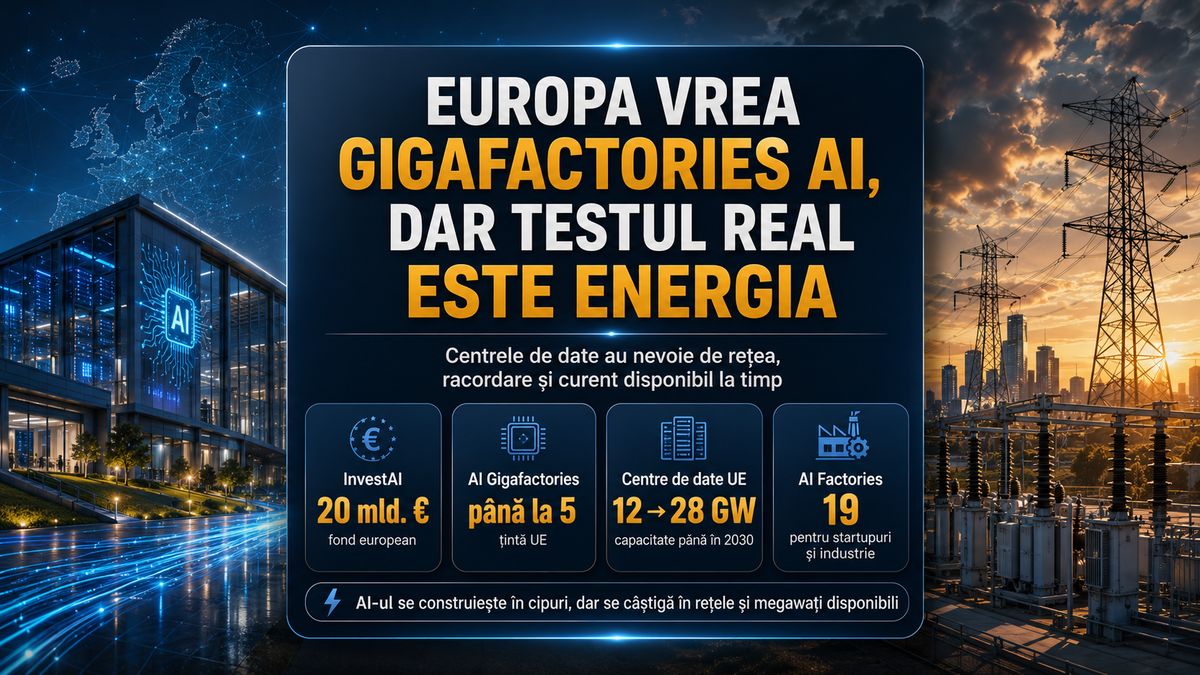
Europe is building its AI strategy around a grand vision: computing factories, data centers, advanced processors, and sovereign capacity to train artificial intelligence models. But the AI race is not won in the cloud alone. It is won in substations, grids, transformers, power purchase agreements, batteries, power plants, and grid connection procedures. The European Commission aims to triple the EU's data center capacity over the next five to seven years through a Cloud and AI Development Act focused on private investment in cloud and AI infrastructure. In parallel, InvestAI includes a €20 billion European fund for up to five AI Gigafactories. The Commission describes these facilities as infrastructures featuring over 100,000 advanced AI processors, reliable supply chains, advanced networking, energy efficiency, and an explicit focus on power supply capacity. This final condition changes the conversation. Computing power is not an isolated asset. A large-scale AI center is only valuable if it receives sufficient, predictable, and timely power. In the new industrial competition, energy is becoming a primary site-selection criterion, not a secondary cost. AI needs chips, but stalls without the grid Data centers are not built where there are only land, buildings, and promises. They are established where there is available power, rapid grid connection, predictable pricing, power contracts, and clear rules for grid expansion. Reuters reported that the EU is preparing minimum energy efficiency standards for data centers at a time when their capacity is projected to grow from 12 GW last year to 28 GW by 2030. This expansion will push the share of data centers in the EU's electricity consumption above the current 2.5%, and the Commission is also preparing a sustainability label that will include criteria such as water consumption and clean energy usage. This is no longer a marginal IT efficiency issue. It is an energy planning issue. If data centers grow faster than grids, the power system becomes the real bottleneck for AI ambitions. If grids, flexibility, and clean generation keep pace, AI can become a new source of industrial demand, integrated into the energy transition. The IEA estimates that, globally, data center electricity consumption will double by 2030, reaching approximately 945 TWh, or nearly 3% of global electricity consumption. In Europe, data center consumption is set to increase by over 45 TWh compared to 2024, representing an increase of approximately 70%. The global figure of 945 TWh shows the scale of the phenomenon. The European figure highlights where the infrastructure test lies: not in the economy's total consumption, but at the nodes where power, cooling, connectivity, and 24/7 availability converge. "Fast Energy" becomes the industrial response to the AI race The European Council on Foreign Relations frames the issue directly: Europe faces higher structural energy costs than the US and China, grid bottlenecks, permitting delays, and carbon prices that undermine its competitiveness. The proposed response is a "fast energy" program: faster permitting, accelerated grid development, and rapid deployment of clean and firm power. The term "Fast Energy" should not be read as the name of an official Commission program, but as a strategic formula for what Europe must do. AI is shifting the competitiveness benchmark: it is no longer enough to have clean energy in plans, strategies, or approved capacities. You must have it connected on time. Fast Energy means treating energy as competitiveness infrastructure. Slow permitting, delayed grid connections, transformer shortages, grid congestion, and a lack of flexibility are no longer mere administrative details. They are the factors that decide where data centers are built and where investments flow. For Europe, time is money. If an AI center has to wait years for a grid connection, capital migrates to locations where power is available faster. If energy is expensive or unpredictable, technological advantage dissolves into operational cost. Grids become the new strategic infrastructure for AI On June 3, 2026, the European Commission published a roadmap for digitalization and AI in energy. The document aims to sustainably integrate data centers into the energy system, accelerate digital and AI technologies for grids, deploy grid-enhancing technologies, and speed up the rollout of smart meters. The Commission estimates that demand-side flexibility could reduce electricity costs for European consumers by over €71 billion per year, while AI-driven operations and maintenance optimization could generate savings of up to €94 billion annually by 2035. This is the less visible side of the AI revolution: artificial intelligence consumes electricity, but it can also optimize the power system. It can assist with forecasting, maintenance, congestion management, flexibility, renewables integration, and grid planning. Eurelectric brought the same theme to the Power…
Ioana Buzoaica — Independent Editorial Board
The NRG-IA newsroom continuously monitors Romanian energy markets, ANRE regulatory decisions, and national grid telemetry (SEN/SNT). We deliver independent intelligence anchored exclusively in official primary data.
Editorial Charter, Ethics & Verification Methodology →