Eurowind Secures 2.3 GW in Romania: Post-2030 Grid Challenge — NRG-IA
Energie Regenerabilă Author: Ioana BuzoaicaEurowind secured grid permits for 2.3 GW in Romania, highlighting the grid capacity challenge as valid connection permits nationwide top 113 GW.
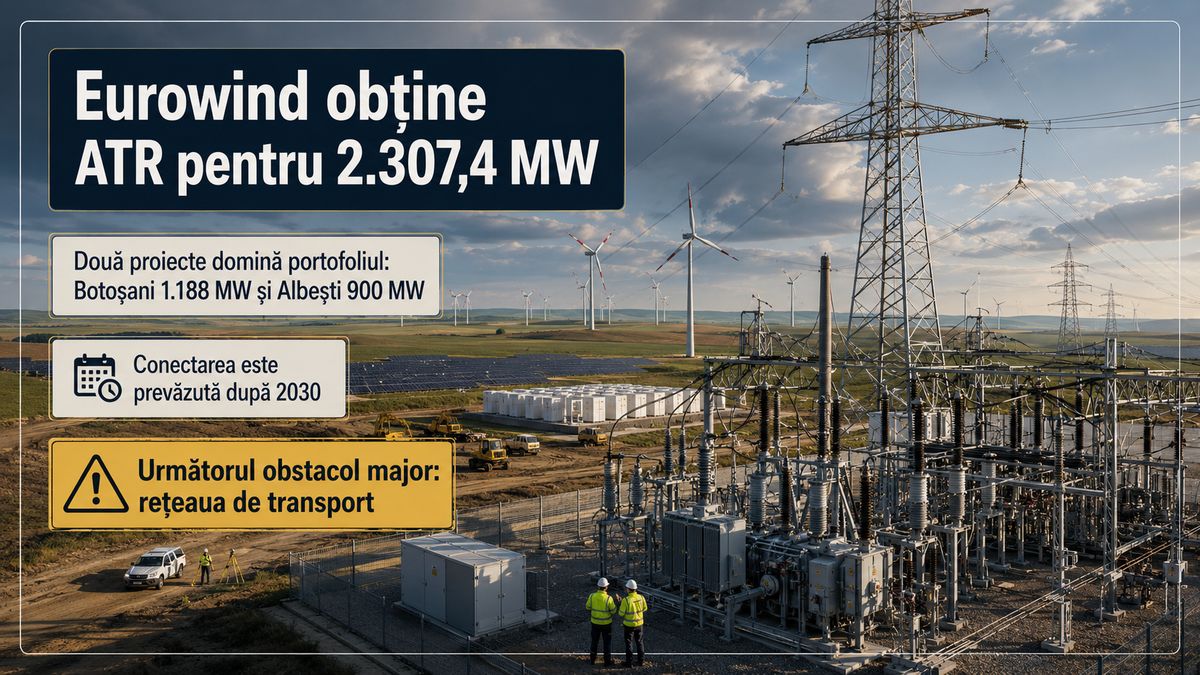
Eurowind Energy Romania has secured Grid Connection Permits (ATRs) for seven renewable energy and storage projects with a cumulative capacity of 2,307.4 MW , marking one of the largest recent advancements by a private developer in the Romanian energy project pipeline. However, almost all of this capacity is concentrated in two massive investments: a 1,188 MW wind complex in Botoșani County and the 900 MW Albești wind farm in Constanța County . Together, the two projects total 2,088 MW , representing approximately 90.5% of the entire capacity for which Eurowind announced securing ATRs . The remainder of the portfolio consists of the Mănești, Stăncuța, Liești, Slobozia Conachi, and Pechea projects, with capacities ranging between 21.6 and 49.6 MW. The permits were obtained in June, and the company states that the projects are scheduled for connection to the National Power Grid after 2030 . This very timeline highlights the true scale of the bet: Eurowind has cleared a critical development milestone, but the next frontier is no longer securing land or obtaining a theoretical spot on the grid. It is building the infrastructure capable of transmitting the power. Botoșani and Albești Anchor the 2.3 GW Bet The largest project is in Botoșani, where Eurowind is developing a cluster of nine wind farms with a total approved capacity of 1,188 MW. As early as 2025, the company was discussing approximately 1,200 MW planned across nine communes in the county, estimating the investment at over one billion euros . At that time, the developer had secured the land, obtained the initial urban planning certificate, and submitted the grid connection application. Securing the ATR in 2026 moves the project into a more advanced stage. Phased execution is planned around 2031 , meaning the development of the wind farm and the expansion of the transmission grid in the Moldova region will progress virtually in parallel. Transelectrica, alongside Delgaz Grid, is planning a new 400/110 kV substation in Botoșani , in the context of the Suceava–Bălți 400 kV line project. The transmission system operator has explicitly indicated that this infrastructure can facilitate the connection of new generation capacities in the area. The second major Eurowind project, Albești, adds 900 MW of wind power in Constanța , a region that already concentrates nuclear generation, significant wind capacities, and a massive volume of renewable projects under development. Transelectrica's plans treat increasing the transmission capacity out of the eastern part of the country, particularly Dobrogea, as one of the grid's structural bottlenecks. Relevant investments include 400 kV corridors such as Smârdan–Gutinaș, Cernavodă–Stâlpu, and Medgidia Sud–Constanța Nord. For Eurowind, its two largest projects are thus situated precisely in the regions where renewable expansion and grid capacity must advance hand in hand. Romania Already Has 113.7 GW of Projects with Connection Permits Eurowind's 2.3 GW seems massive compared to the company's current capacity in Romania. In the context of the wider market, however, they join a much larger wave of projects seeking grid access. As of July 1, 2026 , ANRE reported 1,672 renewable projects with valid ATRs , with a total approved maximum grid injection capacity of 113,652 MW . This is an enormous figure relative to the size of the Romanian power system, showing that Romania no longer suffers from a shortage of proposed projects. The divergence appears in the subsequent stages. Of the 113.7 GW with valid ATRs, projects that already had grid connection contracts totaled 55,399 MW. Those that had reached the building permit stage totaled 33,846 MW. Only 223 projects, totaling 11,153 MW , simultaneously held a connection contract, a building permit, and an establishment authorization issued by ANRE. This gap does not mean the remaining projects will fail; many are simply in earlier stages. However, it illustrates the vast distance between capacity that has received technical connection conditions and capacity that is actually moving toward construction. This very pressure prompted ANRE to tighten connection rules in 2026. The financial guarantee for ATRs was increased from 5% to 20% of the connection fee , in an attempt to curb projects that reserve capacity without making sufficient progress. In this context, the ATR becomes more than just administrative paperwork, yet it remains only one of many investment hurdles. Eurowind Starts from 184 MW in Operation and 138 MW Under Construction The scale of the new package is even more striking when compared to the company's current footprint in the Romanian market. In July, Eurowind stated it had 184 MW in operation in Romania , including the Teiuș storage system, which has a capacity of 60 MW. In parallel, the company has started construction on the Frumușița, Vector, and Pecineaga Nord-Est wind farms, with a cumulative capacity of 138 MW and commissioning estimated for 2027. The…
Ioana Buzoaica — Independent Editorial Board
The NRG-IA newsroom continuously monitors Romanian energy markets, ANRE regulatory decisions, and national grid telemetry (SEN/SNT). We deliver independent intelligence anchored exclusively in official primary data.
Editorial Charter, Ethics & Verification Methodology →