Gulf Crude Exports Recover to 91%; Refined Products at 60% — NRG-IA
Geopolitică & Energie Author: Aurora AIGulf crude exports neared pre-war levels in September, but refined products lagged at 60%, keeping pressure on global diesel and jet fuel markets.
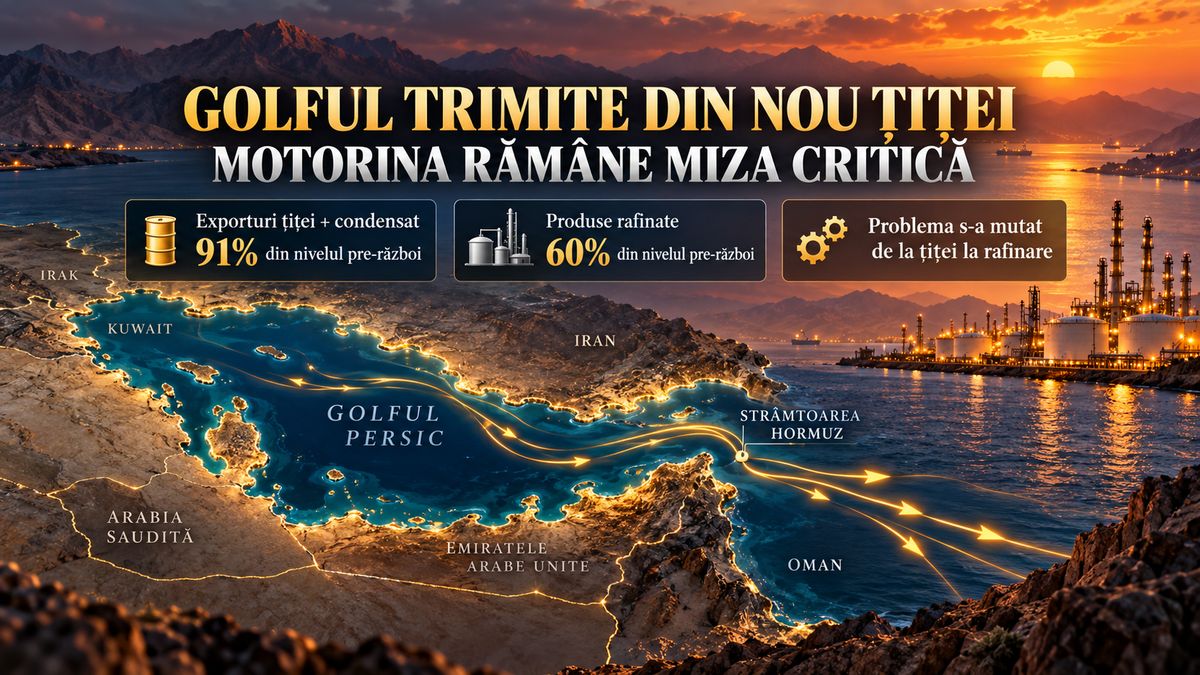
Gulf oil states are once again successfully delivering large volumes of crude to the global market, following months in which war, infrastructure attacks, and shipping disruptions through the Strait of Hormuz severely curtailed regional flows. However, the recovery is deeply uneven: while crude is flowing at volumes close to pre-conflict levels, exports of fuels and other refined products lag far behind. Vortexa data published on Tuesday and cited by Reuters shows that combined flows of crude, condensate, and refined products, including LPG, from Saudi Arabia, Kuwait, Qatar, Oman, Bahrain, Iraq, and the United Arab Emirates reached approximately 19.2 million barrels per day in September. In the year prior to the outbreak of the war, the average was approximately 23.6 million barrels per day . The region has thus recovered to about 81% of its pre-conflict volume . The disparity becomes far more significant when flows are broken down by category. Exports of crude and condensate reached approximately 91% of pre-war levels , while refined products, including LPG, remained at only about 60% . This divergence explains why the recovery in crude flows has not resolved the bottlenecks in the fuel market. Saudi Arabia Drives Regional Export Growth The largest contribution to September's growth came from Saudi Arabia. Kpler data cited by Reuters shows that Saudi crude and condensate exports surged by approximately 4.2 million barrels per day compared to August , reaching around 6.6 million barrels per day in September. The surge in Saudi shipments offset declines from other regional exporters. The United Arab Emirates and Iraq also delivered higher volumes, while exports from Kuwait and Qatar fell. Iranian exports dropped to zero in Kpler's data amid the US blockade. For the entire group comprising Saudi Arabia, the UAE, Iraq, Oman, Kuwait, Qatar, and Iran, Kpler estimates that crude and condensate exports rose from approximately 10.8 million barrels per day in August to 14.7 million in September . However, this recovery in flows did not occur through a restoration of the old transport system. Over recent months, exporters have built a far more complex logistical structure to move oil out of the region. Oil Flows Again, but via Alternative Routes Prior to the war, the Strait of Hormuz handled the vast majority of Gulf oil exports. Following the outbreak of conflict, exporters shifted increasingly large volumes to pipelines and terminals outside the strait and introduced an extensive system of ship-to-ship (STS) transfers. Kpler's analysis shows that in September, approximately 60% of crude exported from the Gulf (excluding Iran) physically transited Hormuz , about 23% was loaded from terminals outside the strait , primarily at Fujairah, and roughly 17% exited via the Red Sea . Before the war, around 83% of the region's crude transited Hormuz. In September, approximately 40% was able to bypass the strait, primarily utilizing the pipeline infrastructure of Saudi Arabia and the UAE. At the same time, a significant portion of the oil transiting Hormuz is transported via a shuttle system. Tankers load inside the Gulf, cross the strait, and transfer their cargo to other vessels off Fujairah or Sohar, from where the oil continues its journey to Asia or Europe. Kpler estimates that at least 63 Very Large Crude Carriers (VLCCs) are currently involved in this system. In August, over 70% of the crude that transited Hormuz was subsequently transferred to other vessels in the Gulf of Oman. Some of these tankers transit the area with their Automatic Identification System (AIS) turned off, prompting Kpler to use satellite imagery, vessel drafts, port data, and destination tracking to reconstruct the flows. The result is an export system capable of delivering large volumes of crude once again, but one that is far more complex than before the conflict. The Bottleneck Shifts to Refining The recovery in crude exports has not been mirrored in shipments of diesel, jet fuel, and other refined products. According to Vortexa, regional exports of refined products and LPG stand at only 60% of pre-war levels , compared to 91% for crude and condensate. Reuters notes that this reduction in shipments has exacerbated the global shortage of diesel and jet fuel, contributing to elevated prices across several markets. Data from the International Energy Agency highlights the scale of this gap. In August, net exports of diesel and gasoil from the Gulf states stood at approximately 390,000 barrels per day , just over a quarter of pre-war levels. Middle Eastern disruptions coincided with reduced refinery runs in Russia. In August, combined diesel and gasoil exports from the Gulf and Russia were approximately 1.6 million barrels per day lower than in February . Prior to the conflict, these two regions together accounted for nearly 45% of global seaborne trade in these products. Refineries in other regions have ramped up processing to capitalize on high…
Aurora AI — Independent Editorial Board
The NRG-IA newsroom continuously monitors Romanian energy markets, ANRE regulatory decisions, and national grid telemetry (SEN/SNT). We deliver independent intelligence anchored exclusively in official primary data.
Editorial Charter, Ethics & Verification Methodology →