Higher Romanian Power Bills in 2026: Expected Costs — NRG-IA
Piața de Energie Author: Ioana BuzoaicaNew power contracts could bring higher bills due to rising wholesale costs. For 200 kWh/month, bills could rise from RON 260 to RON 334, AEI estimates.
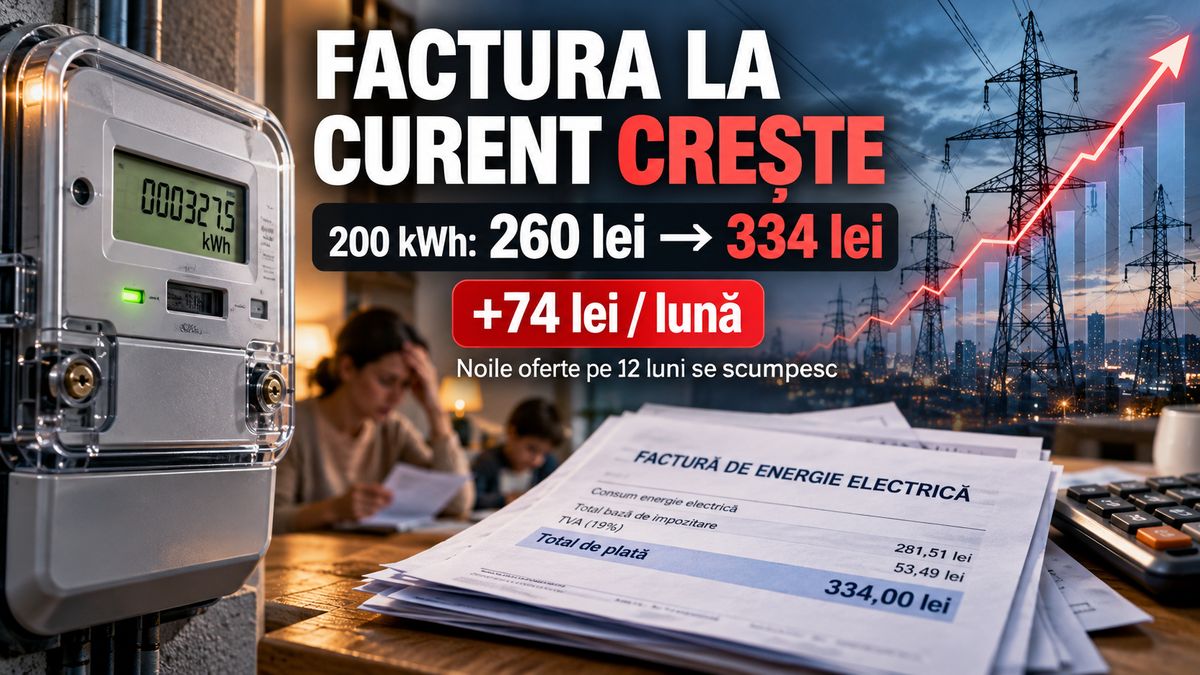
Electricity bills could rise significantly for Romanians signing new supply contracts, driven by surging wholesale power prices. An analysis published on October 7, 2026, by the Intelligent Energy Association (AEI) estimates that the final price of a 12-month offer could reach RON 1.67/kWh, compared to RON 1.30/kWh in the baseline scenario. For a household consuming 200 kWh per month, this difference would translate into a bill increase of RON 74. Price pressures are confirmed by OPCOM data: in August and September 2026, electricity traded on the Day-Ahead Market (DAM) surged by over 80% compared to the same months of the previous year. Drought, reduced hydropower generation, and nuclear outages constrained domestic supply at a time when suppliers must secure energy for future contracts. Nevertheless, the offers available to consumers vary substantially. In the ANRE comparison tool, analyzed prices for Bucharest ranged from approximately RON 1.19 to RON 1.71/kWh, demonstrating that the choice of supplier and the duration of the guaranteed price can have a considerable financial impact. A 37 Bani/kWh Increase Means 28.5%, Not 22% The AEI analysis, authored by the association's president, Dumitru Chisăliță, tracks the evolution of new 12-month supply offers for household consumers compared to similar offers from autumn 2025. The organization uses a final baseline price of RON 1.30/kWh (VAT included) and estimates an increase of between RON 0.25 and RON 0.50/kWh, depending on the evolution of procurement costs and the risks assumed by suppliers. The central scenario assumes an increase of approximately RON 0.37/kWh, resulting in a final price of RON 1.67/kWh. However, the percentage published by AEI is calculated incorrectly. The RON 0.37 difference relative to the initial price of RON 1.30 represents a 28.46% increase, rounded to 28.5%. The figure of approximately 22% is obtained by dividing the difference by the final price of RON 1.67/kWh. This calculation shows the share of the price increase within the new price, rather than how much the price increased relative to its initial value. This error is also present in the other scenarios. The increase from RON 1.30 to RON 1.55/kWh represents 19.2%, compared to the 16% in the AEI analysis. In the high-stress scenario, the rise from RON 1.30 to RON 1.80/kWh represents 38.5%, compared to the 27% figure presented by the association. The absolute price differences and the estimates expressed in RON remain unchanged. However, correcting these percentages is essential for accurately understanding the scale of the anticipated price hikes. A RON 260 Bill Could Reach RON 334 per Month For consumers, the concrete impact of the AEI estimate can be illustrated by the value of the monthly bill. At a consumption of 200 kWh, the baseline price of RON 1.30/kWh corresponds to a bill of RON 260. In the central scenario, at RON 1.67/kWh, the same amount of energy would cost RON 334, which is RON 74 more. If this difference were to persist for 12 months, the additional annual cost would reach RON 888 for a household with a constant monthly consumption of 200 kWh. AEI also presents two alternative scenarios. In the favorable scenario, the final price would reach RON 1.55/kWh, and the bill for 200 kWh would rise to RON 310. In the high-stress scenario, the price would climb to RON 1.80/kWh, resulting in a monthly bill of RON 360. The difference between the favorable and high-stress scenarios is RON 50 per month for the same level of consumption. These values are projections based on a baseline offer, not actual bills already issued or automatic increases applied to existing contracts. However, they illustrate the financial impact that changing energy prices can have on an average household and explain why the validity period of the contract price is becoming increasingly important. Wholesale Electricity Prices Have Risen by Over 80% Compared to 2025 Pressure on retail supply offers is driven by developments in the wholesale market. Official OPCOM data shows that in August 2026, the weighted average price on the Day-Ahead Market (DAM) reached RON 793.19/MWh, compared to RON 409.45/MWh in August 2025—a year-on-year increase of approximately 93.7%. In September, the weighted average price rose to RON 917.36/MWh, compared to RON 506.05/MWh in the same month of the previous year, representing an increase of approximately 81.3%. These levels indicate a very sharp increase in the cost of electricity traded for next-day delivery. This trend is linked to generation challenges in Romania during the summer and early autumn. Drought affected hydropower plants, and exceptionally low Danube water levels led to controlled shutdowns of reactors at the Cernavodă nuclear power plant. Reduced availability of key electricity sources increased the reliance on other generation capacities and imports during a period characterized by high prices and volatility. For suppliers, rising wholesale prices can…
Ioana Buzoaica — Independent Editorial Board
The NRG-IA newsroom continuously monitors Romanian energy markets, ANRE regulatory decisions, and national grid telemetry (SEN/SNT). We deliver independent intelligence anchored exclusively in official primary data.
Editorial Charter, Ethics & Verification Methodology →