How Romanians are cutting household energy consumption — NRG-IA
Ghid Consumator Author: Aurora AIRomanians are adjusting household electricity use through small daily habits, as rising bills drive behavioral changes in appliance use and purchasing.
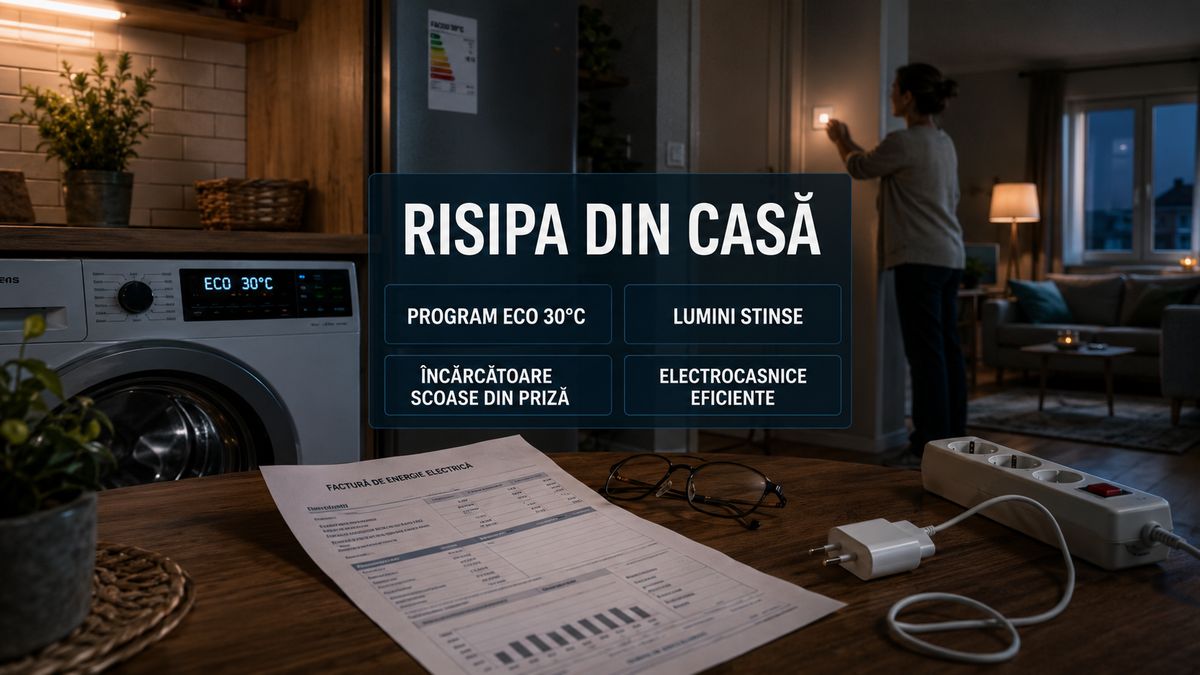
Electricity bills are beginning to change small habits in Romanian households. Washing machines are run more often on eco mode, laundry is air-dried, lights are rarely left on in empty rooms, and chargers are unplugged after use. Data from a study conducted for the despre-energie.ro platform, a project supported by E.ON and Delgaz Grid, shows that energy is no longer consumed mindlessly at home. The change may seem minor at the level of a single household. Across millions of homes, however, it describes a major shift: consumers are beginning to treat energy as a controllable resource. After years in which public debate was dominated by price caps, compensation schemes, offers, tariffs, and prices, attention is shifting toward daily behavior. The bill enters the daily routine According to the study cited by Economica, over 41% of respondents say they now set eco temperatures of around 30°C on their washing machines. Nearly 40% use high temperatures only for bed linens or heavily soiled clothes, while over 13% say they use high temperatures quite often, for more than half of their washing cycles. This difference matters because water heating is one of the primary drivers of washing machine energy consumption. Low-temperature programs can reduce consumption by up to 50–60% compared to standard high-temperature cycles, according to data presented in the Economica article. For the public, the message is simple: the cheapest energy remains the energy that is not wasted. And some savings do not require investments, but rather a change in habits. The washing machine becomes the first front of energy saving The washing machine is an excellent example of how utility bills are integrating into household routines. We are not talking about new technology or costly investments, but simply about choosing the right temperature and program. An eco cycle does not just change instantaneous consumption. It shows that the user is starting to make energy decisions within a routine activity. Until recently, for many consumers, energy was an invisible background: the appliance turned on, consumption accumulated, and the bill arrived. Now, every setting becomes a small economic decision. This is the difference between energy efficiency in public discourse and energy efficiency in the home. The former appears in strategies, campaigns, and regulations. The latter appears when someone chooses 30°C instead of 60°C. Air-drying and turning off lights bring savings without investment Over 80% of respondents say they prefer natural or mostly natural air-drying for laundry. This is a significant figure because electric dryers can consume substantial energy, especially in households where they are used frequently. Over 74% declare they are very attentive to lights left on in unused rooms. Here, individual savings may seem small, especially in homes using LEDs, but the behavioral effect is important: waste becomes visible. A light left on in an empty room is no longer treated as an inconsequential detail. These actions alone will not transform the bill. Major household energy consumption comes from heating, cooling, hot water, cooking, and large appliances. However, energy discipline often begins with simple gestures because they are accessible to everyone and do not depend on income, credit, subsidies, or renovations. Unplugging chargers becomes the symbol of a new awareness of consumption The study shows that 66% of respondents unplug their phone or laptop chargers after charging, while 17.7% still leave them plugged in permanently. Technically, a charger left in the outlet is not the largest source of household consumption. Symbolically, however, it reflects a shift in mindset. Consumers are beginning to notice background consumption: standby power, permanently occupied outlets, and appliances that remain plugged in without being used. This presents an important area for energy education. Not all actions have the same impact, but they all contribute to the idea that household consumption can be controlled. For the consumer, the next step is not just unplugging chargers, but understanding where the largest consumption and real losses occur: old appliances, boilers, air conditioning, inefficiently used washing machines, outdated refrigerators, and poorly insulated homes. The energy label becomes a purchasing criterion The change is not only visible in how existing appliances are used. More than 8 out of 10 Romanians are interested in replacing old appliances with more efficient ones. Nearly 45% prioritize the energy label when buying a new appliance, while another 47% consider it alongside other technical specifications. This is an important shift for the market. While the retail price remains essential, the operating cost is starting to matter more. A cheaper appliance at purchase can become more expensive over time if it has high consumption. An efficient appliance may have a higher upfront cost but can reduce bills over its lifespan.…