The Real Cost of AI: Energy, Water, and Data Centers — NRG-IA
Tehnologie & Inovație Author: Ioana BuzoaicaAI subscriptions mask the real cost of massive physical infrastructure: data centers, energy, water, chips, and grids that are hard to connect.
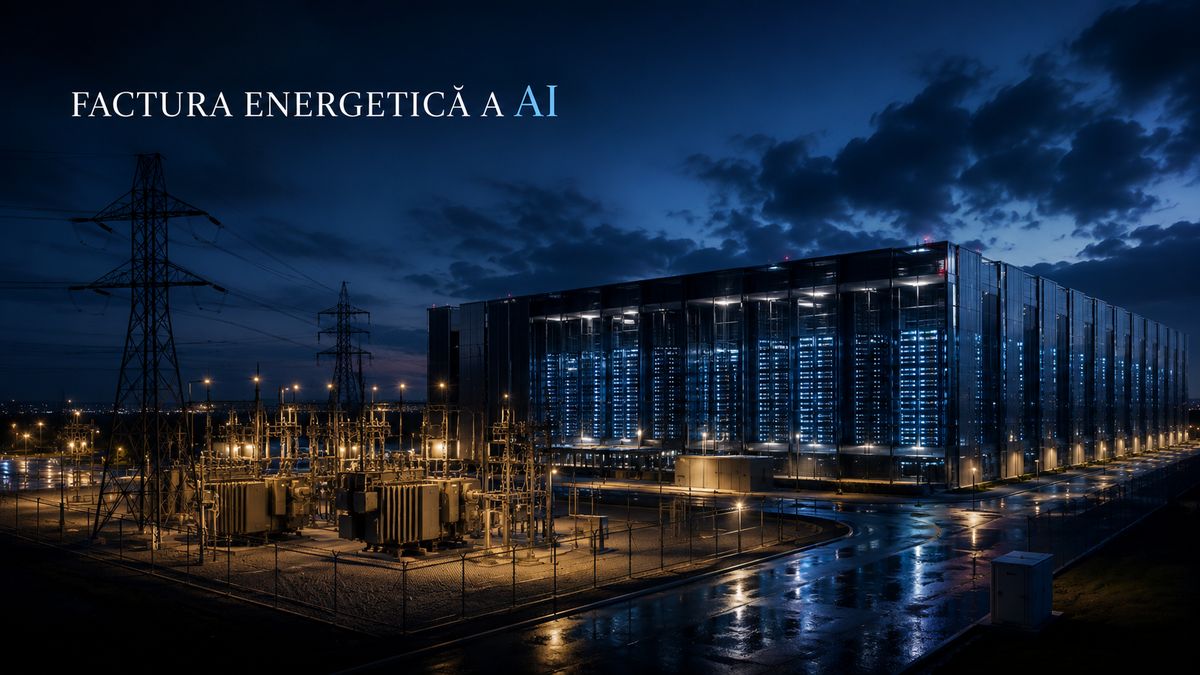
Generative artificial intelligence is marketed to the public as a fast, affordable, and easy-to-use service, but its operation depends on a massive physical infrastructure: data centers, servers, specialized chips, electricity, cooling, water, grids, and capital investments. Mediafax raises the central question of the moment: who pays the real cost of AI, and when will the bill come due? Energy data highlights the scale of this phenomenon. The International Energy Agency estimates that data centers consumed approximately 415 TWh of electricity in 2024, equivalent to about 1.5% of global consumption. By 2030, consumption could exceed 945 TWh, a level slightly above Japan's current electricity consumption. AI is the primary driver of this growth, alongside the general expansion of digital services. Subscriptions mask a variable cost For the user, AI appears as a simple product: a prompt, an answer, an image, a translation, or a summary. Behind the scenes, every prompt triggers processing, energy consumption, server utilization, and the allocation of computing capacity. The difference compared to traditional software is significant. In many traditional digital products, the marginal cost of an additional user can become negligible after initial development. In generative AI, heavy usage directly increases compute consumption. A client sending millions of tokens, requesting long answers, running extended contexts, or using advanced models consumes far greater resources than an occasional user. API pricing published by Anthropic illustrates how this consumption is commercially structured. Models are billed per million input and output tokens, with significant differences between models. While this structure does not reveal the provider's exact internal cost, it confirms the economic mechanism: generative AI has variable costs that scale with usage. The monthly subscription model can mask this reality. The price paid by the user does not always reflect the actual consumption of the most intensive clients. Part of the cost is absorbed by providers, investors, revenues from other business lines, or aggressive growth strategies. Data centers turn AI into a major energy consumer The IEA estimates that an AI-focused data center can consume as much electricity as 100,000 households. The largest facilities currently under construction can consume 20 times more. This scale shifts AI from the realm of abstract software into the domain of heavy energy infrastructure. While the global impact still seems limited as a share of total demand, the local impact can be major. Data centers are geographically concentrated in a few clusters, where energy demand is rising rapidly, putting pressure on grids, transformers, substations, and generation capacity. In the US, data centers could account for nearly half of electricity demand growth through 2030. This concentration changes the conversation about cost. A data center does not just require energy on an annual average basis. It demands available power, grid connection, redundancy, cooling, reliability, and network access. For system operators, the issue is not merely the volume of electricity consumed, but the location, timing, and profile of this demand. The power grid becomes part of the AI bill The IEA warns that approximately 20% of planned data center projects could face delays if grid issues are not resolved. Building new transmission lines can take between four and eight years in advanced economies, and lead times for transformers and cables have doubled over the past three years. This reality creates direct economic tension. Data centers can be built faster than the grids required to power them. When demand emerges in already congested areas, grid operators must decide how to expand capacity, who pays for the upgrades, and how costs are shared among large consumers, other customers, and public budgets. The Brookings Institution describes this issue through the lens of energy bills. In regions where data centers require major infrastructure expansions, costs can end up in consumer tariffs if they are not clearly allocated to the operators driving the new demand. The stakes are not just technological, but regulatory: contracts, connection fees, and cost-allocation rules will determine how much of the AI bill remains with tech companies and how much is shifted to the system. For Europe, this discussion is increasingly relevant amid industrial electrification, rising consumption from heat pumps, electric vehicles, and industrial manufacturing. Data centers compete with other forms of consumption for grid access, available capacity, and secure energy supply. Big Tech funds the race with hundreds of billions of dollars Reuters reports that Alphabet, Microsoft, Meta, and Amazon are on track to invest approximately $600 billion in AI in 2026. This spending is testing investor patience, as the pace of infrastructure investment outstrips the certainty of direct economic returns.…