Finland Sand Battery Stores 100 MWh of Thermal Energy — NRG-IA
Energie Author: Aurora AIFinland has commissioned the world's largest commercial 100 MWh thermal battery, using 2,000 tons of soapstone for district heating.
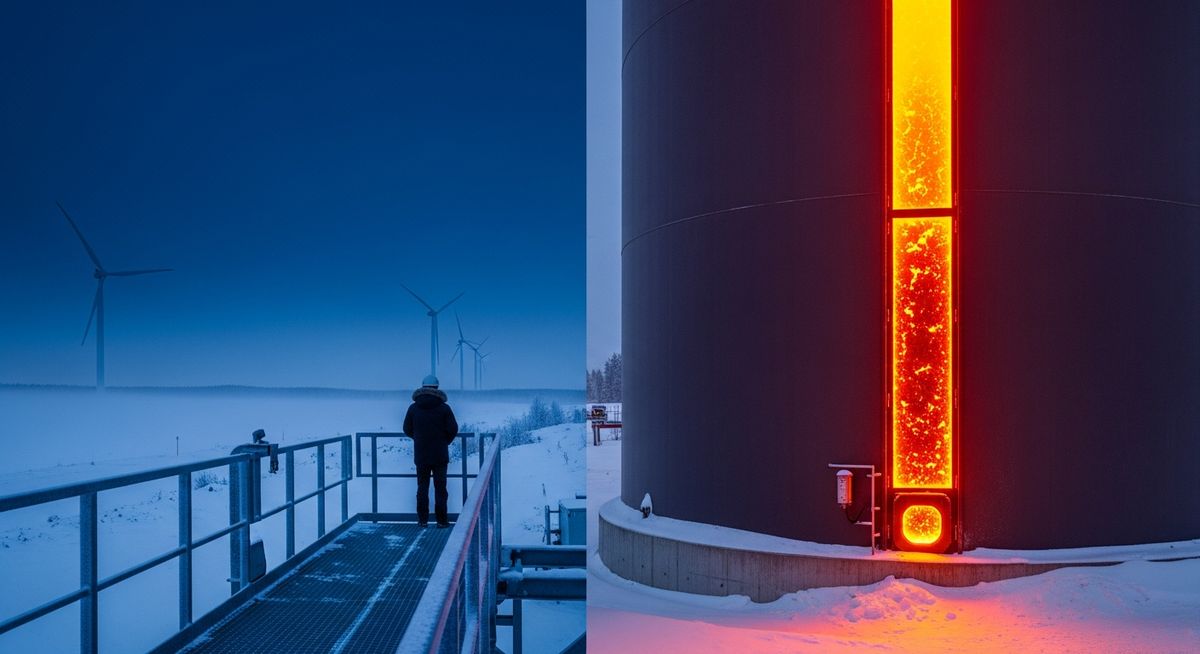
The 100 MWh thermal storage in Pornainen — how the "sand battery" works Finland stores 100 MWh of renewable energy in a giant soapstone thermal battery, marking a global industrial milestone. The commercial facility in Pornainen, developed by Polar Night Energy in collaboration with district heating operator Loviisan Lämpö, utilizes approximately 2,000 tons of soapstone stored inside a silo 13 meters high and 15 meters in diameter. The project addresses one of the greatest challenges of the global energy transition: capturing surplus wind and solar power during periods of high generation and negative prices, and releasing it as heat when district heating demand peaks. The system operates like a massive industrial thermos. When renewable generation exceeds market demand and spot electricity prices drop significantly, the surplus electricity powers resistive heating elements. These elements heat the crushed soapstone inside the silo to several hundred degrees Celsius. Thanks to high-density thermal insulation, the silo can retain this heat for weeks, gradually releasing it via heat exchangers directly into the local district heating network. According to technical data released by Polar Night Energy, the Pornainen facility can fully cover the heating needs of the town’s approximately 5,000 residents for nearly a month during summer and about one week during winter. This performance reduces greenhouse gas emissions from the local district heating network by nearly 70% and cuts wood chip biomass consumption by approximately 60%. The existing biomass plant remains active only as an operational backup for extreme winter peaks. The transition from fossil fuels and biomass to high-temperature thermal storage The decision to deploy this technology at a commercial scale was driven by the urgent need to decarbonize Finland’s heating sector, which historically relied on burning oil and forestry biomass. Polar Night Energy’s CEO, Tommi Eronen, emphasized that Pornainen previously relied on combustion processes to maintain winter heating. The rising volatility of electricity prices on the Nord Pool market, driven by heavy wind penetration, created the perfect economic opportunity: storing energy when electricity purchase prices are zero or negative, and utilizing it later as cheap thermal energy. This approach is supported by international energy policy experts, such as Jan Rosenow, a professor at Oxford University, who points to thermal storage as a critical component for eliminating fossil fuels from district heating networks. The project received direct political backing, with Finnish Climate Minister Sari Multala attending the inauguration and highlighting the importance of domestic innovation in achieving climate neutrality goals. The opportunity for Romania: Thermal storage solutions for Termoenergetica and Dobrogea's surplus power In NRG-IA’s view, the success of this Finnish project provides a critical roadmap for modernizing Romania’s centralized district heating systems, particularly for Bucharest (Termoenergetica) and other large urban areas facing chronic financial and structural crises. Romania frequently faces a major paradox: in Dobrogea, wind and solar farms are often curtailed or produce power at extremely low prices due to a lack of storage capacity within the transmission grid managed by Transelectrica. If such a thermal storage model were implemented within Bucharest’s major CHP (CET) plants, cheap surplus renewable energy from Dobrogea could be converted directly into thermal energy stored in similar batteries. This mechanism would massively reduce the district heating system's dependence on imported or domestic natural gas, lowering the cost of the gigacalorie on consumer bills and reducing network losses through localized, controlled generation. Technical limitations of power-to-heat-to-power conversion and scaling risks While the technology promises a heating revolution, major technical limitations require caution before scaling. First, overall energy efficiency is high only if the stored energy is used directly as heat; converting the heat back into electricity is highly inefficient thermodynamically, meaning the facility cannot function as a standard utility-scale battery for power grid balancing. Second, there is a risk of material confusion: although marketed as a "sand battery," the Pornainen plant uses crushed soapstone, a thermally dense industrial byproduct from local mining operations. Replicing the same efficiency using common construction sand is technically impossible, which limits global adoption to regions with access to similar geological materials or introduces significant logistical costs. Moving forward, Polar Night Energy and Loviisan Lämpö will monitor the material's behavior under repeated heating and cooling cycles—a critical parameter not specified in current technical data, but essential for calculating the investment's lifespan before physical reconditioning is required.