Carlyle & EBRD Sell Black Sea Oil & Gas to Mazarine Energy — NRG-IA
Gaze Naturale Author: Ioana BuzoaicaCarlyle and EBRD agree to sell Black Sea Oil & Gas to Dutch firm Mazarine Energy, transferring control of the 1 bcm/yr Midia offshore project ahead of winter.
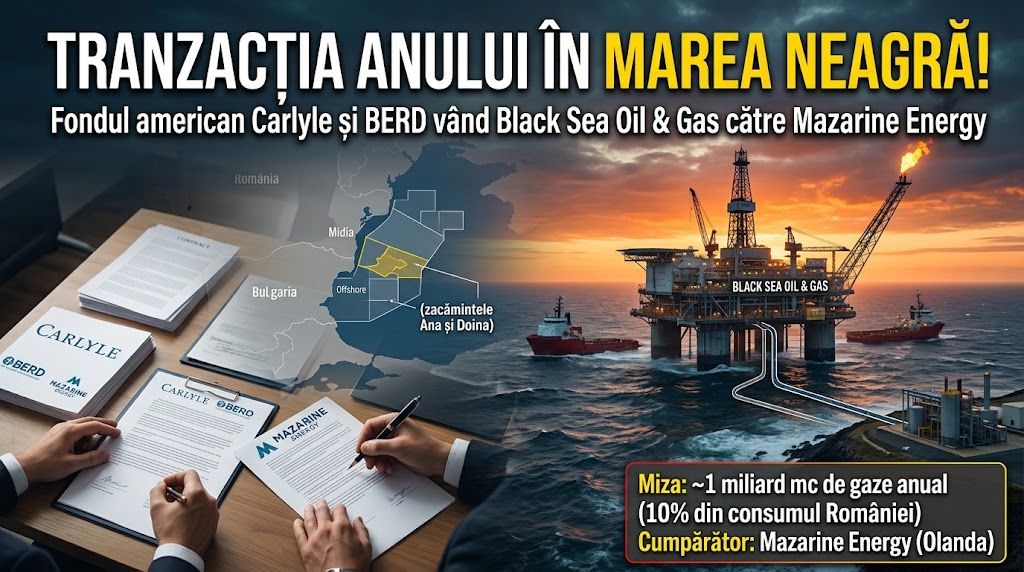
Global investment firm Carlyle and the European Bank for Reconstruction and Development (EBRD) signed an agreement in late October 2026 to sell Black Sea Oil & Gas to Dutch hydrocarbon producer Mazarine Energy, controlled by businessman Edward van Kersbergen. The deal represents the most significant upstream M&A transaction in Romania's exploration and production sector this year, transferring ownership of the Midia Gas Development project—the only new offshore development brought online in the Romanian sector of the Black Sea over the past decade. The economic and strategic rationale behind the agreement stems from the volume of gas Black Sea Oil & Gas feeds directly into Romania's National Transmission System. The offshore block operated by the company extracts approximately one billion cubic meters of natural gas annually, covering roughly one-tenth of Romania's domestic demand. The acquisition of this asset by an operator already active in the local market reconfirms the high commercial value of reserves on the Romanian continental shelf, amid a autumn where European gas markets face renewed price volatility. For the institutional investors exiting their position, signing the deal with Mazarine Energy completes a full industrial development cycle. US private equity firm Carlyle and the EBRD financed and guided the Midia project from exploration, permitting, and subsea and onshore infrastructure construction through to mature commercial production generating steady cash flows, now handing over the equity stake to a specialized operator focused on long-term field management. One billion cubic meters of gas per year and dedicated onshore infrastructure at the Black Sea coast The sale agreement transfers an integrated energy complex to Mazarine Energy, whose value extends well beyond the concession license for the Ana and Doina fields in the shallow-water XV Midia block. The project operated by Black Sea Oil & Gas includes an automated offshore production platform at the Ana field, a subsea wellhead at the Doina field, a subsea and onshore pipeline bringing gas ashore, and a modern gas treatment plant in Corbu, Constanța County, directly tied into the national transmission grid operated by Transgaz. This technical architecture provides the company with a privileged position in the regional energy market. Unlike greenfield developments requiring years of capital expenditure before delivering the first molecule of gas, the Midia field operates at full commercial capacity, delivering daily supply into the national grid without import logistics costs. Furthermore, the energy corridor developed by Black Sea Oil & Gas on the Black Sea coast was designed with the potential to integrate future renewable energy projects or repurpose existing infrastructure for new energy developments. For Dutch group Mazarine Energy, acquiring Black Sea Oil & Gas marks a strategic leap in scale in Romania, transforming a producer previously focused on conventional onshore assets into a leading offshore player. Founded by Edward van Kersbergen, the company already operates mature onshore oil and gas fields acquired in previous years. Adding 1 bcm of annual Black Sea production significantly expands its reserve portfolio, operating cash flows, and wholesale market share in Bucharest. Onshore field depletion in Romania raises the strategic value of Black Sea gas The ownership change at Black Sea Oil & Gas comes as operational data reported to the Bucharest Stock Exchange for the first nine months of 2026 highlights a continuous decline in output from Romania's mature onshore fields. Romgaz, the country's largest gas producer, extracted 3.6 billion cubic meters between January and September 2026, down 2.1% compared to the same period in 2025, while OMV Petrom reported a 7% drop in domestic hydrocarbon output amid natural depletion across legacy onshore fields. Against this backdrop of structural decline in onshore resources, every billion cubic meters extracted from the Black Sea becomes indispensable for maintaining Romania's high degree of energy self-sufficiency. Until 2027, when OMV Petrom and Romgaz are scheduled to start first gas from the deepwater Neptun Deep block—a project supported in the first nine months of 2026 by an OMV Petrom investment budget of RON 6.6 billion—the Midia operation remains the sole new offshore source offsetting falling onshore production. The importance of domestic supply is further amplified by Europe's precarious balance heading into the heating season on November 1, 2026. According to data from the Agency for the Cooperation of Energy Regulators (ACER) and European inventory platforms, gas storage facilities across the EU stand at 75% capacity—the lowest level recorded for early November since 2009 and well below the five-year average of 86%. Romania enters winter with storage at 76.26%, slightly above the European average but below the 80% target, making the continuous gas stream from Midia vital…
Ioana Buzoaica — Independent Editorial Board
The NRG-IA newsroom continuously monitors Romanian energy markets, ANRE regulatory decisions, and national grid telemetry (SEN/SNT). We deliver independent intelligence anchored exclusively in official primary data.
Editorial Charter, Ethics & Verification Methodology →