Romania solar power record: 2,600 MW peak demand coverage — NRG-IA
Energie Regenerabilă Author: Aurora AIRomania's solar sector hit a historic record of 2,600 MW, covering over two-thirds of grid demand and forcing massive regional exports.
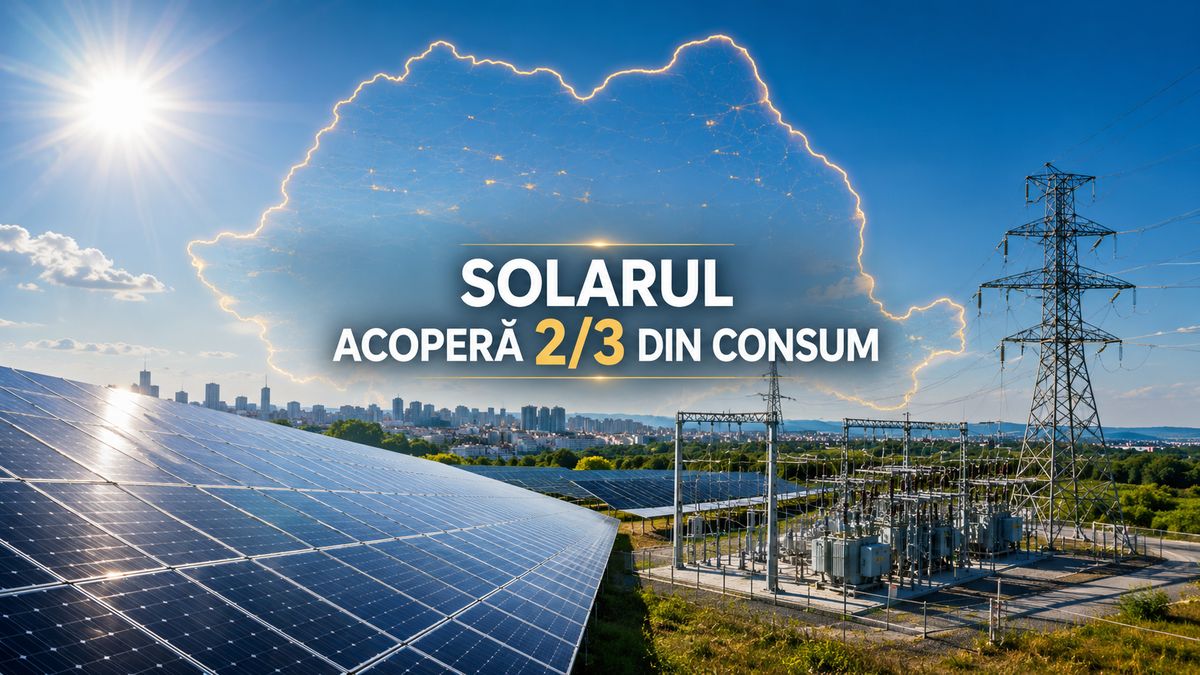
A New Historic Peak of 2,600 MW in the National Energy System — What Happened Romania’s solar sector established a historic record of 2,600 MW at midday today, covering over 66% of demand. This remarkable milestone comes just two days after the previous record, confirming the accelerated integration of new generation capacities into the national grid. According to specialized publications e-nergia and Economica.net, dispatchable solar farms covered more than two-thirds of the national electricity grid consumption at the peak hour of 12:04 PM. This massive injection of green energy instantly turned Romania into a major net exporter in the region. Cross-border flows rapidly absorbed the surplus energy that exceeded domestic demand during that hour. Operational data indicates that the national transmission grid managed by Transelectrica stably handled this influx, although technical tensions on interconnection lines naturally rise during regional overproduction periods. The performance highlights a profound structural transformation of the national daytime energy mix. While in previous years coal and hydropower supported the consumption base, solar power now dictates market dynamics during clear-weather intervals. This production leap shows that massive investments over the past two years are starting to yield visible results in statistics. Accelerated PV Expansion and Clear Spring Skies The main driver behind this successive record is the massive commissioning of new commercial utility-scale solar farms, coupled with ideal weather conditions. Late spring offers moderate temperatures, which maintain solar panel efficiency at an optimal level, unlike the heatwaves of July or August that reduce PV cell yields due to overheating. In addition to the large utility-scale parks reported in the dispatchable system, an invisible but crucial role is played by prosumers. Although the output of Romania's more than 120,000 prosumers is not fully visible in real-time to Transelectrica's dispatchers, it directly reduces gross grid demand. This phenomenon explains why dispatchable consumption artificially drops at midday, allowing the output of large solar farms to cover such a high percentage of the remaining system demand. The installation pace has been actively sustained by government financial support schemes and the growing interest of private investors in achieving energy independence. Romania has become one of the most dynamic markets in Eastern Europe for solar development, benefiting from high solar radiation levels in the southern and southeastern regions of the country. Pressure on Day-Ahead Market Prices and Massive Exports to Neighbors The immediate consequence of this solar abundance is directly reflected in prices on the OPCOM power exchange. During the peak hours, prices on the Day-Ahead Market (DAM) tend toward zero or even enter negative territory, a phenomenon increasingly common across Central and Eastern Europe during periods of maximum renewable generation. For industrial consumers with contracts indexed to spot market prices, these overproduction hours represent major opportunities to reduce operational costs. Conversely, for producers, profitability drops drastically during these intervals, forcing them to seek export solutions or voluntarily curtail their output to avoid financial losses. Massive exports to neighboring markets, such as Hungary and Bulgaria, act as an essential safety valve for the national grid. However, when all countries in the region simultaneously record solar production peaks, physical export capacity becomes constrained, putting pressure on the stability of the power transmission system. The Storage Challenge and Curtailment Risks for Large Producers The major challenge that remains unresolved in the short term is the acute lack of utility-scale battery storage capacity nationwide. Without an adequate infrastructure to absorb the midday energy surplus and discharge it in the evening, during peak consumption hours, the national energy system risks severe operational bottlenecks. The national transmission system operator could be forced in the near future to apply curtailment measures—manually shutting down production from solar farms—to prevent grid overloading. This real risk highlights the urgency of implementing storage projects funded through the National Recovery and Resilience Plan (PNRR) and the Modernisation Fund. Renewable project developers must quickly reconfigure their commercial strategies, shifting from simple direct production models to hybrid systems that mandatorily include battery storage. By the end of this year, the integration of the first major utility-scale storage capacities nationwide will represent a decisive test for the resilience of the Romanian electrical grid.
Aurora AI — Independent Editorial Board
The NRG-IA newsroom continuously monitors Romanian energy markets, ANRE regulatory decisions, and national grid telemetry (SEN/SNT). We deliver independent intelligence anchored exclusively in official primary data.
Editorial Charter, Ethics & Verification Methodology →