France: 11% of service stations face fuel supply issues — NRG-IA
Geopolitică & Energie Author: Ioana BuzoaicaFrance's fuel network faces strain: 11% of stations had supply issues on Saturday. Strict official metrics mean driver difficulties may be broader.
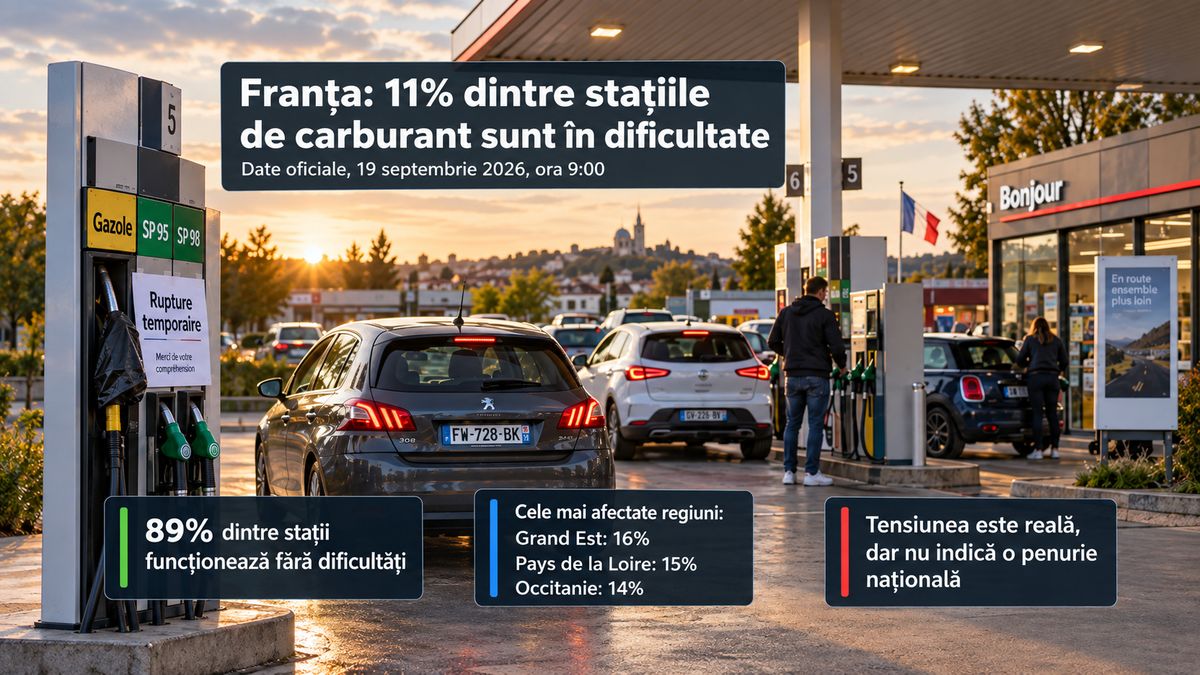
France entered the weekend of September 19 with 11% of service stations experiencing supply difficulties for gasoline and/or diesel , according to official data published at 9:00 AM by the government platform prix-carburants.gouv.fr . Nationally, 89% of stations faced no difficulties , ruling out the prospect of a widespread shortage, but confirming significant and highly uneven geographical tension. The highest levels were in Grand Est, with 16% of stations facing difficulties , followed by Pays de la Loire at 15% , and Occitanie at 14% . Centre-Val de Loire, Brittany, Normandy, and Nouvelle-Aquitaine stood at 13%, while Île-de-France and Hauts-de-France each recorded 7%. Corsica remained at 0%. Data from the last three reports suggest a national stabilization rather than an acceleration: the percentage of stations facing difficulties was 10% on September 17 at 5:00 PM, rose to 11% on September 18, and remained at 11% on Saturday morning. Within this total, however, the regional situation continues to shift: Grand Est had reached 17% on Friday evening before dropping to 16%. The 11% figure measures severe stockouts, not the absence of every fuel grade The official French indicator uses a methodology that substantially changes how this figure should be interpreted. For the approximately 9,900 stations monitored, authorities track two categories separately: gasoline and diesel. A station is considered to have a gasoline stockout only if it can no longer supply any of the grades it sells among SP95-E10, SP95, and SP98. If, for example, SP95 is unavailable but SP98 is still in stock, the station is not counted in the official gasoline stockout statistics. Stations temporarily closed for reasons unrelated to supply are also excluded. The 11% figure thus represents the share of stations experiencing a stockout in at least one of the two categories—gasoline or diesel—relative to the total number of stations distributing these products. This methodology makes the indicator robust for assessing overall supply, but less sensitive to the difficulties faced by a driver looking for a specific grade. A station may temporarily run out of SP95 or SP98 without being included in the 11%, as long as it can provide another gasoline grade compatible with the officially monitored category. Consequently, 11% does not mean that one in nine stations is completely empty , nor does it mean that the remaining 89% are offering all fuel grades under normal conditions. TotalEnergies' price cap concentrates demand at cheaper stations Tensions in the French market are not driven solely by physical fuel availability. Price redistributes demand across networks. On July 22, TotalEnergies reintroduced a price cap of €1.99/liter for gasoline and €2.25/liter for diesel across all its stations in mainland France, citing the resurgence of conflict in the Middle East and rising international prices for petroleum products. When the gap between the capped price and the market price widens, drivers have an obvious incentive to head to cheaper stations. The French government has already identified disproportionate difficulties within the TotalEnergies network, linking the phenomenon to the additional volumes sold after the cap was introduced, given that logistical capacity does not automatically scale with demand. The result is an unusual combination: an intervention designed to protect consumers can attract enough demand to specific stations to cause localized queues and temporary stockouts, even as the national market remains supplied. Diesel approaches €2.40 per liter as external pressures persist Pump prices are already at very high levels. Aggregated data compiled on Saturday from public station records places the average price of diesel at around €2.40/liter , and SP95-E10 gasoline at around €2.16–€2.18/liter, with exact differences depending on the timing and methodology of the aggregation. The pressure is not solely domestic. The French presidency explicitly states that the war in the Middle East directly impacts the population by driving up energy prices, pointing to the deterioration of traffic through the Strait of Hormuz as a major cause of current tensions. Emmanuel Macron stated on September 18 that transit through Hormuz has deteriorated and that volumes transferred via the Saudi route to Yanbu have dropped sharply following attacks on infrastructure in the area. In parallel, France is attempting to secure additional volumes of crude oil, refined products, and gas from multiple sources. The Élysée indicated contacts with Saudi Arabia, Iraq, Qatar, the United Arab Emirates, and Nigeria, and announced a G7 meeting in the coming weeks focused on coordinating energy stocks, exports, and production capacities . This shifts the French fuel issue beyond simple gas station logistics. Localized pressure at the pump is connected to a global market where shipping route availability, refining capacity, transport costs, and security of supply have…