France sends troops to Yanbu to protect oil bypass route — NRG-IA
Geopolitică & Energie Author: Aurora AIFrance steps in to protect a key oil route bypassing the Strait of Hormuz following attacks on Saudi Arabia's East-West Pipeline and the Yanbu area.
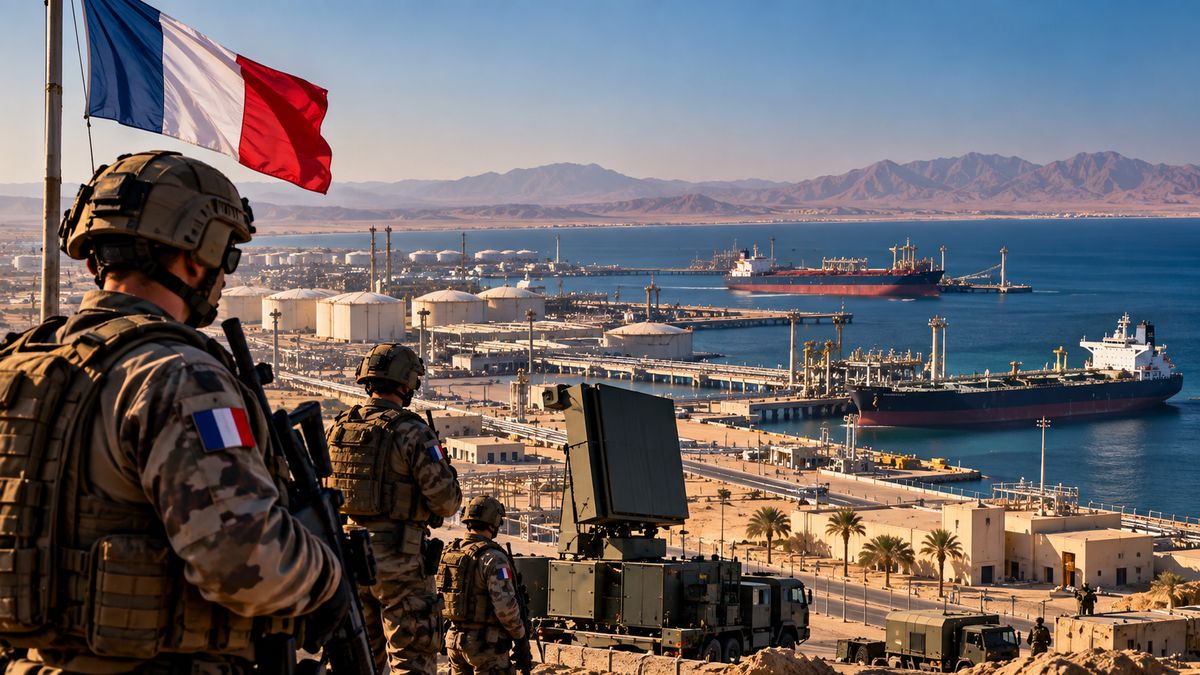
France will send troops, radar, and defense systems to Saudi Arabia to protect the Yanbu oil site, a key piece of infrastructure allowing Saudi crude exports to bypass the Strait of Hormuz. President Emmanuel Macron announced the deployment on September 24, after Paris and Riyadh finalized talks regarding the mission. "We will send military assets, meaning soldiers, radar, and defense systems," Macron stated, specifying that the objective is to protect Yanbu, not to involve France in the conflict. Paris has not disclosed the number of troops, the exact types of systems, or the deployment timeline. The decision shifts the protection of oil flows from maritime patrols to the physical infrastructure through which Saudi Arabia seeks to reduce its dependence on Hormuz. Yanbu is the western terminus of the East-West Pipeline, also known as Petroline, which spans approximately 1,200 kilometers from the kingdom's producing east to the Red Sea. Yanbu has become the strategic outlet for Saudi oil to the Red Sea Saudi Aramco indicates a maximum capacity of approximately 7 million barrels of crude per day for the East-West Pipeline, of which about 2 million barrels per day can feed Saudi refineries. The company announced that the infrastructure reached maximum capacity in the first quarter of 2026, specifically to support exports via the west coast amid disruptions in Hormuz. The importance of this alternative is underscored by the sheer scale of Hormuz. In the first half of 2025, an average of 20.9 million barrels of oil and petroleum products per day passed through the strait, equivalent to roughly 20% of global petroleum liquids consumption. EIA data shows that flows dropped to just 4.9 million barrels per day in the second quarter of 2026 , massively increasing the value of alternative routes. In this configuration, Petroline is no longer just backup infrastructure. Reuters reports that following the resumption of operations, the pipeline redirects approximately 4 million barrels per day to Yanbu, representing around 4% of global oil supply . The September 11 attack struck the very alternative to Hormuz The vulnerability of this architecture became evident on September 11, when a drone attack forced the shutdown of the East-West Pipeline. Three pumping stations were damaged, and crude loadings at Yanbu were disrupted. The pipeline was restarted on September 22 at a reduced flow rate. Sources cited by Reuters estimated that returning to the maximum capacity of 7 million barrels per day could take six to eight weeks , precisely due to the damage caused to the pumping infrastructure. The resumption of flows was enough to push Brent down by over $2 per barrel, signaling the market's sensitivity to any change in Yanbu's status. The attack also had repercussions beyond Saudi Arabia. Saudi Aramco informed some European refineries that certain contracted shipments for October would not take place, after the pipeline disruption affected loadings at the Red Sea. New attacks have turned the protection of Yanbu into a military issue France's announcement came on the very day of fresh attacks on Saudi Arabia. The Riyadh-led coalition stated it had intercepted six ballistic missiles launched by the Houthis, including toward the Yanbu area on the Red Sea. The Houthis separately claimed missile and drone attacks on Saudi targets, listing Saudi Aramco infrastructure in Yanbu among their objectives. The Houthi claim of striking Aramco facilities does not amount to independent confirmation of new damage on September 24. What is certain, however, is that the Yanbu area has become a repeated target as its infrastructure has gained far greater importance for the continuity of Saudi exports. France is thus intervening at a point where energy security and air defense directly overlap: the military objective is to protect an infrastructure that can keep millions of barrels per day in global circulation when the primary outlet from the Persian Gulf is severely disrupted. Protecting Yanbu does not eliminate Red Sea vulnerability The East-West Pipeline solves a specific geographical problem: it allows Saudi crude to reach the Red Sea without crossing the Strait of Hormuz. From Yanbu, oil destined for Europe can continue north through the Red Sea and the Suez Canal or the SUMED pipeline system, while Asia-bound exports remain exposed to security conditions in the Bab el-Mandeb area. Consequently, shifting flows westward does not eliminate geopolitical risk; it merely changes where it must be managed. The attack on Petroline demonstrated that infrastructure built to bypass a vulnerable chokepoint can itself become a target once it gains strategic importance. The mission announced by Macron aims precisely to protect this link. The French president insisted that the troops sent to Saudi Arabia will serve a defensive role, while Paris simultaneously continues diplomatic efforts to reopen and secure traffic through Hormuz. The next milestone is…